 MineArchive
Water Balance
| Also known as | Water-balance Machine (Gresley's heading for it), Balance Pit (the shaft in which the balance rises and falls) |
|---|---|
| Dialect | South Wales |
| Category | Structures & Machinery |
A method of winding in which a tank of water, filled at the surface and let down the shaft, raises a loaded tram of coal by its own weight — the pit's power supply being a pond rather than an engine.
Historical usage
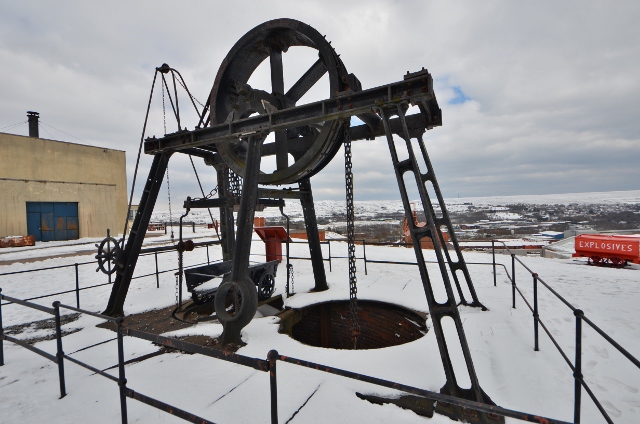
Gresley's 1883 glossary marks the water-balance machine as South Welsh and, writing when it was already going out of use, calls it 'an antiquated method of raising minerals in a pit-shaft by water power', the principle being a bucket of water filled at the surface which by its descent raised a tram of twenty hundredweight. It belongs to the shallow pits of the eastern valleys before steam winding became general: Lletty Shenkin at Cwmbach was wound this way from 1843, and Middle Duffryn at Aberdare too. The Royal Commission on the Ancient and Historical Monuments of Wales records a surviving example at Cwmbyrgwm Colliery, Abersychan.
How it worked
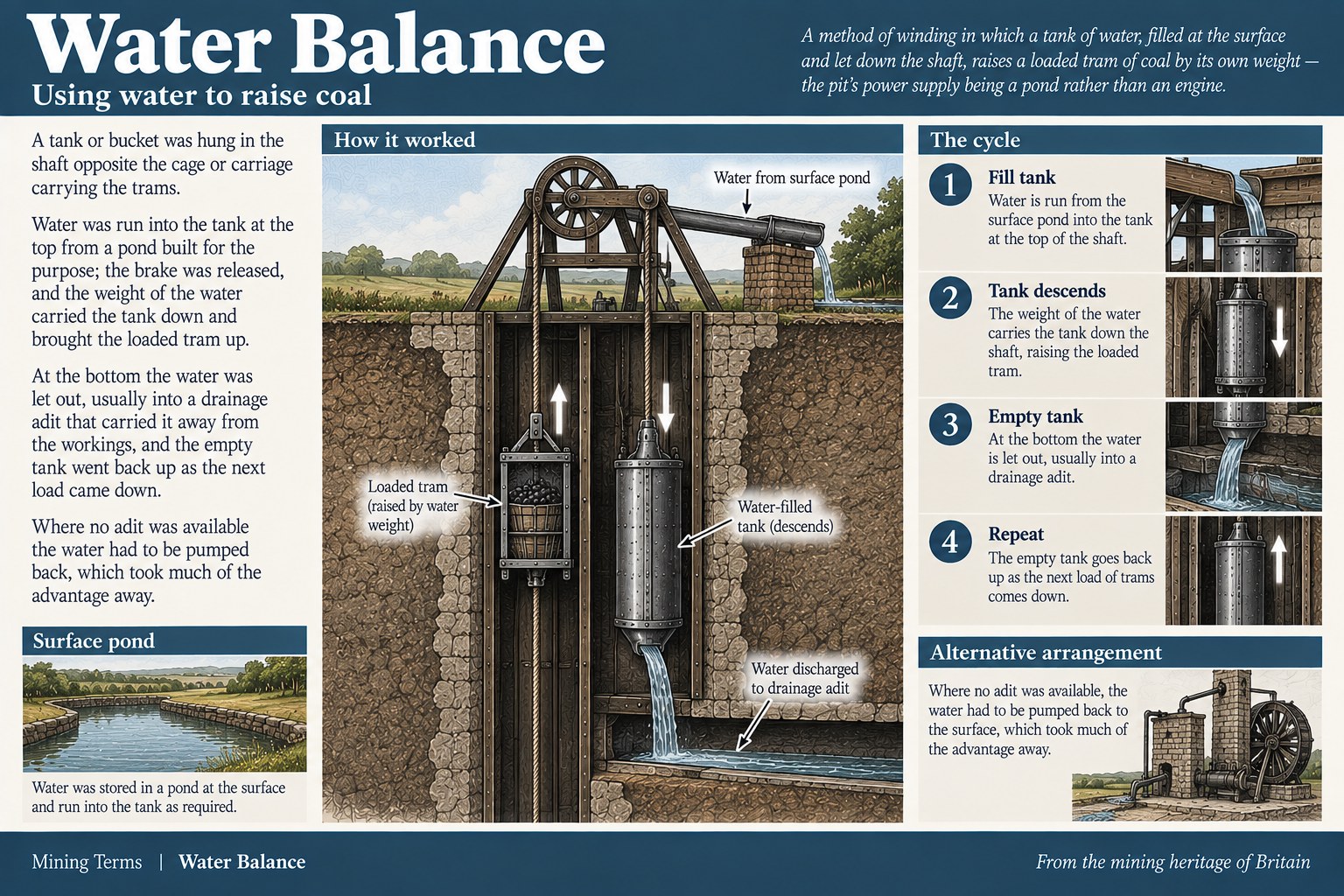
A tank or bucket hung in the shaft opposite the cage or carriage carrying the trams. Water was run into the tank at the top from a pond built for the purpose; the brake was released, and the weight of the water carried the tank down and brought the loaded tram up. At the bottom the water was let out, usually into a drainage adit that carried it away from the workings, and the empty tank went back up as the next load came down. Where no adit was available the water had to be pumped back, which took much of the advantage away.
Why it was used
It cost almost nothing to run. A colliery on a hillside with a stream above it and an adit below had, in effect, free winding power, and needed no boiler, no engine and no coal burnt at the surface. For shallow pits raising modest tonnages that was enough.
Risks & limitations
The method could only lift what the head of water would lift, from depths a falling tank could reach, at the pace the tank could be filled and emptied — so it set a hard ceiling on a colliery's output. It depended on a reliable water supply and on somewhere for the water to go. Steam winding, which had none of those limits, displaced it during the second half of the nineteenth century, and by the time Gresley wrote it was already something to be described in the past tense.
Regional variation
Strongly associated with the South Wales coalfield, where it is what the word normally means. The same principle drove water-balance inclines and lifts in the North Wales slate quarries — the Royal Commission records them at Penrhyn, Aberllefenni and Maenofferen — where a descending water tank moved slate wagons rather than coal trams.
Related terminology
Mines associated with this term
5 examples chosen from 38 linked records — the term page is not an index.
- Cwmavon Copper Works — Neath Port Talbot (well documented example)
Named in this record’s workings: “…run under the Cwmavon name alongside dozens of named levels and balance pits.” - Glyn Pits, Pontypool — Torfaen (well documented example)
Named twice in this record, first in the history: “…Race Colliery, began in the 1830s when Capel Hanbury Leigh sank the Balance Pit; the Nos. 1 and 2 pits followed in the early 1840s to supply his…” - Lletty Shenkin Colliery — Rhondda Cynon Taf (well documented example)
Named twice in this record, first in the history: “…seam. A second, Upper, shaft followed in 1850; both were wound by water balance and ventilated by furnace, with two more ventilation shafts added…” - Tynewydd Colliery, Porth — Rhondda Cynon Taf (well documented example)
Named 5 times in this record, first in the summary: “…in 1852 by the Troedyrhiw Coal Company and still raising its coal by water balance in 1877, when it was called almost the last balance pit in the…” - Ash Tree Pit, Tredegar — Blaenau Gwent (well documented example)
Named 3 times in this record, first in the summary: “A water-balance pit sunk in 1826 to feed the Tredegar ironworks, known as Pwll Mary…”
Disasters associated with this term
5 examples chosen from 6 linked records, most direct relationship first.
- Werfa Colliery shaft accident, 1851 (relevant method/equipment)
The men rode water-balance cages. - Cwmbyrgwm Colliery boiler explosion, 1858 (contextual relationship)
Named in this record’s summary: “…1858 a boiler exploded on the surface at Cwmbyrgwm Colliery, a water-balance pit near Abersychan, demolishing the engine house and killing a man…” - Cwmneol Colliery overwind, 1855 (contextual relationship)
The pit wound by water balance until 1855. - Tynewydd Colliery inundation, 1877 (contextual relationship)
Tynewydd raised its coal by water balance. - Victoria Colliery shaft accident, Ebbw Vale, 1848 (contextual relationship)
Named in this record’s narrative: “No. 6 was one of the water-balance pits sunk by the Monmouthshire Iron and Coal Company to feed its…”
Sources
- (primary) Cwmbyrgwm Colliery: Water Balance (NPRN 85075) — Royal Commission on the Ancient and Historical Monuments of Wales
- (primary) W. S. Gresley, A Glossary of Terms used in Coal Mining (1883) — W. S. Gresley; digitised by the Internet Archive
- (secondary) Glossary of South Wales colliery terms — Welsh Coal Mines
Record created: 4 September 2026 · Last researched: 4 September 2026