 MineArchive
Glyn Pits, Pontypool
| Also known as | Glyn Collieries, Race Colliery, Cwm-y-Glyn Colliery |
|---|---|
| Location | Pontymoile, on the hillside east of Pontypool, Torfaen — 51.6926, -3.0639 (approximate) |
| Commodity | Coal |
| Type | Coal |
| Worked | Early 1840s (Balance Pit 1830s)–1932 (coal); pumping until 1949 or later |
| Maximum depth | 190 yards (Welsh Coal Mines) or 190 feet, 58 m (RCAHMW) |
| Operators | Capel Hanbury Leigh (1840–1852), J. Blindell and Co. (1903–1906), Ebbw Vale Steel, Iron and Coal Company (?–1909), Crumlin Valley Collieries Company (1909–?), National Coal Board (1947–1949) |
Overview
A colliery on the hillside east of Pontypool, sunk in the early 1840s by Capel Hanbury Leigh to feed his Pontypool iron and tinplate works, where both engine houses still hold their engines: a rotative beam engine of 1845, probably built by the Neath Abbey Ironworks, and a vertical winding engine with flat-rope reels in place by 1865. An explosion and fire in 1890 killed five men whose bodies were never recovered. Coal winding ended by 1932 and the shafts went on pumping water for neighbouring collieries.
History
The Glyn Pits complex, also called Cwm-y-Glyn or the Race Colliery, began in the 1830s when Capel Hanbury Leigh sank the Balance Pit; the Nos. 1 and 2 pits followed in the early 1840s to supply his Pontypool iron and tinplate works, and the beam engine house carries a datestone of 1845. The pair of shafts is recorded as 190 yards deep by Welsh Coal Mines and as 190 feet (58 metres) by the Royal Commission, and the pit is said to have been one of the first collieries to wind by steam. A local syndicate took it over in 1852, and in 1855 it passed to Messrs Levick, Brown, Darby and Robinson, who went on to found the Ebbw Vale company; the Balance Pit seems to have been disused by the 1860s. Some time between 1852 and 1865 a vertical winding engine was built to the east, taking the winding from the beam engine. On 1 June 1864 an explosion killed four, blamed on a length of timber the young door-boy had left propping open an air door, and a roof fall killed two more later that year. In the early hours of 23 January 1890 an explosion set off underground fires so fierce that the pit had to be flooded with five men and nine horses still inside, and the bodies were never recovered (see Disasters, below); many of the men found work at Llanerch Colliery, where 176 died days later. The Nos. 3 and 4 pits were developed in the late 1880s or 1890s on a separate site, later Albion Road Colliery. Only 22 men were at work in 1896, raising the Old Coal, Rock Vein and Meadow Vein. J. Blindell and Co. owned the pits from 1903 to 1906; they closed in 1907 and were reopened that year by the Ebbw Vale Steel, Iron and Coal Company, and by 1908 the workforce was 353. The Crumlin Valley Collieries Company took over in 1909, and in 1923 seventy-four men were raising steam and manufacturing coal from the Droideg seam. Welsh Coal Mines counts 69 men killed at the Glyn in its working life. Coal winding ended in 1928 by one account and production in 1932 by others, and the shafts were kept pumping for Hafodyrynys: until final closure under the National Coal Board in 1949, by Industrial Gwent's account, or into the 1960s by others.
Geology
Worked seams of the eastern South Wales Coalfield: the Old Coal, Rock Vein and Meadow Vein in 1896 and the Droideg seam in 1923.
Geological setting: Sedimentary Beds and Seams (well documented example)
Workings
Two masonry-lined shafts side by side: the eastern the upcast, used for both winding and pumping, its pump rods in a compartment beside the cage guides, and the western the downcast. The 1845 beam engine drove a flywheel and, through reduction gears and a T-bob in a pit beside the shaft head, the pump rods; water was raised to the 80-yard level and ran out by adit to the valley bottom. The later vertical winding engine, possibly second-hand and of unknown make, wound from reels of flat rope set above it. A timber tandem headframe was replaced in steel, electric pumps were later fed from a brick transformer house, and a Sirocco fan driven by a small steam engine ventilated the upcast through a brick barrel-vaulted tunnel. A boiler-water reservoir lay behind the site, fed by a mile-long leat from the Blaen-Bran ponds.
Closure
Welsh Coal Mines and the 28DaysLater report give 1932 for the end of production and Industrial Gwent 1928 for the end of coal winding. The shafts were then kept as a pumping station, for Hafodyrynys, until the National Coal Board closed the site in 1949 by Industrial Gwent's account; Welsh Coal Mines says pumping went on into the 1960s, and a 2012 visitor wrote that electric pumps were working until the site was abandoned in 1966.
What remains
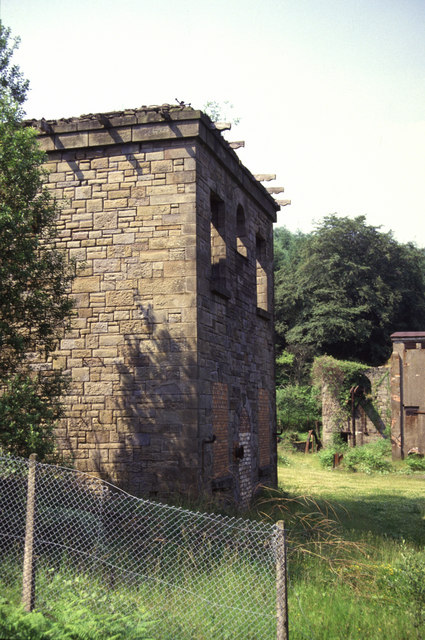
Both engine houses survive with their engines. The Royal Commission records the beam engine as substantially complete, with flywheel, crankshaft, gearing, sheaves and pump rods, and the vertical winder with its sheaves, part of its brake gear and wire ropes; the fan machinery and brick fan tunnel remain. A 1994 visitor found the beam engine house roofless; photographs of 2010-15 and a 2012 visit show both houses fenced, with scaffolding and corrugated roofs, the winding house roof having burnt, and valve gear and other parts lost to scrap theft.
Beam engine house (1845) with engine, vertical winding engine house with engine, two shafts, fan tunnel and fan, reservoir and leat.
Related mines
- Hafodyrynys Colliery — After coal winding ended the Glyn Pits shafts were kept pumping water for Hafodyrynys.
Nearby mines
- Tirpentwys Colliery — 1.9 km W
- Cwmbran Colliery — 2.9 km S
- Llanerch Colliery — 2.9 km N
- Hafodyrynys Colliery — 3.1 km SW, Caerphilly
- Blaenserchan Colliery — 3.8 km N
Straight-line distance, within 15 km. Show on the map.
Disasters & major incidents
-
Glyn Pits explosion and fire, 1890
23 January 1890 · Explosion · 5 fatalities
In the early hours of Thursday 23 January 1890 gas exploded underground at the Glyn Pits near Pontypool. Most of the men struggled out, but five miners and nine horses were missing, and fires spread through the workings so fiercely that rescue was almost impossible. Five days later the colliery was deliberately flooded to put out the fire and save the pit, and the five bodies were never recovered. Within a fortnight some of the men who had gone to work at nearby Llanerch Colliery died in the explosion there.
Recorded claims
Individual factual claims, each attached to the source(s) that support it below. Where sources disagree, both are kept.
- The colliery was sunk by Capel Hanbury Leigh in the early 1840s to supply his Pontypool iron and tinplate works. 1,2,3
- A masonry engine house of 1845 holds a single-cylinder rotative beam engine, probably by the Neath Abbey Ironworks, used first for pumping and winding; between 1852 and 1865 a winding engine to the east took over the winding. 2,4
- The later engine house contains a vertical engine, possibly second-hand and of unknown make, dated 1859-65 by RCAHMW, winding from flat-rope reels. 2,3,5
- The pits were sunk to a depth of 190 yards. (disputed) 1
- The two shafts were sunk side by side to 190 feet (58 m). (disputed) 6
- An explosion in January 1890 killed five miners whose bodies were never recovered; the fires were so fierce the pit was flooded. 1,3,7
- Production stopped in 1932. (disputed) 1,5
- Glyn Pits Nos. 1 and 2 ceased coal winding in 1928 and became a pumping site for Hafodyrynys, finally closing in 1949 under NCB ownership. (disputed) 3
- The pit was still used as a pumping station for Hafodyrynys until the 1960s; a 2012 account says electric pumps were in use until the site was abandoned in 1966. (uncertain) 1,8
- In 2012 both engine houses were fenced, the beam engine house propped with scaffolding under a corrugated roof, and much valve gear missing to theft. 8
Photographs & further reading
Royal Commission record of the colliery with the 2005-06 digital survey drawings.
View sourceIllustrated history of the Glyn Pits complex with historic maps and photographs of both engines.
View sourceOwnership history, the 1864 and 1890 explosions with the names of the dead, and early photographs.
View sourcePhotographs of the engine houses taken in 1994, with later pictures of the site under scaffolding.
View sourceSources
- (secondary) Glyn pits, Pontypool — Welsh Coal Mines
- (primary) Glyn Pits; Glyn Collieries, Nos 1 & 2 Pits; Race Colliery, Pontypool (NPRN 33566) — Coflein, Royal Commission on the Ancient and Historical Monuments of Wales
- (secondary) The Glyn Pits, the Industrial Archaeology and History — Industrial Gwent
- (primary) Glyn Pits, Beam Pumping Engine House and Engine (NPRN 33729) — Coflein, Royal Commission on the Ancient and Historical Monuments of Wales
- (observational) Report - Glyn Pits Colliery, Pontypool, South Wales (Moelwyn, 2021; photographs of 1994) — 28DaysLater
- (primary) Glyn Pits, Nos 1 and 2 Shafts (NPRN 405691) — Coflein, Royal Commission on the Ancient and Historical Monuments of Wales
- (secondary) Welsh mining fatalities, 1890 — Welsh Coal Mines
- (observational) Cornish engine in Wales - Glyn Pits, near Pontypool (2012) — Anarchadia (blog)
Record created: 13 September 2026 · Last researched: 13 September 2026