 MineArchive
Blaen y Cwm Quarry
| Location | Blaenau Ffestiniog, Gwynedd — 52.9989, -3.8883 (exact) |
|---|---|
| Commodity | Slate |
| Type | Slate |
| Worked | c. 1818–8 May 1914 |
| Operators | William Henry Gatty (1866–?) |
Overview
A small-to-modest slate quarry east of Blaenau Ffestiniog, on land belonging to the Wynne family's Blaen y Cwm farm, first trial-worked around 1818 and operated sporadically under a succession of lessees and companies until final closure in 1914. It reached the Ffestiniog Railway via the Rhiwbach Tramway from 1869, working ground badly disturbed by faulting near the Manod Mawr igneous intrusion, which left much of its slate cracked and discoloured.
History
The roughly 500-acre Blaen y Cwm farm was owned by the Wynne family of Peniarth, who attempted unsuccessfully to sell it in 1813 and 1826. Thomas Roberts made small-scale trial workings around 1818, and Adam Gregory of Worksop took a 21-year lease from 1838, surrendering it in 1849 after financial difficulty; during this lease Gregory also made trial workings at the neighbouring Cwt-y-Bugail ground. Thomas and James Swinton Spooner, sons of the Ffestiniog Railway's engineer James Spooner, leased the mineral rights from 1853 but made no significant progress before giving up in 1857.
In 1861 the Bangor solicitor Hugh Beaver Roberts took a fresh lease, selling on half-rights to a group of partners; by 1866 William Henry Gatty of Market Harborough had acquired the lease and established the Blaenycwm Slate Company, bringing in William Griffiths, formerly of Penrhyn quarry, as manager. Later operators included William Lewis of the Tan-y-Grisiau Foundry (1889-90), George Watson's Blaenycwm Slate Quarry Company Ltd — the site's first limited company, employing 16 men in 1898 — and finally the Blaen-y-Cwm Slate Quarry Company, which worked the site in two further spells, 1904-06 and 1910-14. Production was always small: 487 tons were shipped in 1900 and 398 tons in 1901. The quarry closed for the last time on 8 May 1914, and later saw only minor extraction of 'rustic slates' in the 1960s by George Budski, with no full resumption.
Geology
Slate east of Blaenau Ffestiniog, in ground badly disturbed by faulting near the Manod Mawr igneous intrusion, which left much of the quarry's slate cracked and discoloured.
Workings
Slate was originally carried out by packhorse via Cwm Machno and Cwm Penmachno to Trefriw on the Conwy, a route of roughly 14 miles; from the 1820s this shifted to a shorter, 7-mile route south to Porthmadog via Ffestiniog. In 1861 the owners of the neighbouring Rhiwbach quarry built the Rhiwbach Tramway to connect their own workings to the Ffestiniog Railway at Blaenau Ffestiniog, and from 1869 Blaen y Cwm connected onto this tramway rather than building its own line to the railway. An incline built between about 1871 and 1876, 285ft long at a 22-degree gradient and raising wagons 107ft, linked Blaen y Cwm's own internal tramways up to the Rhiwbach Tramway — unusually, its haulage engine was sited at the bottom of the incline rather than the top. A second, shallower incline of around 508ft served the neighbouring Nelw Williams quarry. Internally the quarry used the same 1ft 11½in gauge as the Rhiwbach Tramway, with no locomotives — wagons were worked singly by hand. Rail sleepers of the Thomas Hughes pattern, circular bars with elbows fitting cast-iron sleeper holes and invented around 1845, were found on site — reportedly the only known use of this system anywhere in the Ffestiniog slate district.
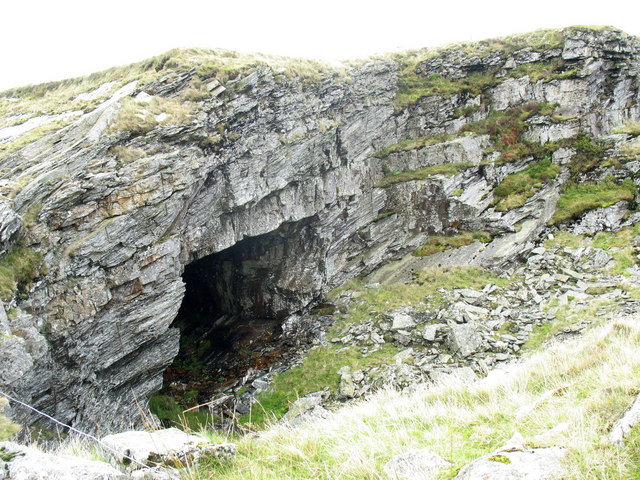
Working was mainly by open pit, covering a comparatively wide area because operators had to search for usable stone amid faulting and distortion associated with the nearby Manod Mawr igneous intrusion; the quarry's 'Back Vein' slate was often cracked, discoloured and fit only for waste. Surviving photographs show large exposed chambers within the pit walls, suggesting part-galleried working alongside the open pit rather than pure open-cast extraction, though no source describes a formal system of deep levels comparable to larger neighbouring quarries.
Closure
Closed for the last time on 8 May 1914, with only minor extraction of rustic slates in the 1960s afterwards.
What remains
The site is abandoned; surviving structures include a ruined mill, ruined weighhouse buildings, an entrance level, waste and rubbish wagon runs, a former slate stacking yard and a mill wheel pit.
Related mines
- Cwt-y-Bugail Quarry — Adam Gregory, lessee of Blaen y Cwm from 1838, made trial workings at Cwt-y-Bugail around 1840 during his tenure.
- Penrhyn Quarry — William Griffiths, formerly of Penrhyn quarry, was brought in as Blaen y Cwm's manager.
Nearby mines
- Rhiwbach Quarry — 0.4 miles (0.6 km) E
- Manod Quarry — 0.5 miles (0.8 km) S
- Graig Ddu Quarry — 0.7 miles (1.1 km) SW
- Cwt-y-Bugail Quarry — 0.9 miles (1.5 km) NW
- Penmachno Quarry — 1.1 miles (1.8 km) E, Conwy
Straight-line distance, within 9 miles (15 km). Show on the map.
Recorded claims
Individual factual claims, each attached to the source(s) that support it below. Where sources disagree, both are kept.
- Thomas Roberts made small-scale trial workings at Blaen y Cwm around 1818, on land belonging to the Wynne family's roughly 500-acre farm. 1
- By 1866 William Henry Gatty had acquired the lease and established the Blaenycwm Slate Company, with William Griffiths, formerly of Penrhyn quarry, as manager. 1
- From 1869 Blaen y Cwm connected onto the Rhiwbach Tramway, built in 1861 by the owners of the neighbouring Rhiwbach quarry, to reach the Ffestiniog Railway at Blaenau Ffestiniog. 1,2
- Production was small-scale: 487 tons of slate were shipped in 1900 and 398 tons in 1901. 1
- The quarry closed for the last time on 8 May 1914, with only minor 'rustic slate' extraction by George Budski in the 1960s and no full resumption. 1
Sources
- (secondary) Blaen y Cwm quarry — Wikipedia
- (secondary) Blaen Y Cwm — Festipedia (Ffestiniog Railway Society wiki)
Record created: 26 August 2026 · Last researched: 26 August 2026