 MineArchive
Graig Ddu Quarry
| Also known as | Craig Ddu Quarry |
|---|---|
| Location | Manod, near Blaenau Ffestiniog, Gwynedd — 52.9923, -3.8998 (exact) |
| Commodity | Slate |
| Type | Slate |
| Worked | c.1800–1946 |
| Operators | New Craig Ddu Slate Company (1864–1880) |
Overview
A remote, high-altitude slate quarry above Blaenau Ffestiniog — reputedly the highest industrial site in Britain — worked from around 1800 and famous among Welsh slate quarries for the ceir gwyllt, home-built 'wild cars' that let quarrymen ride the mile-long inclines down at the end of a shift, a practice that also caused a string of fatal accidents before it was finally stopped in 1939. Still worked today by Welsh Slate.
History
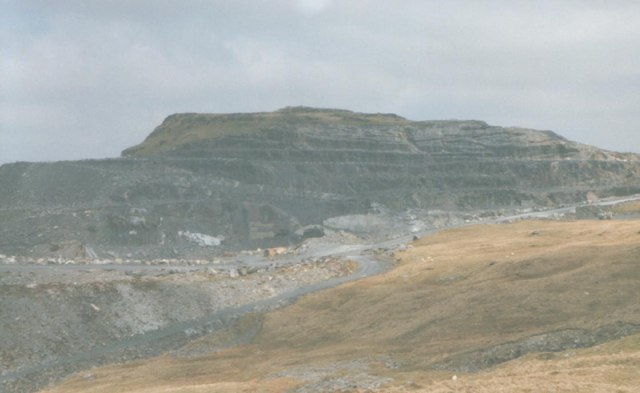
Quarrying began around 1800 on this exposed site above Blaenau Ffestiniog, 1,800 feet (550 m) above ordnance datum, under the name Manod Quarry; it is the same working that developed under the name Graig Ddu from the 1840s, and the older name survives locally as Old Manod to distinguish it from the separate New Manod quarry — Bwlch y Slaters — further along the mountain. The site's remoteness was a persistent handicap: slate was at first floated down the River Dwyryd, until around 1865-67 when three cable-worked inclines, on a shallow gradient of about 1 in 6, were built down to the road at Tan y Manod. The New Craig Ddu Slate Company Ltd, formed in 1864-65, consolidated the operation, and once the Festiniog and Blaenau Railway opened in 1868 a fourth incline was added, connecting in late 1869 to give the quarry a proper rail outlet for the first time. Ownership passed to the Craigddu Slate Company from 1880. Despite its difficult location, the quarry grew into a substantial operation with around 36 saw tables and the same number of dressing machines, employing 110 men in 1882 and producing some 6,000 tons of slate a year at the turn of the century. Water was short, as it was across the district: what there was came from an underground waterwheel fed by an iron-lined leat, most of it pumped up from Llyn y Manod by a second wheel, with a 16 hp steam engine to take over when the supply failed.
Graig Ddu closed in 1939 with 86 men on the books, reopened briefly at the end of the war to cut slate for repairing bomb damage, and closed again in 1946. What happened next happened to it rather than at it: from the mid-1980s the untopping operation at the neighbouring Bwlch y Slaters quarry worked over the summit of Manod Mawr and reached the derelict Graig Ddu, obliterating much of the old site. Alfred McAlpine, who then owned it, renamed the combined Bwlch y Slaters and Graig Ddu working Cwt y Bugail — a name borrowed from a different quarry two miles away — and untopping at Graig Ddu itself stopped in September 2007 when the company ran into financial difficulties. The Breedon Group has worked the site since, under the Welsh Slate name.
Geology
Graig Ddu works the same belt of high-quality Ordovician slate that runs through the Blaenau Ffestiniog district, quarried here at unusually high altitude on the flank of Manod Mawr rather than in the valley workings more typical of the area — one of very few genuinely open-cast slate sites in the district, later supplemented by underground working once the accessible surface rock was exhausted.
Workings
Originally worked as an open quarry — one of the few true opencast slate sites in the Blaenau Ffestiniog area — with underground working added from the 1920s; later 20th-century operations under Alfred McAlpine reworked much of the site by untopping, quarrying down from the surface through former underground galleries.
Closure
The original quarry closed in 1939, reopened briefly after the war for bomb-damage repair slate, and closed again in 1946; the site was later reopened for untopping operations from the mid-1980s and remains in production today.
What remains
The ground is worked today as part of the combined Bwlch y Slaters and Graig Ddu operation run by Welsh Slate (part of the Breedon Group), thought to be the highest industrial site in Britain; it produces standard 50 by 25 cm roofing slates to British Standard thicknesses of 5.5, 7.5 or 9.5 mm, and planning permission to extract has been sought to 2048. Graig Ddu as a quarry in its own right is disused, and much of the historic site has been quarried away by the untopping that engulfed it.
The historic incline routes down to Tan y Manod survive alongside the modern working, and waste tips from the old quarry are visible on the north summit of Manod Mawr. Much of the quarry itself has been obliterated by untopping since the mid-1980s.
Related mines
- Cwt-y-Bugail Quarry — The same 1961 consortium, led by Dafydd Price, owned both quarries.
- Manod Quarry — Neighbours on Manod Mawr, half a mile apart, whose names have been exchanged for two centuries: Graig Ddu opened as Manod Quarry and is the Old Manod of the sources, while Bwlch y Slaters is the New Manod, and a later owner renamed both together Cwt y Bugail. Since the mid-1980s the untopping operation at Bwlch y Slaters has worked over the summit and engulfed the derelict Graig Ddu, so the two are now physically one working.
Nearby mines
- Manod Quarry — 0.4 miles (0.6 km) E
- Blaen y Cwm Quarry — 0.7 miles (1.1 km) NE
- Diphwys Casson Quarry — 0.8 miles (1.3 km) NW
- Cwt-y-Bugail Quarry — 0.9 miles (1.5 km) NW
- Rhiwbach Quarry — 0.9 miles (1.5 km) NE
Straight-line distance, within 9 miles (15 km). Show on the map.
Graig Ddu is an active working quarry — this entry describes history and general location only, not an access guide.
Recorded claims
Individual factual claims, each attached to the source(s) that support it below. Where sources disagree, both are kept.
- Opened around 1800 as Manod Quarry, redeveloped as Graig Ddu from the 1840s; three cable-worked inclines to Tan y Manod were built around 1865-67, and a fourth incline connected the quarry to the Festiniog and Blaenau Railway in late 1869. 1,2
- The quarry held around 36 saw tables and dressing machines, employed 110 men at its 1882 peak, produced over 6,000 tons of slate a year around 1900, and was among the first Welsh slate quarries to adopt compressed-air drills and winches, in use by 1902. 1
- Invented by the company blacksmith in the 1870s and, by contemporary account, unique to Graig Ddu among the Blaenau Ffestiniog quarries, these wheeled devices let quarrymen ride the inclines down at shift's end; fatal accidents are recorded in 1897, 1898 and the 1920s, and the practice continued until the quarry's 1939 closure. 1,2
- The quarry closed in 1939 and briefly reopened after the war for bomb-damage repair slate, closing again in 1946. From the mid-1980s the untopping operation at the neighbouring Bwlch y Slaters quarry extended over the summit of Manod Mawr and engulfed the derelict Graig Ddu; Alfred McAlpine renamed the combined working Cwt y Bugail, untopping at Graig Ddu ceased in September 2007, and the site is worked today by Welsh Slate under the Breedon Group. 1
Sources
- (secondary) Graig Ddu quarry — Wikipedia
- (secondary) Graig Ddu Quarry — Festipedia (Ffestiniog Railway heritage wiki)
Record created: 26 August 2026 · Last researched: 26 August 2026