 MineArchive
Rhiwbach Quarry
| Location | east of Blaenau Ffestiniog, near Penmachno, Gwynedd — 52.9977, -3.8799 (exact) |
|---|---|
| Commodity | Slate |
| Type | Slate |
| Worked | Around 1812–1952 |
| Maximum depth | Worked on around eight underground floors |
| Operators | Festiniog Slate Company Limited (1858–1891) |
Overview
A remote slate quarry east of Blaenau Ffestiniog, worked from 1812 to 1952 and reached before 1863 only by cart over the hills — so isolated that it became the last Welsh slate quarry where workers lived on site in barracks, in a settlement complete with its own shop, school and chapel.
History
Rhiwbach was first worked commercially around 1812 by two men from Penmachno and Ysbyty Ifan, the partnership gradually growing to five men before the quarry was sold in 1849 to Robert Owen Mousdale of Bryndyffryn, Llanrwst. Its remoteness — nearly four miles from Duffws, the Ffestiniog Railway's terminus at Blaenau Ffestiniog — meant that before 1863 its slate had to be carted out over the hills through Betws-y-coed to Trefriw, a costly and slow arrangement that limited the quarry's growth. A rapid sequence of company formations followed through the 1850s — the Rhiw Bach Slate Quarries Company, the Cambrian Slate Quarrying Company, the Manchester and Ffestiniog Slate and Slab Company — before the business was incorporated in 1858 as the Ffestiniog Slate Quarry Co Ltd, raising £100,000 in capital.
The quarry's fortunes changed decisively with the opening of the Rhiwbach Tramway in 1863, a narrow-gauge line financed by the quarry companies it served but built by the Ffestiniog Railway, linking Rhiwbach and neighbouring quarries — Maenofferen, Cwt y Bugail and Blaen y Cwm among them — down to the Ffestiniog Railway at Duffws and from there to the port at Porthmadog. An exit incline worked by a stationary steam engine, one of only two used this way among the Ffestiniog-served quarries, hauled loaded wagons up from the underground workings to tramway level. Output peaked in 1869 at nearly 8,000 tons of finished slate a year, falling within a few years to below 4,000 tons and eventually to only around 1,000 tons by 1935 as the accessible reserves thinned. The original company was wound up in 1877 and reconstituted as the Festiniog Slate Company Limited, which was itself liquidated in 1891; a Mr H. Humphries continued working the quarry afterward as 'Rhiw Bach Quarry Owners' until his own company wound up and the quarry formally closed in 1913, though some limited export continued into 1918-19. The quarry was bought by the neighbouring Maenofferen quarry in 1928 and worked on a reduced basis until final closure in 1952 — by which time only two men were still living in the site's barracks.
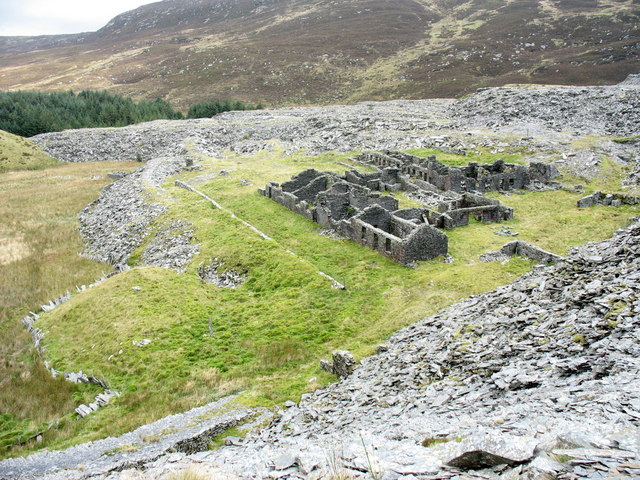
Because of its isolation, Rhiwbach developed into something close to a self-contained village rather than a simple work camp: alongside barracks for single men, paying rent of between 2s 4d and 5s 8d a month, the settlement grew family housing, a shop, and a meeting room that doubled as school and chapel, along with a workers' reading room and library. It became known as the last Welsh slate quarry where workers actually lived on site. One tale recorded from the settlement's schoolteacher, Kate Griffiths, has her breaking quarry rules by riding the exit incline's gravity-worked wagons — the car gwyllt, or 'wild car' — down to Blaenau Ffestiniog, on the reasoning that, not being a quarryman, the rule barring passengers did not strictly apply to her.
Geology
Rhiwbach lies within the same belt of Ordovician slate that runs through Blaenau Ffestiniog, where five roughly parallel veins of workable slate occur in sequence; at Rhiwbach only two of these, known locally as the North Vein and the Back Vein, proved workable, mined underground on around eight successive floors as the workings deepened.
Workings
An underground slate mine worked on eight floors following the North and Back Veins, drained by a long adit tunnel and connected to the surface tramway by a steam-worked exit incline. The quarry's mill was among the first in the district to use corrugated iron sheeting in its construction during the 1860s, trialled (unsuccessfully at first) wire saws for slate cutting around 1900, adopted compressed-air rock drills in 1902, and converted from steam to electric power in 1935.
Closure
The quarry formally closed in 1913 after its operating company wound up, though limited export continued into 1918-19; bought by the neighbouring Maenofferen quarry in 1928, it was worked on a much reduced basis until final closure in 1952.
What remains
Substantial ruins survive at this remote, disused site, including the stacked engine house and slate mill, and the engine house's distinctive tall, square chimney, separately recognised for preservation. The former barracks settlement, Pentre Rhiwbach, survives as a ruined but still legible small village of housing, barracks, shop and school buildings.
The ruined barracks settlement of Pentre Rhiwbach, the engine house and its tall chimney, and the slate mill survive at this isolated upland site, along with traces of the Rhiwbach Tramway's exit incline.
Related mines
- Cwt-y-Bugail Quarry — Connected by the Rhiwbach Tramway, built in 1861-63 by Rhiwbach's owners specifically to link the two quarries to the Ffestiniog Railway.
- Maenofferen Quarry — Maenofferen bought Rhiwbach, together with its tramway, in 1928 and worked it until final closure.
Nearby mines
- Blaen y Cwm Quarry — 0.4 miles (0.6 km) W
- Manod Quarry — 0.6 miles (1.0 km) SW
- Penmachno Quarry — 0.9 miles (1.4 km) NE, Conwy
- Graig Ddu Quarry — 0.9 miles (1.5 km) SW
- Cwt-y-Bugail Quarry — 1.3 miles (2.1 km) W
Straight-line distance, within 9 miles (15 km). Show on the map.
The underground workings and ruined buildings are unstable and this is a remote upland site — this entry describes history and general location only, not an access guide.
Recorded claims
Individual factual claims, each attached to the source(s) that support it below. Where sources disagree, both are kept.
- Commercial working began around 1812; before the Rhiwbach Tramway opened in 1863, slate had to be carted out over the hills through Betws-y-coed to Trefriw. 1,2
- Output peaked in 1869 at nearly 8,000 tons of finished slate, falling to below 4,000 tons within a few years and to around 1,000 tons annually by 1935. 1
- Incorporated in 1858 as the Ffestiniog Slate Quarry Co Ltd, reconstituted in 1877, liquidated in 1891, continued by H. Humphries as 'Rhiw Bach Quarry Owners' until closing in 1913; sold to Maenofferen quarry in 1928 and finally closed in 1952. 1
- Rhiwbach was the last Welsh slate quarry where workers lived on site in barracks, with a settlement including family housing, a shop and a combined school/chapel; two men were still living in the barracks at the quarry's 1952 closure. 1,2
Sources
- (secondary) Rhiwbach quarry — Wikipedia
- (secondary) Rhiwbach Quarry — Festipedia (Ffestiniog Railway heritage wiki)
Record created: 26 August 2026 · Last researched: 26 August 2026