 MineArchive
Cwt-y-Bugail Quarry
| Also known as | New Welsh Slate Quarry |
|---|---|
| Location | east of Blaenau Ffestiniog, on Moel Bowydd, Gwynedd — 53.0045, -3.9089 (exact) |
| Commodity | Slate |
| Type | Slate |
| Worked | c. 1840–1961 (sporadic extraction to 1972) |
| Operators | Owen Williams (1877–1907) |
Overview
A remote slate quarry east of Blaenau Ffestiniog, trial-worked from around 1840 and in continuous production from 1863 to 1961, with sporadic extraction continuing to 1972. Connected to the Ffestiniog Railway via the Rhiwbach Tramway, it passed through numerous owners — from a Victorian joint-stock company through a genuine workers' cooperative to a 20th-century family firm — and at its 1870s peak employed around 116 men. Note: the modern working branded 'Cwt y Bugail' by Alfred McAlpine from the 1980s is a different site roughly two miles away, formerly known as Bwlch y Slaters or Graig Ddu (New Manod) Quarry, not a continuation of this one.
History
Adam Gregory, lessee of the neighbouring Blaen y Cwm quarry from 1838, made trial workings at Cwt-y-Bugail during his tenure there, around 1840, though quarrying on the site is separately described as beginning as early as the 1820s; large-scale development followed only once the Rhiwbach Tramway connection was made. In 1863 Hugh Beaver Roberts sold half his interest in the ground to a consortium that formed the New Cwt y Bugail Slate Company Ltd, beginning continuous production. The quarry passed in 1875 to the Bugail Slate Quarry Company Ltd, chaired by Thomas Scott of Edinburgh and known locally as 'y cwmni Ysgottiad' ('the Scottish Enterprise'). Production peaked around 1877, at over 3,500 tons a year with a workforce of up to 116 men, and Owen Williams of Penmachno took over management that year, running the quarry for the next thirty years.
Output declined sharply from 1884 and the quarry closed by 1887; Williams formed a genuine workers' cooperative in 1888, which purchased the quarry from the Bugail Slate Quarry Company for a nominal fee in 1892 and employed around 60 men through the 1890s. A serious rock fall in 1908 left the cooperative company in debt, and it soon went into receivership; the receiver sold the quarry to Cadwalader Owen Roberts of Betws-y-Coed, who worked it as 'the New Welsh Slate Quarry' until closure in April 1914, reopened it in 1919 for three further years, then closed it again. In 1923 Tudor Roberts of Glanypwll set up Cwt y Bugail Slate Quarries Ltd, which owned the site until 1961, sub-leasing it to the neighbouring Maenofferen Quarry between 1946 and 1956 and then to Manod Slate Quarries Ltd. In 1961 a consortium led by Dafydd Price, which also owned the more productive Graig Ddu Quarry, took over Cwt-y-Bugail Slate Quarries Ltd, and sporadic slate extraction continued until 1972. The land and mineral rights were sold in 1985 to a subsidiary of Ffestiniog Slate Quarry Ltd and taken over by the McAlpine group in 1997, but the quarry itself has not been worked since the 1970s — the 'Cwt y Bugail' name later used by McAlpine belongs to a different site, formerly Bwlch y Slaters/Graig Ddu, some two miles away.
Geology
Slate east of Blaenau Ffestiniog; the vein is not named on the record.
Workings
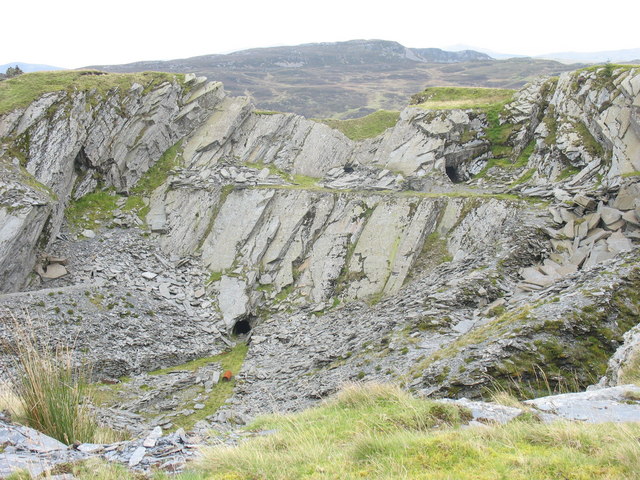
The quarry combined open-pit and underground working: it was initially worked underground on the rich 'Back Vein,' source of the finest slate in the district, with a later open-pit working on the inferior 'North Vein,' giving two open pits (North and South) alongside a number of adits leading to underground chambers. Machinery and the site's internal inclines were originally steam-powered, replaced by an oil engine after the Second World War. Because of its remoteness, quarrymen lived on site in a large barracks block. The quarry connected to the Rhiwbach Tramway — built in 1861-63 by the owners of the neighbouring Rhiwbach quarry to link their own workings to the Ffestiniog Railway at Blaenau Ffestiniog — under a private wayleave agreement, rather than through any shared ownership; Cwt-y-Bugail's own internal cable-hauled incline lifted loaded wagons around ten feet from the quarry's mill level up to the tramway junction. Rhiwbach Quarry itself closed in 1953 and the tramway between it and Cwt-y-Bugail was lifted in 1956; Cwt-y-Bugail was the tramway's last user, in 1961, and the remaining track was lifted by 1964.
Closure
Output declined sharply from 1884 and the quarry closed by 1887; it was reworked as the New Welsh Slate Quarry until a later closure in April.
What remains
The site is a derelict industrial ruin. Surviving structures include a ruined mill building that once held a slate-dressing machine, a ruined inclined plane, remains of the workers' barracks, a Pooley and Sons weighing platform still fixed in its original seating, sections of narrow-gauge tramway track, a small reservoir, a drilling rig left in place, and the rusted remains of a lorry engine used to power the site in its final years. Most of the underground workings have since collapsed and are not considered safe to enter.
Related mines
- Blaen y Cwm Quarry — Adam Gregory, lessee of Blaen y Cwm from 1838, made trial workings at Cwt-y-Bugail around 1840 during his tenure.
- Graig Ddu Quarry — The same 1961 consortium, led by Dafydd Price, owned both quarries.
- Maenofferen Quarry — Maenofferen sub-let Cwt-y-Bugail between 1946 and 1956.
- Manod Quarry — The two quarries share a genuine naming overlap -- the 'Cwt y Bugail' name used by a later owner belongs to a different, separate site.
- Rhiwbach Quarry — Connected by the Rhiwbach Tramway, built in 1861-63 by Rhiwbach's owners specifically to link the two quarries to the Ffestiniog Railway.
Nearby mines
- Diphwys Casson Quarry — 0.5 miles (0.9 km) SW
- Maenofferen Quarry — 0.8 miles (1.2 km) SW
- Votty and Bowydd Quarry — 0.9 miles (1.4 km) SW
- Blaen y Cwm Quarry — 0.9 miles (1.5 km) SE
- Graig Ddu Quarry — 0.9 miles (1.5 km) SE
Straight-line distance, within 9 miles (15 km). Show on the map.
Recorded claims
Individual factual claims, each attached to the source(s) that support it below. Where sources disagree, both are kept.
- The New Cwt y Bugail Slate Company Ltd began continuous production in 1863, after Hugh Beaver Roberts sold half his interest in the ground to the consortium that formed it. 1
- Production peaked around 1877 at over 3,500 tons a year with a workforce of up to 116 men. 2
- Owen Williams formed a genuine workers' cooperative in 1888, which purchased the quarry from the Bugail Slate Quarry Company for a nominal fee in 1892. 1
- A serious rock fall in 1908 left the cooperative company in debt, and it soon went into receivership. 1
- Rhiwbach Quarry itself closed in 1953 and the tramway between it and Cwt-y-Bugail was lifted in 1956; Cwt-y-Bugail was the tramway's last user, in 1961, and the remaining track was lifted by 1964. 3,4
- Sporadic slate extraction at Cwt-y-Bugail continued to 1972, after which the site was not worked again; the 'Cwt y Bugail' name later used by the McAlpine group belongs to a different site, formerly Bwlch y Slaters/Graig Ddu, roughly two miles away. 1,5
Sources
- (secondary) Cwt-y-Bugail Quarry — Festipedia (Ffestiniog Railway Society wiki)
- (observational) Cwt y Bugail (old) quarry — penmorfa.com
- (observational) Rhiwbach Tramway route guide — penmorfa.com
- (primary) Rhiwbach Tramway, Moel Bowydd (NPRN 65647) — Royal Commission on the Ancient and Historical Monuments of Wales (Coflein)
- (secondary) Cwt y Bugail quarry — Wikipedia
Record created: 26 August 2026 · Last researched: 26 August 2026