 MineArchive
Diphwys Casson Quarry
| Also known as | Diffwys Quarry, Diphwys Quarry, Diffwys Casson Quarry |
|---|---|
| Location | Blaenau Ffestiniog, Gwynedd — 52.9981, -3.9161 (exact) |
| Commodity | Slate |
| Type | Slate |
| Worked | 1760s (Methusalem Jones)–1925 (sources differ) |
| Operators | Methusalem Jones (1760–1800), Turner and Casson (1800–1892) |
Overview
Known as Diffwys or Diphwys Casson, this is the 'mam-chwarel' (mother quarry) of the Blaenau Ffestiniog slate district -- the first Ffestiniog quarry to produce for export rather than purely local use, worked from the 1760s into the 20th century on the same Old Vein that underpinned the prosperity of the wider Ffestiniog slate industry.
History
Men led by Methusalem Jones of the long-established Cilgwyn quarry in Nantlle began working the slate beds of Ceunant y Diphwys around 1760, under a lease to the Peniarth estate; Jones was the first to discover and exploit the Old Vein that would underpin the wider Ffestiniog slate industry's prosperity, and the exact site of this original working has since been obliterated by later mining. In 1800 the quarry was bought by William Turner and William Casson -- slate quarrymen and entrepreneurs who had worked in the Lake District -- along with fellow managers Thomas Wright, Hugh Jones and Thomas Assheton Smith; Casson's name became permanently attached to the quarry's own. Underground mining had begun by 1820, and output exceeded 5,000 tons a year through the 1820s, when Diphwys Casson was the dominant producer in the district. Considerable capital was invested in steam-powered saw-mills -- the quarry lacked its own water supply, so could not rely on waterwheels the way many neighbouring quarries did -- and in 1862 George Casson, William's nephew, recommended selling the business for the enormous sum of £120,000, reflecting that investment. Production declined thereafter, and by 1892 the operating company was bankrupt, the quarry back on the market for a fraction of its earlier valuation (£3,435) and employing fewer than 200 men. A brief 1920s reworking followed. From 1864 the quarry was connected to the Ffestiniog Railway's Duffws terminus by the Diffwys Incline, part of the Rhiwbach Tramway system also used by the neighbouring Votty & Bowydd quarry.
Geology
Diphwys Casson worked a series of slate veins of the Ordovician period, part of the same slate-bearing sequence exploited across the wider Ffestiniog district.
Geological setting: Slate and Regional Metamorphism (well documented example)
Workings
A mixture of opencast and underground working: early quarrying followed the Old Vein from the surface, with underground mining established by 1820 as workings deepened. 'Untopping' operations -- removing overlying rock to expose formerly-underground pillars for further extraction from above -- began in the 1980s, long after the quarry's main working life had ended.
Closure
Coflein and a 2020 site survey both record small-scale extraction continuing to 1925; Wikipedia's own account instead describes a 1920s reopening lasting seven years before final closure in 1955. Both cannot be fully reconciled, so both are recorded here rather than one being silently preferred.
What remains
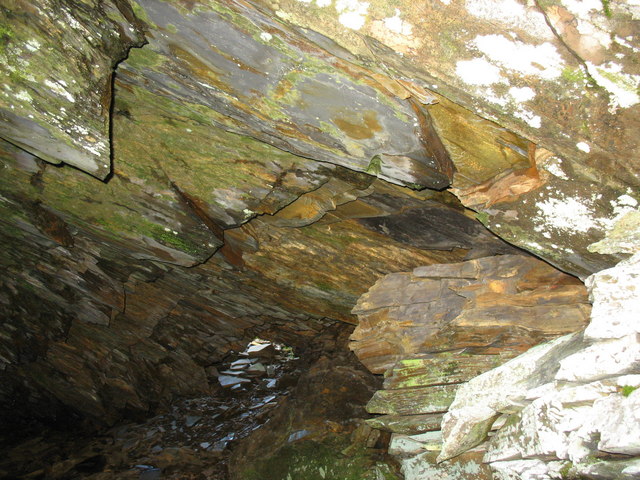
A 2020 site visit found several old adits covered over and areas near the top of the workings completely collapsed, though underground caverns connected by tunnels and rails remain accessible in places, some flooded; ruins of the processing mill and winding stations also survive. The remains of the main mill structure stand above the neighbouring Maenofferen quarry. The original 1760s quarry site itself has been obliterated by the later, much larger workings built on top of it.
Related mines
- Cilgwyn Quarry — Men led by Methusalem Jones from the established Cilgwyn quarry began working Diphwys Casson around 1760.
Nearby mines
- Maenofferen Quarry — 0.4 miles (0.7 km) W
- Votty and Bowydd Quarry — 0.5 miles (0.8 km) W
- Cwt-y-Bugail Quarry — 0.5 miles (0.9 km) NE
- Graig Ddu Quarry — 0.8 miles (1.3 km) SE
- Llechwedd Slate Caverns — 1.1 miles (1.8 km) NW
Straight-line distance, within 9 miles (15 km). Show on the map.
What's uncertain
Points where sources disagree or the record could not be settled; both accounts are kept. All open questions in the archive.
- Coflein and a 2020 site survey both record small-scale extraction continuing to 1925; Wikipedia instead describes a 1920s reopening lasting seven years before a final 1955 closure. (disputed) 1,2,3
Recorded claims
Individual factual claims, each attached to the source(s) that support it below. Where sources disagree, both are kept.
- Methusalem Jones and men from Cilgwyn quarry began working Ceunant y Diphwys around 1760, discovering and exploiting the Old Vein that underpinned the wider Ffestiniog slate district's prosperity. 1,2
- The quarry was bought in 1800 by William Turner and William Casson, with fellow managers Thomas Wright, Hugh Jones and Thomas Assheton Smith; underground mining had begun by 1820, and output exceeded 5,000 tons a year through the 1820s, when it was the district's dominant producer. 1,2
- In 1862 George Casson, William's nephew, recommended selling the business for £120,000, reflecting heavy investment in steam-powered saw-mills; by 1892 the operating company was bankrupt, the quarry on the market for £3,435 and employing fewer than 200 men. 1
- Coflein and a 2020 site survey both record small-scale extraction continuing to 1925; Wikipedia instead describes a 1920s reopening lasting seven years before a final 1955 closure. (disputed) 1,2,3
- A September 2020 site visit found several old adits covered over, areas near the top of the workings completely collapsed, but underground caverns connected by tunnels and rails still accessible in places (some flooded), with mill and winding-station ruins surviving. 3
Sources
- (primary) Diffwys Slate Quarry, Blaenau Ffestiniog (NPRN 85487) — Coflein (RCAHMW)
- (secondary) Diphwys Casson quarry — Wikipedia
- (observational) Diffwys Slate Mine (nr Blaenau Ffestiniog, Sept 2020) — 28DaysLater
Record created: 29 August 2026 · Last researched: 29 August 2026