 MineArchive
Slate and Regional Metamorphism
| Category | Formation Processes |
|---|
A fine-grained metamorphic rock, formed when mudstone or shale is subjected to intense pressure during mountain-building, that splits cleanly into thin, durable sheets — the roofing material behind one of Britain's largest historic quarrying industries, and a genuinely different kind of deposit from anything else on this site: not a concentration of ore within a host rock, but a transformation of the host rock itself into the valuable material.
How it forms
Slate begins as ordinary mud or clay-rich sediment, deposited in layers like any other mudstone. When this rock is caught up in the compression of a mountain-building event — in Britain's case, the Caledonian orogeny that closed an ancient ocean and raised mountains across Wales, the Lake District and Scotland during the later Silurian and into the Devonian — sustained directional pressure, at modest temperatures well under those needed for melting (roughly 300-400°C), recrystallises the original clay minerals into new, flat mica and chlorite crystals. Critically, these new crystals don't grow randomly: they align perpendicular to the direction of squeezing, giving the rock a strong, penetrative fabric called slaty cleavage that has nothing to do with the original horizontal bedding of the mudstone.
Why minerals concentrate here
This isn't a concentration process in the sense that applies to a metal ore — slate isn't a rare material picked out of a larger volume of rock, it's the wholesale transformation of a large volume of mudstone into a new, uniformly useful rock. What matters commercially is where mudstone of the right original composition happened to be caught in a belt of the right intensity and orientation of regional pressure: too little, and the rock never develops a strong cleavage; too much, and higher-grade metamorphism destroys the fine, even fabric that makes slate split cleanly rather than crumbling.
Typical shape of the deposit
A very large, laterally extensive body — entire hillsides and mountains of usable rock, following the outcrop of the original mudstone formation and the belt of metamorphism that affected it, rather than any narrow vein or discrete bed. Quality is not uniform throughout: cleavage strength and freedom from mineral veins or fractures vary within the same formation, and locating the best 'true' slate demanded real skill.
What this means for mining
Because usable slate occupies vast, solid hillsides rather than a narrow target, it was worked as bulk open-pit quarrying or, underground, as large chambered workings — never followed as a vein. What made slate different from a coal seam, though, is that the cleavage plane, not the rock's outer shape, dictated the whole logic of extraction: blocks were split along the grain of the cleavage into thin sheets by hand or machine, so quarry planning centred on reading the cleavage's orientation correctly and working with it rather than against it. Waste was enormous by the standards of any other industry on this site — producing one ton of finished roofing slate at some Welsh quarries meant removing and tipping around nine tons of waste rock, since only a fraction of any given block actually split cleanly enough to be useful.
Associated commodities
Slate (Slate is itself the product of this metamorphic process, not a mineral concentrated within a separate host rock.)
Diagrams
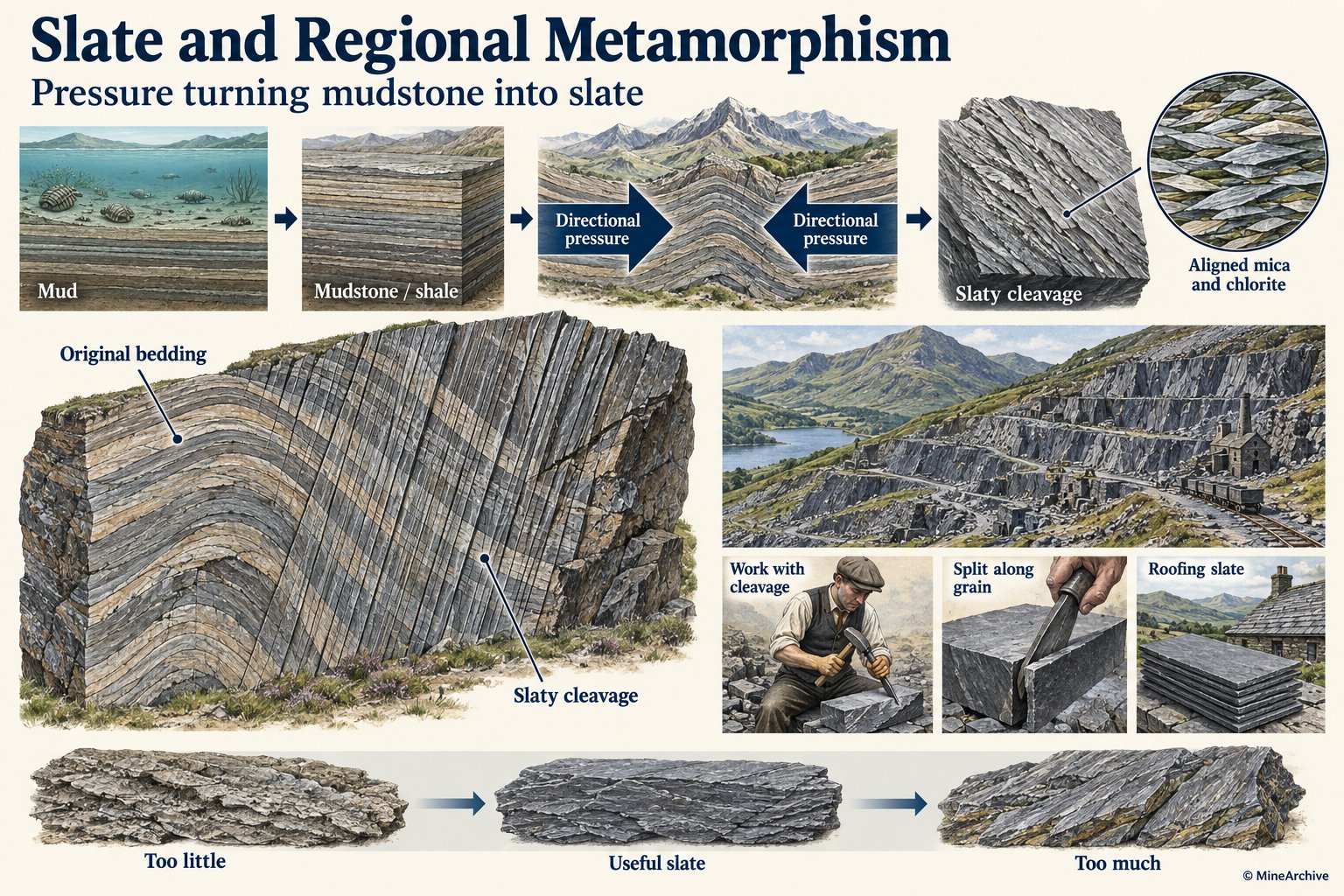
Images
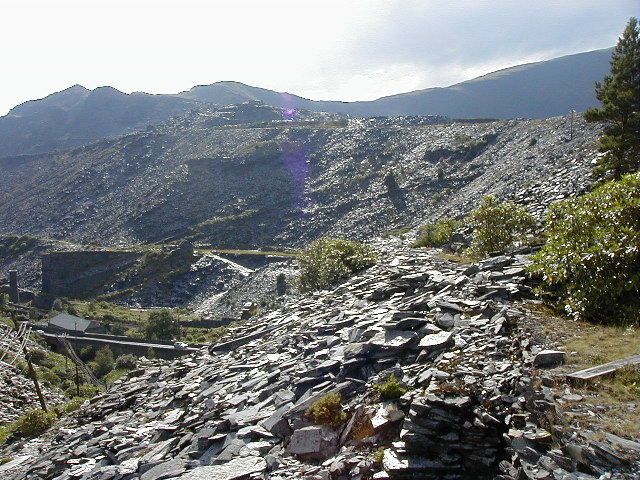
MineArchive examples
Included only where MineArchive's own research gives a reasonable evidential basis — not every mine where this geology might plausibly apply. Showing the 10 strongest examples of 35 linked mines.
- Delabole Slate Quarry — Cornwall (well documented example)
Devonian mudstones cleaved to slate — and cleaved so consistently over so large a body that one pit could be worked for seven centuries without moving. - Dorothea Quarry — Gwynedd (well documented example)
A textbook case of cleavage controlling mine design: the Nantlle slate stands near-vertical, so Dorothea had to be worked as deep pits below the water table rather than as hillside chambers. - Honister Slate Mine — Cumbria (well documented example)
Borrowdale Volcanic Group ash cleaved into slate — the same process as Wales, but on volcanic rock rather than mudstone, which is where the green comes from. - Bagalow Quarry — Cornwall (well documented example)
Upper Devonian and Lower Carboniferous mudstones recrystallised so that they split along a cleavage cutting across the bedding — the process that makes a roofing slate, and the reason this cliff was worth working. - Ballachulish Slate Quarries — Highland (well documented example)
The mine's own recorded geology explicitly describes a metamorphic rock formed from Dalradian-age mudstones. - Bank Wood Quarry — Cumbria (well documented example)
The quarry worked Borrowdale Volcanic Group slate, the regionally metamorphosed Ordovician tuffs of the central Lake District. - Bellstone Quarry — Pembrokeshire (well documented example)
The quarry worked the slate of the Preseli Hills at the south-western end of the Welsh slate belt, on the same hillside as Rosebush. - Braichgoch Slate Mine — Gwynedd (well documented example)
The mine worked slate of the Cambrian slate belt of Snowdonia, the regionally metamorphosed sequence worked across the Corris quarries. - Cilgerran Quarries — Pembrokeshire (well documented example)
The quarries worked the slate exposed in the gorge the Teifi has cut below Cilgerran, a hard building stone rather than a fine roofing slate. - Deeside and Moelfferna Quarries — Denbighshire (well documented example)
The quarries worked the north-eastern end of the Ordovician slate belt that runs across mid Wales from Tywyn to Chirk, where shales and mudstones were compressed and metamorphosed into slate.
See all 35 linked mines.
Sources
- (primary) Caledonian orogeny, Silurian, Wales — BGS Earthwise
- (primary) Wales Regional Geology — Radioactive Waste Management Ltd / BGS
Record created: 22 August 2026 · Last researched: 22 August 2026