 MineArchive
Llechwedd Slate Caverns
| Location | Blaenau Ffestiniog, Gwynedd — 53.0046, -3.9403 (exact) |
|---|---|
| Commodity | Slate |
| Type | Slate |
| Worked | 1846–1970s |
| Operators | John Whitehead Greaves (1846–?) |
Overview
A slate quarry nearly bankrupted within its first years of digging, saved only when unpaid workers struck a great vein by chance — today one of Wales's leading slate heritage attractions, and part of the UNESCO Slate Landscape of Northwest Wales.
History
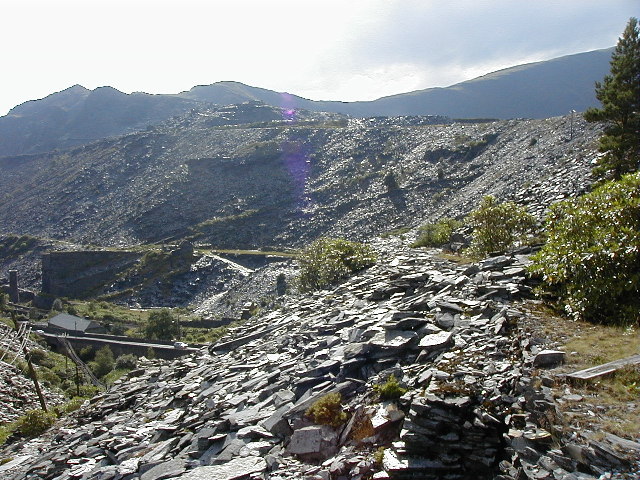
Llechwedd was opened in 1846 by J.W. Greaves. Early results were poor: by 1849, having spent some £25,000 exploring the site with nothing to show for it and refused further credit by the banks, the venture stood on the brink of failure. According to the traditional account, loyal workers carried on searching unpaid for several weeks longer, and were rewarded when they struck the rich 'Old Merioneth Vein', securing the quarry's future. An incline connecting Llechwedd to the Ffestiniog Railway, which had opened in 1836, was completed in 1848, giving the quarry a route to the port at Porthmadog and from there to markets worldwide. Production peaked in 1884 at 23,788 tons of finished slate and 513 employees. Like other Blaenau Ffestiniog quarries, Llechwedd worked underground by driving chambers into the hillside rather than quarrying an open pit, and its slate roofed buildings across Britain and beyond through the Victorian boom. Underground working continued into the 1970s before the site was repurposed; the Miners' Tramway tour, taking visitors 800 metres underground by battery-electric train, opened in 1972, followed by the deeper Deep Mine attraction in 1979. The site is now part of the UNESCO Slate Landscape of Northwest Wales World Heritage Site, inscribed in 2021.
Geology
Llechwedd works the same Cambrian slate beds that made Blaenau Ffestiniog one of the three great centres of the Welsh slate industry, extracted from underground chambers rather than a surface pit.
Geological setting: Slate and Regional Metamorphism (well documented example)
Workings
Slate was worked underground, following the vein through a series of large interconnected chambers driven into the hillside, in the characteristic Blaenau Ffestiniog 'mining' style rather than the open-pit quarrying used at Penrhyn and Dinorwig.
Closure
Underground slate working wound down through the 1970s as the Welsh slate industry contracted, but the site was never fully abandoned — it was converted into a visitor attraction rather than closing outright.
What remains
A major working heritage attraction, with guided tours running deep into the original underground workings by tramway.
Extensive underground chambers, an incline to the former Ffestiniog Railway connection, and surface processing buildings, now all part of the visitor site.
Related mines
- Votty and Bowydd Quarry — Llechwedd has untopped the Votty and Bowydd chambers for crushed slate since the mid-1980s.
Nearby mines
- Gloddfa Ganol Quarry — 0.3 miles (0.6 km) W
- Oakeley Quarry — 0.3 miles (0.6 km) W
- Palmerston Quarry — 0.4 miles (0.7 km) W
- Maenofferen Quarry — 0.7 miles (1.1 km) SE
- Votty and Bowydd Quarry — 0.7 miles (1.1 km) SE
Straight-line distance, within 9 miles (15 km). Show on the map.
What's uncertain
Points where sources disagree or the record could not be settled; both accounts are kept. All open questions in the archive.
- According to the traditional account, unpaid workers continued searching after funding ran out and struck the rich 'Old Merioneth Vein' within weeks, securing the quarry's future. (disputed) 1
Recorded claims
Individual factual claims, each attached to the source(s) that support it below. Where sources disagree, both are kept.
- Llechwedd was opened in 1846 by J.W. Greaves; by 1849 some £25,000 had been spent exploring the site with no return, and the banks refused further loans. 1,2
- According to the traditional account, unpaid workers continued searching after funding ran out and struck the rich 'Old Merioneth Vein' within weeks, securing the quarry's future. (disputed) 1
- Production peaked in 1884 at 23,788 tons of finished slate with 513 employees. 1
- The site became part of the UNESCO Slate Landscape of Northwest Wales World Heritage Site, inscribed in 2021. 2
- Located at about 53.005 N, 3.940 W. 2
Sources
- (secondary) Visit Llechwedd Slate Caverns in Blaenau Ffestiniog — Live the World
- (secondary) Llechwedd Slate Caverns — Wikipedia
Record created: 21 August 2026 · Last researched: 21 August 2026