 MineArchive
Gloddfa Ganol Quarry
| Location | Blaenau Ffestiniog, Gwynedd — 53.0033, -3.9484 (exact) |
|---|---|
| Commodity | Slate |
| Type | Slate |
| Worked | to 1997 |
| Maximum depth | The wider Oakeley quarry it formed part of reached 26 floors over nearly 1,500 feet (460 m) of vertical extent -- the largest underground slate mine in the world. |
| Operators | Narrow Gauge Enterprises (1978–1997) |
Overview
The Middle Quarry section of the vast Oakeley slate mine at Blaenau Ffestiniog, reopened in 1974 as the Gloddfa Ganol Mountain Centre -- a tourist attraction offering underground tours and, for over two decades, home to one of Britain's finest private collections of narrow-gauge industrial locomotives -- before closing in 1997.
History
Gloddfa Ganol occupied the Middle Quarry section of the Oakeley slate quarry at Blaenau Ffestiniog, itself the largest underground slate mine in the world at 26 floors and nearly 1,500 feet of vertical extent. Like the rest of the Welsh slate industry, Oakeley suffered a sharp, sustained decline in worldwide demand after the Second World War, and by the 1960s was in serious economic difficulty. As slate working contracted through the 1970s, the quarry's owners sought to diversify into Wales's growing tourist trade, reopening the abandoned Middle Quarry workings in 1974 as the Gloddfa Ganol Mountain Centre, offering guided tours through several miles of underground tunnels and chambers based around the rebuilt old Middle Mill. The attraction gained its most distinctive feature in 1978, when the railway enthusiast Rich Morris, who had been assembling a private collection of narrow-gauge industrial locomotives since 1963, was offered space at Oakeley after the Festiniog Group closed its Pen-yr-Orsedd quarry in 1977. A new company, Narrow Gauge Enterprises, was formed to run the resulting museum; Morris moved the bulk of his collection to Gloddfa Ganol starting in May 1978, with more than 70 locomotives on site by that September, eventually growing to over 80 engines representing industrial railways from across Britain and Europe. Around 1985 Holland's Lower Mill was rebuilt to accommodate the growing collection, and a short passenger railway began operating in 1988. The attraction's end came suddenly: on 8 October 1997 Alfred McAlpine Slate announced its takeover of the Ffestiniog Slate group, including Oakeley quarry, and immediately confirmed Gloddfa Ganol would close at the end of that year. The locomotive collection was dispersed at auction in February 1998, its pieces going to railway museums and private collectors across the country; Morris himself retained his industrial monorail equipment and several locomotives, later donating what remained of his collection to the Tanat Valley Light Railway on his death in 2018.
Geology
Slate of the Blaenau Ffestiniog belt — the Middle Quarry section of the Oakeley mine, the largest underground slate mine in the world.
Workings
Underground tours ran through several miles of the Middle Quarry's slate chambers and tunnels, based around the rebuilt Middle Mill; the site's narrow-gauge locomotive collection, latterly housed partly in the rebuilt Holland's Lower Mill, ran its own short passenger demonstration railway from 1988. The tour route also took in the workings of the neighbouring Nyth-y-Gigfran quarry, absorbed into the wider Oakeley complex in the 1920s (see the separate Nyth-y-Gigfran Quarry record).
Closure
Closed at the end of 1997 following Alfred McAlpine Slate's takeover of the Ffestiniog Slate group; its locomotive collection was auctioned off in February 1998.
What remains
The tourist centre itself closed in 1997 and its exhibits were dispersed at auction in 1998; the underlying Oakeley/Middle Quarry workings survive as part of the wider Oakeley complex.
The former Middle Mill and Holland's Lower Mill buildings, and the underground chambers and tunnels once shown to visitors, survive as part of the wider Oakeley quarry site.
Related mines
- Nyth-y-Gigfran Quarry — Nyth-y-Gigfran's workings were absorbed into the wider Oakeley complex in the 1920s and shown to visitors on Gloddfa Ganol's own tour route.
- Oakeley Quarry — Gloddfa Ganol formed part of the vast Oakeley slate quarry complex.
- Palmerston Quarry — The two quarries worked the same vein of slate directly above and below one another, Palmerston beneath Gloddfa Ganol. Palmerston's progress was limited by the Middle Quarry's slower advance, and the Welsh Slate Company's removal of the slate walls supporting the workings above is what undermined Gloddfa Ganol and caused the falls of 1882 and 1883.
Nearby mines
- Oakeley Quarry — 0.0 miles (0.0 km) SE
- Palmerston Quarry — 0.2 miles (0.3 km) N
- Llechwedd Slate Caverns — 0.3 miles (0.6 km) E
- Nyth-y-Gigfran Quarry — 0.5 miles (0.8 km) SW
- Votty and Bowydd Quarry — 0.9 miles (1.5 km) E
Straight-line distance, within 9 miles (15 km). Show on the map.
Recorded claims
Individual factual claims, each attached to the source(s) that support it below. Where sources disagree, both are kept.
- From 1978 the site housed the private narrow-gauge locomotive collection of railway enthusiast Rich Morris, run by a new company, Narrow Gauge Enterprises; more than 70 engines were on site by September 1978, eventually growing to over 80, drawn from industrial railways across Britain and Europe, with a short passenger demonstration railway operating from 1988. 1
- Alfred McAlpine Slate's takeover of the Ffestiniog Slate group was announced on 8 October 1997, with Gloddfa Ganol's closure confirmed immediately for the end of that year; the locomotive collection was dispersed at auction in February 1998, with Morris donating what he retained to the Tanat Valley Light Railway on his death in 2018. 1
- The wider Oakeley quarry, of which Gloddfa Ganol's Middle Quarry section formed a part, was the largest underground slate mine in the world, extending across 26 floors and nearly 1,500 feet (460 m) of vertical height. 2
Sources
- (secondary) Gloddfa Ganol — Wikipedia
- (secondary) Oakeley quarry — Wikipedia
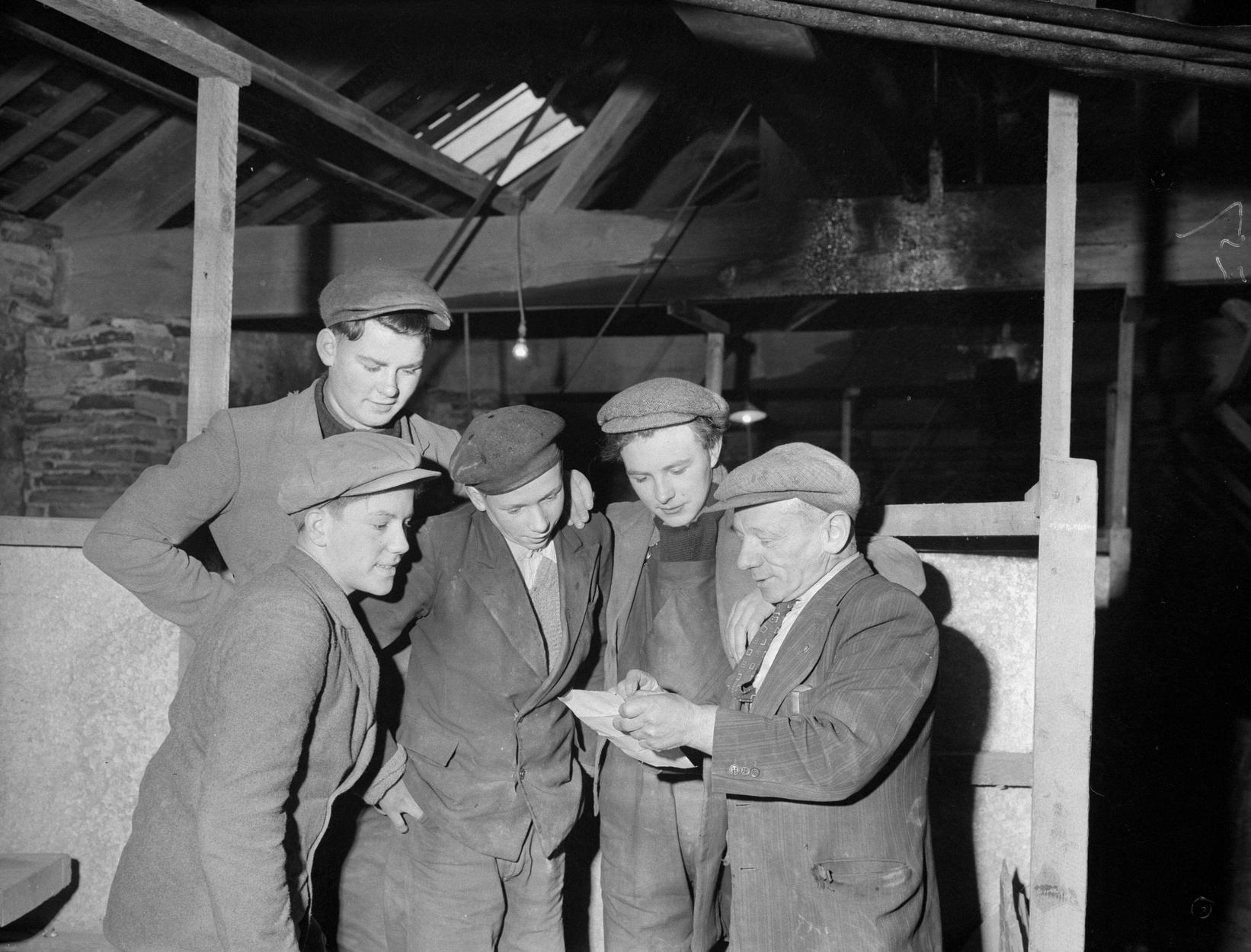
- (observational) Four new apprentices at Oakley Quarry, Blaenau Ffestiniog (1959) — National Library of Wales / Wikimedia Commons (Geoff Charles)
.jpg)
Record created: 30 August 2026 · Last researched: 30 August 2026