 MineArchive
Nyth-y-Gigfran Quarry
| Location | above Glan y Pwll, south of Blaenau Ffestiniog, Gwynedd — 52.9966, -3.9535 (exact) |
|---|---|
| Commodity | Slate |
| Type | Slate |
| Worked | Worked from around 1840–1870 |
| Maximum depth | Unknown. |
| Operators | Glan-y-Pwll Slate & Slab Company Ltd (1861–1872) |
Overview
An entirely underground slate quarry on the cliffs above Glan y Pwll, worked from around 1840 and known for its distinctive green 'Olive Vein' slate, closed in 1870 after a legal dispute with the neighbouring Oakeley quarry before being absorbed into Oakeley itself in the 1920s and toured as part of the Gloddfa Ganol tourist attraction decades later.
History
Nyth-y-Gigfran quarry was worked from around 1840 under Thomas James, situated some 300 feet above the settlement of Glan y Pwll on the steep, inaccessible cliffs forming the eastern edge of Allt-fawr, south of Blaenau Ffestiniog. James's early working was sporadic -- getting slate down from so difficult a location was a persistent problem -- and the quarry was abandoned during the 1850s. It was revived in 1861 when the Glan-y-Pwll Slate & Slab Company Ltd was incorporated to work it, with an incline built in 1867 to connect to the Ffestiniog Railway. The quarry worked the Glan y Pwll vein, whose distinctively green slate earned it the alternate name the 'Olive Vein'. Closure came in 1870, after the neighbouring Oakeley quarry won a legal injunction alleging that Nyth-y-Gigfran's workings were encroaching underground on its own ground; the Glan-y-Pwll company was wound up in liquidation in 1872, and the site then lay idle for half a century. Oakeley's own owners eventually acquired the quarry, inspecting it in 1922 and reporting 'the prospect of a considerable quarry being opened out there'; by 1924 a tunnel had been driven to connect Nyth-y-Gigfran underground with the main Oakeley workings, resuming extraction after the fifty-year hiatus and helping make the combined Oakeley complex the largest underground slate mine in the world. Nyth-y-Gigfran's own workings continued as part of Oakeley until the parent quarry's 1969 closure, and, from 1974 to 1997, its old chambers were shown to the public as part of the underground tour route of the Gloddfa Ganol tourist attraction (see the separate Gloddfa Ganol Quarry record).
Geology
The Olive Vein, a distinctively green slate, worked entirely underground in the cliffs above Glan y Pwll.
Workings
Entirely underground, worked from open pits on the south side of Allt-fawr via multiple chambers and adits, including a roughly 500-yard trial adit driven westward; slate descended a single-pitch incline around 100 feet below adit level to a platform where it was transferred from wooden sledways to wagons.
Closure
Closed in 1870 after Oakeley's successful injunction over underground encroachment; the operating company was liquidated in 1872. Revived as part of Oakeley from 1924 and worked until Oakeley's own 1969 closure.
What remains
Survives as part of the wider, disused Oakeley complex; its workings were shown to the public as part of the Gloddfa Ganol tourist attraction's underground tour between 1974 and 1997.
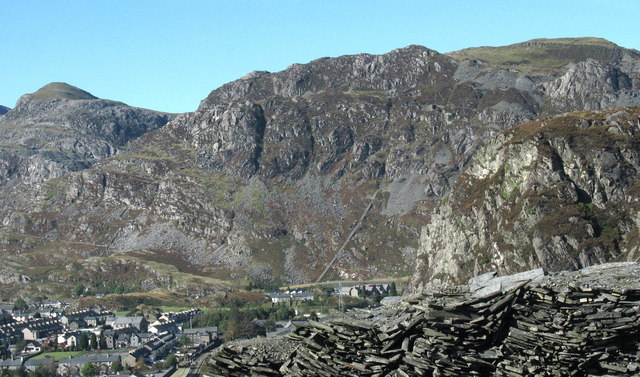
A dramatic incline and associated quarry infrastructure survive on the cliffs above Glan y Pwll.
Related mines
- Gloddfa Ganol Quarry — Nyth-y-Gigfran's workings were absorbed into the wider Oakeley complex in the 1920s and shown to visitors on Gloddfa Ganol's own tour route.
- Oakeley Quarry — Nyth-y-Gigfran closed in 1870 after Oakeley won a legal injunction over encroaching workings, and was later absorbed into Oakeley itself in the 1920s.
Nearby mines
- Gloddfa Ganol Quarry — 0.5 miles (0.8 km) NE
- Oakeley Quarry — 0.5 miles (0.8 km) NE
- Cwmorthin Slate Mine — 0.6 miles (1.0 km) W
- Palmerston Quarry — 0.7 miles (1.1 km) N
- Llechwedd Slate Caverns — 0.8 miles (1.3 km) NE
Straight-line distance, within 9 miles (15 km). Show on the map.
Recorded claims
Individual factual claims, each attached to the source(s) that support it below. Where sources disagree, both are kept.
- Nyth-y-Gigfran worked the Glan y Pwll vein, whose distinctively green-coloured slate earned it the alternate name the 'Olive Vein'. 1
- The quarry closed in 1870 after the neighbouring Oakeley quarry won a legal injunction alleging underground encroachment; the operating company was wound up in liquidation in 1872, and the site then lay idle for around fifty years. 1
- Oakeley's owners inspected the site in 1922, and by 1924 a connecting tunnel had been driven underground, resuming extraction and helping make the combined Oakeley complex the largest underground slate mine in the world. 1
- Between 1974 and 1997, Nyth-y-Gigfran's old workings were shown to the public as part of the underground tour route of the Gloddfa Ganol tourist attraction. 1
- Located at about 52.997 N, 3.953 W. 1
Sources
- (secondary) Nyth-y-Gigfran quarry — Wikipedia
- (observational) The dramatic incline from Nyth y Gigfran Quarry — Geograph Britain and Ireland (Eric Jones)

Record created: 30 August 2026 · Last researched: 30 August 2026