 MineArchive
Moel Faban Quarry
| Also known as | Moel Faban Slate Quarries, Moel Faban Green Slate Quarry |
|---|---|
| Location | Lower slopes of Moel Faban, close to Rachub, above Bethesda, Gwynedd — 53.1901, -4.0582 (exact) |
| Commodity | Slate |
| Type | Slate |
| Worked | Mid-19th century–before 1914 |
| Maximum depth | Unknown. |
Overview
A group of small slate workings on Moel Faban above Rachub, opened in the mid-19th century and reopened in 1903 by the Bethesda Co-operative Quarries to employ men locked out during the Penrhyn Great Strike.
History
The Moel Faban quarries are a series of small slate workings on the lower slopes of Moel Faban close to Rachub, above Bethesda, spread over about 400 m by 300 m. They opened in the mid-19th century and produced speciality slate. The main working ran through adits on three levels, linked by an incline, with little chambering; red rock was worked first and green came later from the tunnels. Material was first lowered by a second incline, perhaps to a small mill, and carted out through Rachub; later a tramway may have joined the Tan-y-bwlch quarry mill. J. J. Evans reported on the quarry in 1887.
Moel Faban became a hope of the Penrhyn Great Strike. In December 1902 the Crown granted a 69-year lease of 280 acres to a company proposing to work the rich slate beds on co-operative lines, and men still locked out of the Penrhyn quarry looked to it for work; the ground had been partly opened by Evan D. Jones of Carneddi. The strikers' London committee sent an expert to report on it early in 1903, and John Menzies of Caernarfon reported the same year. North Wales Quarries Ltd, funded largely by the North Wales Quarrymen's Union, bought Moel Faban with Pantdreiniog and Tan-y-bwlch as the Bethesda Co-operative Quarries, and in late October 1903 the first men started work there. In 1904 the ground on Moel Faban was being opened up busily, and in 1906 the society proposed mortgage bonds to develop it faster, depositing its lease with Lloyds Bank. The quarry is said to have closed before 1914, though maps suggest some work into the mid-20th century, and a Moel Faban Green Slate Quarry was offered for sale in 1923.
Geology
Red slate worked first, then green slate from the tunnels.
Workings
Small open workings and a principal working through adits on three levels linked by an incline, with little chambering.
Closure
Reputedly closed in the early 1900s, before 1914; map evidence suggests some later small-scale work.
What remains
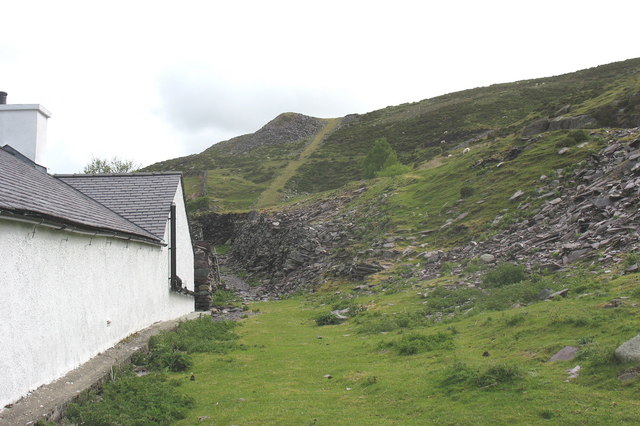
Traces of adits and buildings, the upper incline formation and a row of cottages remain (in 1991).
Adit mouths, building traces, incline and tramway formations, and a row of cottages.
Redevelopment
Open hillside.
Related mines
- Pantdreiniog Quarry — Worked together as the Bethesda Co-operative Quarries from 1903.
Nearby mines
- Pantdreiniog Quarry — 0.5 miles (0.8 km) S
- Coetmor Quarry — 0.6 miles (1.0 km) SW
- Bryn Hafod-y-Wern Quarry — 0.9 miles (1.5 km) N
- Penrhyn Quarry — 1.6 miles (2.6 km) S
- Marchlyn Quarry — 3.5 miles (5.7 km) SW
Straight-line distance, within 9 miles (15 km). Show on the map.
What's uncertain
Points where sources disagree or the record could not be settled; both accounts are kept. All open questions in the archive.
Recorded claims
Individual factual claims, each attached to the source(s) that support it below. Where sources disagree, both are kept.
- The principal Moel Faban working ran through adits on three levels with an incline connection, red rock being quarried first and then green from the tunnels. 1
- In December 1902 the Crown granted a 69-year lease of 280 acres at Moel Faban to a company proposing to work the slate on co-operative principles. 2
- North Wales Quarries Ltd, funded mainly by the North Wales Quarrymen's Union, bought Pantdreiniog together with Moel Faban and Tanybwlch quarries in 1903 as the Bethesda Co-operative Quarries. 3,4
- Moel Faban was operated cooperatively during the Penrhyn stoppage of 1900-03. 1,5
- In late October 1903 a number of men began work at the new Moel Faban quarry. 6
- Reports on the Moel Faban slate quarry were made by J. J. Evans in 1887 and John Menzies in 1903, and its lease was deposited with Lloyds Bank in 1906. 7,8
- In 1906 the co-operative society proposed £30,000 of mortgage bonds for the more rapid development of the Moel Faban quarry. 9,10
- The Moel Faban quarry closed before 1914. (uncertain) 1,5
Sources
- (secondary) Moel Faban Slate Quarries (NPRN 420102) — Coflein (RCAHMW)
- (primary) Carnarvon and Denbigh Herald, 12 December 1902: The Penrhyn strife: the quarry at Moel Faban — Carnarvon and Denbigh Herald (Welsh Newspapers Online, National Library of Wales)
- (secondary) Pantdreiniog quarry — Wikipedia
- (primary) Rhyl Record and Advertiser, 10 October 1903: North Wales Co-operative Quarries — Rhyl Record and Advertiser (Welsh Newspapers Online, National Library of Wales)
- (observational) Old incline and tramway formations behind Tyn-y-mynydd (Geograph 431366) — Geograph Britain and Ireland
- (primary) Y Negesydd, 29 October 1903: Chwarel Moel Faban — Y Negesydd (Welsh Newspapers Online, National Library of Wales)
- (primary) NLW MS 8771E, Miscellanea (W. J. Parry papers) — National Library of Wales archives catalogue
- (primary) The North Wales Express, 23 January 1903: [No title] — The North Wales Express (Welsh Newspapers Online, National Library of Wales)
- (primary) Yr Herald Cymraeg, 2 August 1904: Pant Dreiniog a Moel Faban: y safle bresennol — Yr Herald Cymraeg (Welsh Newspapers Online, National Library of Wales)
- (primary) Llandudno Advertiser, 24 February 1906: Co-operative quarrying — Llandudno Advertiser (Welsh Newspapers Online, National Library of Wales)
Record created: 20 October 2026 · Last researched: 20 October 2026