 MineArchive
Glynrhonwy Quarry
| Location | Llanberis, Gwynedd — 53.1269, -4.1386 (exact) |
|---|---|
| Commodity | Slate |
| Type | Slate |
| Worked | early 1700s (Lower Glynrhonwy)–25 January 1930 |
| Maximum depth | Unknown. |
Overview
Two adjacent former slate quarries near Llanberis, worked from as early as the 1700s until 1930, afterward converted by the Air Ministry into an underground Second World War bomb store that partially collapsed in 1942 while burying 14% of the RAF's total bomb stock -- without a single fatality.
History
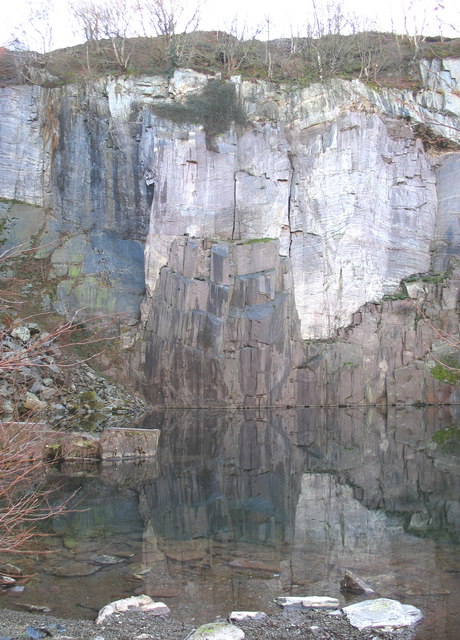
Lower Glynrhonwy, known locally as Captain Taylor's Quarry, was worked for slate from as early as the 1700s, while the adjacent Upper Glynrhonwy quarry ('Glyn Ganol') opened in 1861; both used 2-foot-gauge internal railways connecting to the London and North Western Railway's Caernarfon-to-Llanberis branch. Slate working at both sites ended on 25 January 1930. On 18 August 1939 the Air Ministry sought approval to acquire the disused Lower Glynrhonwy workings, judged suitable for storing 18,000 tons of bombs, and converted the eastern pit into a two-level underground depot using the same design as an earlier RAF store at Harpur Hill in Derbyshire: some 40 feet of broken slate overhead for protection, standard and narrow-gauge railways serving the lower level, and electric lifts raising bombs to the upper floor. On 25 January 1942, roughly two-thirds of the structure collapsed within seconds under the weight of its own backfill, completely engulfing a 27-wagon train that was in the process of unloading and burying more than 14,000 tons of bombs -- around 14% of the RAF's total bomb stock at that date. A court of inquiry found faulty design was the principal cause; cracks noticed as the structure neared completion had been dismissed as minor, and wartime Treasury pressure to cut costs and speed construction was a contributing factor. Remarkably, no casualties were recorded despite the scale of the collapse. Most of the buried bombs were recovered, though the collapsed section was afterward used only for open storage of incendiaries, and no further ammunition was ever stored underground at Llanberis. Seized German chemical-weapon shells were briefly held at the site after the war before being moved on to RAF Llanwrog. The Air Ministry retained the site until 1961, and from 1969 to 1975 RAF personnel systematically cleared 352 tons of remaining explosive debris from the workings.
Geology
Slate of the Llanberis belt, worked in two adjacent quarries above the village.
Workings
Slate was worked from deep open pits linked by tunnels; the wartime conversion added a reinforced concrete lower-level ceiling doubling as an arch-roofed upper floor, with narrow- and standard-gauge railways and electric lifts moving bombs between levels.
Closure
Slate working ended in 1930; the site's later military use ended when the Air Ministry gave it up in 1961.
What remains
The surviving underground sections were grilled and gated to prevent entry by 2003. A 100 MW pumped-storage hydroelectric scheme, marketed as a 'quarry battery', reached detailed engineering design by 2019, proposing to reuse the flooded former workings.
Flooded pits, tunnels and adits from the slate-working era, together with the surviving, now-sealed sections of the wartime bomb store.
Nearby mines
- Vivian Quarry — 1.0 miles (1.7 km) E
- Dinorwig Slate Quarry — 1.7 miles (2.7 km) E
- Marchlyn Quarry — 2.2 miles (3.5 km) NE
- Penrhyn Quarry — 4.1 miles (6.5 km) NE
- Alexandra Quarry — 4.4 miles (7.1 km) SW
Straight-line distance, within 9 miles (15 km). Show on the map.
Recorded claims
Individual factual claims, each attached to the source(s) that support it below. Where sources disagree, both are kept.
- On 25 January 1942, around two-thirds of the underground bomb store's structure collapsed within seconds, burying a 27-wagon train and more than 14,000 tons of bombs -- about 14% of the RAF's entire bomb stock at the time -- with no recorded casualties. 1,2
- A court of inquiry found faulty design was the principal cause of the collapse; cracks had appeared during construction and been wrongly dismissed as minor defects. 2
- The Air Ministry occupied the site until 1961; captured German chemical-weapon shells were held there briefly after the war before being moved to RAF Llanwrog, and RAF personnel cleared 352 tons of remaining explosives from the site between 1969 and 1975. 1,2
Photographs & further reading
A detailed account of the wartime bomb store conversion, the 1942 collapse and its aftermath.
View sourceSources
- (secondary) Glynrhonwy quarries — Wikipedia
- (secondary) Llanberis Bomb Store — Subterranea Britannica
- (observational) A bit of sunshine can change this dark pool into a thing of beauty — Geograph Britain and Ireland (Eric Jones)

Record created: 30 August 2026 · Last researched: 30 August 2026