 MineArchive
Alexandra Quarry
| Location | Moel Tryfan, Nantlle Valley, Gwynedd — 53.0830, -4.2160 (approximate) |
|---|---|
| Commodity | Slate |
| Type | Slate |
| Worked | Lease obtained 1861; Alexandra Slate Company Ltd formed 1863–Closed 1914 (WWI); worked on reduced scale to 1939 |
| Maximum depth | Deep adit reached slate at 410 yards |
| Operators | Alexandra Slate Company Ltd (1863–1914) |
Overview
A remote Nantlle Valley slate quarry on Moel Tryfan, named for the Princess of Wales and kept alive through the 1860s and 70s only by one investor's personal fortune, that only became truly viable once a branch of the North Wales Narrow Gauge Railways finally reached it in 1877 — and which later pioneered hydro-electric power in the Welsh slate industry before repeated rockfalls forced its closure.
History
Local slate on Moel Tryfan, in the bleak upland bog the Welsh called Cors y Bryniau, had attracted failed prospecting attempts as early as 1824, and small-scale trial workings by quarrymen from neighbouring pits through the 1820s and 1850s, before William W. Griffith, works manager of the Moelwyn quarry, finally secured a 92-acre lease in 1861. The Alexandra Slate Company Ltd was formed in 1863 with £40,000 of capital, taking its name from Princess Alexandra of Denmark, who had recently married the Prince of Wales — Griffith himself received £500 in cash and £9,500 in shares for bringing the lease to the company. Locating workable slate proved difficult and expensive: a deep adit designed by the engineer Charles Easton Spooner, begun in 1869 specifically to intercept the productive veins, eventually cost £33,000 to drive — £19,000 of it found personally by the shareholder Samuel Bateson — before finally striking good slate at a depth of 410 yards. A reconstituted second Alexandra Slate Company Ltd, formed in 1874 under Bateson's family, produced 891 tons in its first full year, and Bateson again dug into his own pocket, both investing a further £15,000 and subsidising the near-bankrupt North Wales Narrow Gauge Railways to keep the quarry's only practical transport link alive. That transport link finally paid off in 1877, when a winding two-mile railway connected the quarry to the Bryngwyn Drumhead, at the top of an incline shared with three neighbouring quarries, from where slate descended to Bryngwyn station for onward carriage to the main line at Dinas. With reliable transport at last in place, the quarry grew rapidly: employment reached 230 men by 1886 and peaked at 257 in 1896, and the works modernised steadily — a steam-powered mill with twenty saw tables went up in 1887-88, steam winders followed in 1888, a water-balanced shaft was working by 1893, and two Blondin aerial cableways were installed in 1901 with more added in 1909. In 1913 Alexandra went further still, replacing its steam engines with 500-volt three-phase electric motors powered from the newly built Cwm Dyli hydro-electric station — among the earliest adoptions of hydro-electric power anywhere in the Welsh slate industry. The quarry's workforce was covered by a sick club shared with eight other Nantlle Valley quarries, but the work remained dangerous: eight men were killed at Alexandra between 1895 and 1913, likely from unstable quarry faces, and in 1907 a locomotive boiler explosion on the quarry's own tramway killed one passenger and severely scalded the driver, leading to £50 fines for both the quarry's agent and the company itself. The quarry closed on the outbreak of the First World War, on 15 August 1914, and a liquidator was appointed in 1916, though the plant was never dismantled; instead, its shares passed in 1918 to the newly formed Amalgamated Slate Association Ltd, which combined Alexandra with the neighbouring Moel Tryfan, Cilgwyn and long-defunct Braich quarries into one of Caernarfonshire's three major slate concerns. Alexandra weathered the 1921 coal strike better than most rivals, thanks to its electricity supply, but major rock collapses in October 1926 and again through 1928-30 forced repeated closures, and by the end of 1930 persistent face instability shut the quarry down — leaving unemployment in the nearby village of Rhosgadfan at close to 100 per cent. A rescue scheme devised by Major Owen MP and Owen W. Owen, backed by government funding of £15,000-£18,500 to strip overburden and channelled through the newly formed Caernarvonshire Crown Slate Quarries Company, gradually revived operations from 1934-35 with around 140 men producing some 3,000 tons a year — but electric power, and the more usable of Alexandra's own plant, was relocated to Moel Tryfan in 1935, and once the Welsh Highland Railway itself closed in 1936, Alexandra's own working continued only at reduced scale, latterly reworking old tips and cutting granite for the county council, into the early years of the Second World War.
Geology
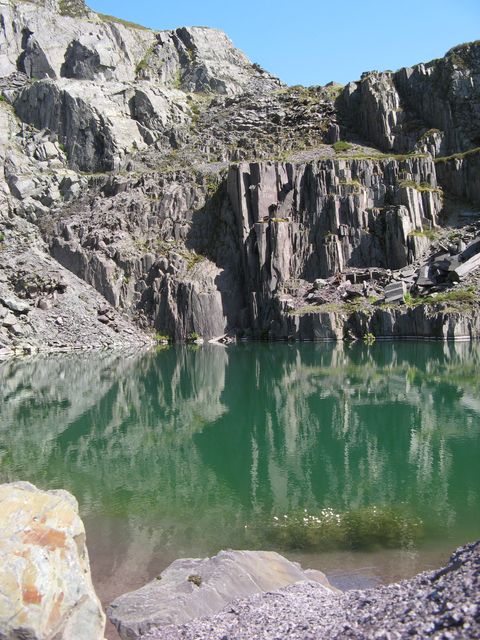
Alexandra worked Cambrian slate veins on the flank of Moel Tryfan, part of the same productive belt exploited across the wider Nantlle Valley slate district; a photograph of the flooded modern workings shows the sharp contrast between the even, fine cleavage of the productive slate beds and the rough, unproductive sandstone outcrops immediately alongside them, illustrating just how narrowly the workable veins were confined within the wider rock sequence.
Workings
A substantial open-pit quarry worked via a deep adit driven specifically to intercept the productive slate at 410 yards, developed with a steam-powered sawing mill, steam and later electric winders, a water-balanced shaft and, from 1901, Blondin aerial cableways for moving blocks; slate was carried out via an internal locomotive-worked tramroad connecting to a two-mile railway reaching the Bryngwyn Drumhead from 1877.
Closure
The quarry closed on the outbreak of the First World War in August 1914; its assets passed into the Amalgamated Slate Association in 1918, and after further closures caused by major rock collapses in 1926 and 1928-30, a government-backed rescue scheme revived limited working from 1934-35, continuing at reduced scale into the early years of the Second World War.
What remains
The old workings are now flooded, forming a quarry pool where water crowfoot and small fish have established themselves; slate tips, tramway remains and the ruined drumhouse at the top of the Moel Tryfan incline survive across the wider site.
A flooded quarry pool, spoil tips, tramway trackbed and the ruined incline drumhouse survive on the Moel Tryfan hillside; part of the old Bryngwyn Branch trackbed has been converted to a public footpath.
Related mines
- Cilgwyn Quarry — Both passed into the Amalgamated Slate Association in the 1918 amalgamation that combined Alexandra with Cilgwyn and other Nantlle Valley quarries.
- Moel Tryfan Quarry — Both passed into the Amalgamated Slate Association in the 1918 amalgamation that combined Alexandra with Moel Tryfan and other Nantlle Valley quarries.
Nearby mines
- Moel Tryfan Quarry — 0.6 km SW
- Pen-yr-Orsedd Quarry — 2.6 km S
- Cilgwyn Quarry — 3.4 km SW
- Dorothea Quarry — 3.4 km SW
- Coedmadoc Quarry — 4.8 km W
Straight-line distance, within 15 km. Show on the map.
The flooded workings are deep and the quarry faces remain unstable — this entry describes history and general location only, not an access guide.
What's uncertain
Points where sources disagree or the record could not be settled; both accounts are kept. All open questions in the archive.
- Eight men were killed at the quarry between 1895 and 1913; in 1907 a locomotive boiler explosion on the quarry tramway killed one passenger and severely scalded the driver, resulting in £50 fines for both the agent and the company. (uncertain) 1
Recorded claims
Individual factual claims, each attached to the source(s) that support it below. Where sources disagree, both are kept.
- William W. Griffith secured a 92-acre lease in 1861; the Alexandra Slate Company Ltd (1863) and its 1874 successor spent £33,000 on a deep adit designed by Charles Easton Spooner, largely funded personally by shareholder Samuel Bateson, before striking workable slate at 410 yards. 1
- A two-mile railway connected the quarry to the Bryngwyn Drumhead from 1877, part of the North Wales Narrow Gauge Railways' Bryngwyn branch, which also served the neighbouring Moel Tryfan, Fron and Braich quarries. 1,2
- Employment peaked at 257 men in 1896; in 1913 the quarry replaced its steam engines with 500-volt three-phase electric motors powered from the Cwm Dyli hydro-electric station, among the earliest such installations in the Welsh slate industry. 1
- Eight men were killed at the quarry between 1895 and 1913; in 1907 a locomotive boiler explosion on the quarry tramway killed one passenger and severely scalded the driver, resulting in £50 fines for both the agent and the company. (uncertain) 1
- The quarry's assets passed to the Amalgamated Slate Association in 1918, combining it with Moel Tryfan, Cilgwyn and Braich; major rock collapses in October 1926 and 1928-30 forced repeated closures, with the quarry shut by the end of 1930 before a government-backed rescue scheme revived limited working from 1934-35. 1
Photographs & further reading
Festipedia article on the North Wales Narrow Gauge Railway branch serving the quarry.
View sourceSources
- (secondary) Alexandra quarry — Wikipedia
- (secondary) Bryngwyn Branch — Festipedia (Ffestiniog Railway heritage wiki)
Record created: 27 August 2026 · Last researched: 27 August 2026