 MineArchive
Captain
| Dialect | Cornish |
|---|---|
| Category | Labour & Roles |
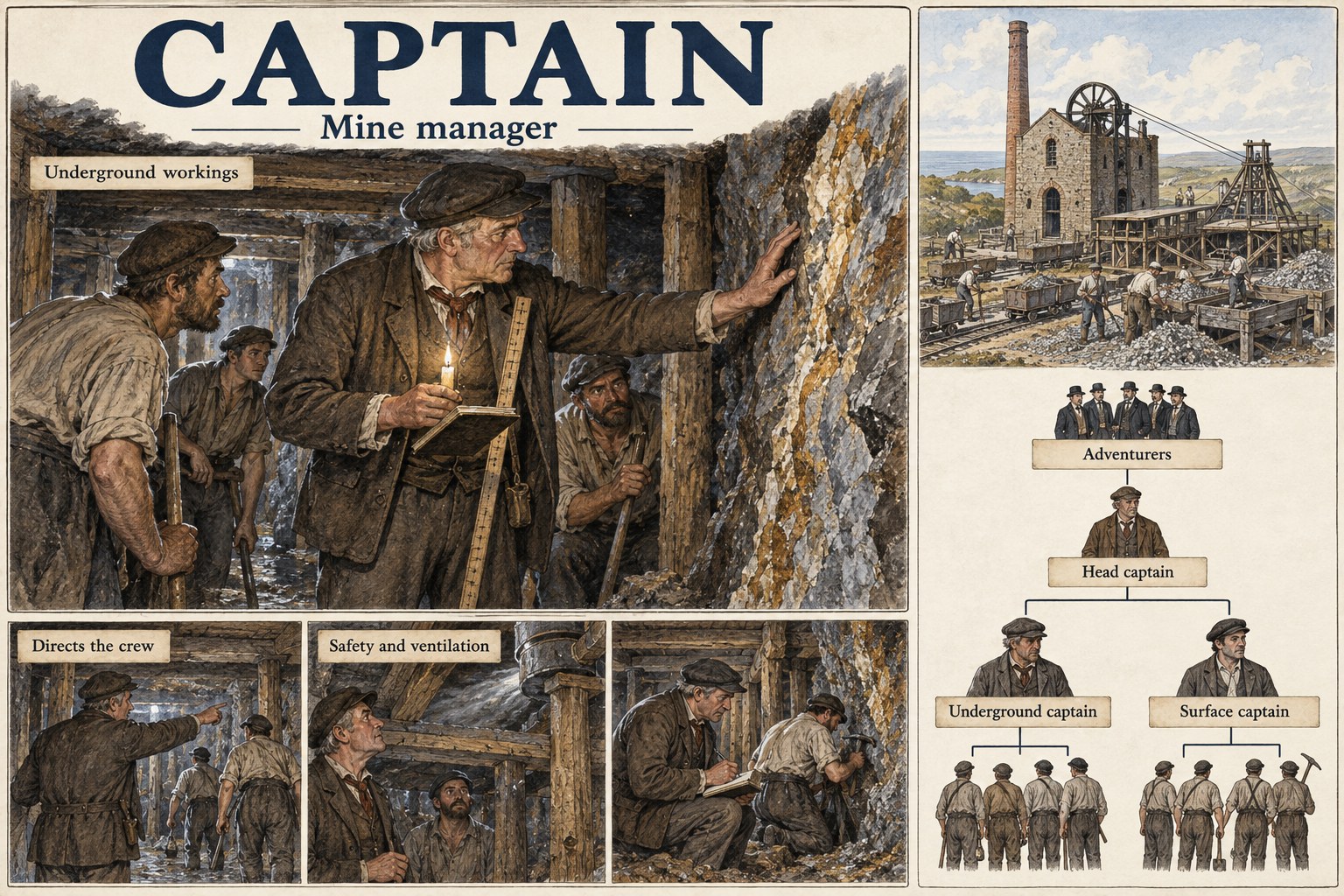
A senior mine official responsible for supervising and directing work at a Cornish mine — the standard job title for a mine manager or department head, not a military or naval rank.
Historical usage
Cornish mines were typically run by several captains with distinct responsibilities: an underground captain overseeing work below surface, a surface captain overseeing the dressing floors and surface plant, and a head captain acting as overall manager, answering to the mine's shareholders (the 'adventurers'). Cornwall's long history of hard-rock mining made its captains genuinely expert, and Cornish captains and their crews were recruited to manage mines across the world, from South Africa to the American West, as the Cornish mining industry itself declined at home.
How it worked
A captain directed a 'crew' of miners, agreeing work and setting pay under the tribute and tutwork systems (see this site's own term page), overseeing safety, ventilation and the practical day-to-day running of the section of the mine in their charge.
Why it was used
A good captain's judgement genuinely determined a mine's fortunes: at Dolcoath, mine captain Charles Thomas convinced the mine's adventurers in 1832 to keep working despite failing copper grades, on the belief that good tin would be found at greater depth — a gamble vindicated when the first tin dividend was paid in 1853, going on to make Dolcoath the largest, deepest and most productive mine in Cornwall.
Risks & limitations
A captain's authority rested on judgement rather than on any formal qualification, and that cut both ways. He set the bargains under the tribute and tutwork systems, which put him on the opposite side of a monthly negotiation from the men he also had to lead, and he was the person answerable at an inquest for a working place he had approved. The same absence of certification that let an able miner rise to captain also meant there was no external standard to appeal to when a mine's fortunes turned: the adventurers who paid him could stop paying him. And the expertise itself was a commodity that left with its owner — the Cornish captains recruited to run mines in South Africa, Australia and the American West took the skill out of Cornwall at exactly the point its own mines most needed it.
Regional variation
The title and its underground/surface/head divisions were specifically Cornish conventions, though Cornish captains carried the same job title and practice with them wherever they went to manage mines overseas. The World Heritage Site's own glossary indexes the role under agents rather than captains, defining agents simply as the managers of a mine — a reminder that captain was the spoken Cornish title for a job the written record often gives another name to. The purser was a separate office and not a captain's: the treasurer and secretary who kept the accounts and paid the workers.
Operator record
Captain Thomas Glanville — Glanville is recorded as captain of Wheal Union in 1864 — the working title this term describes, for the man in day-to-day charge underground.
Related terminology
Mine Dry, Miners' Barracks, Overman, Tribute and Tutwork
Mines associated with this term
5 examples chosen from 31 linked records — the term page is not an index.
- Flockton Collieries — West Yorkshire (well documented example)
Named in this record’s history: “…came to nothing. Emroyd was nearly worked out by the 1880s. Captain Stansfield died early in 1893; later that year the men joined the…” - Glenbuck Colliery — East Ayrshire (well documented example)
Named in this record’s history: “…older brothers all played for the Cherrypickers before he went on to captain Scotland and build Liverpool into a dominant force as manager. A…” - Meliden Lead Mines — Denbighshire (well documented example)
Named in this record’s history: “…were laid off in 1905; an attempt to refinance the mine in 1903 by Captain Matthew Francis came to nothing.” - Boscean Mine — Cornwall (well documented example)
Named in this record’s history: “…£4,920 of capital, its purser Samuel York of Penzance and its captains John Carthew, Richard Berryman and James Trezise; the mine had…” - Bradda Head Mines — Isle of Man (well documented example)
The mine captain's house at South Bradda survives low on the rock face, alongside the pump house, still visible from the sea.
Disasters associated with this term
5 examples chosen from 9 linked records, most direct relationship first.
- Drakewalls Mine Entombment and Rescue, 1889 (contextual relationship)
Named in this record’s narrative: “…contact. Renewed efforts were led by Moses Bawden, the purser, Captain Richards, the agent, and the inspector; at 9 p.m. a small hole was…” - East and North Wheal Rose Flooding Disaster (contextual relationship)
It was mine captain Middleton who gave the clearest account of how fast it happened — in less than five minutes, he testified, water was coming off the hills in torrents and into the shafts. - Mawstone Mine Disaster (contextual relationship)
Named in this record’s narrative: “…was converted into a temporary mortuary for the eight dead: mine captain Poultney Poulter and his 27-year-old son James, Kenneth Seville,…” - Minnie Pit Explosion, 1918 (contextual relationship)
Named twice in this record, first in the summary: “…the old Bullhurst Rearers shaft at Miles Green. Hugh Doorbar, captain of the Birchenwood rescue brigade, died two days later in breathing…” - Portland Colliery Nursery Pit explosion, 1900 (contextual relationship)
Named in this record’s rescue and recovery: “…manager, Mr Gilmour, was in Kilmarnock at the time and came at once; Captain Hill of the burgh police kept order among crowds of several hundred…”
Sources
- (primary) Definition of mine captain — Mindat
- (secondary) A Cornish mining glossary — Cornish Mining World Heritage Site (UNESCO)
- (secondary) Charles Thomas (mine agent) — Wikipedia
- (secondary) Some Cornish Mining Terms — navsbooks
Record created: 21 August 2026 · Last researched: 11 September 2026