 MineArchive
East and North Wheal Rose Flooding Disaster
A sudden, violent thunderstorm flooded East Wheal Rose and the neighbouring North Wheal Rose within minutes on 9 July 1846, drowning 39 miners in the deadliest single mining disaster in Cornwall's history.
| Date | 9 July 1846 |
|---|---|
| Mine | East Wheal Rose |
| Region | Cornwall |
| Primary type | Flooding / Inundation |
| Associated types | Entrapment |
| Fatalities | 39 (38 died at East Wheal Rose itself; a 39th, Frederick Sanders, died at the neighbouring North Wheal Rose while attempting to escape the same floodwaters.) |
| Context | During active mining |
Cause
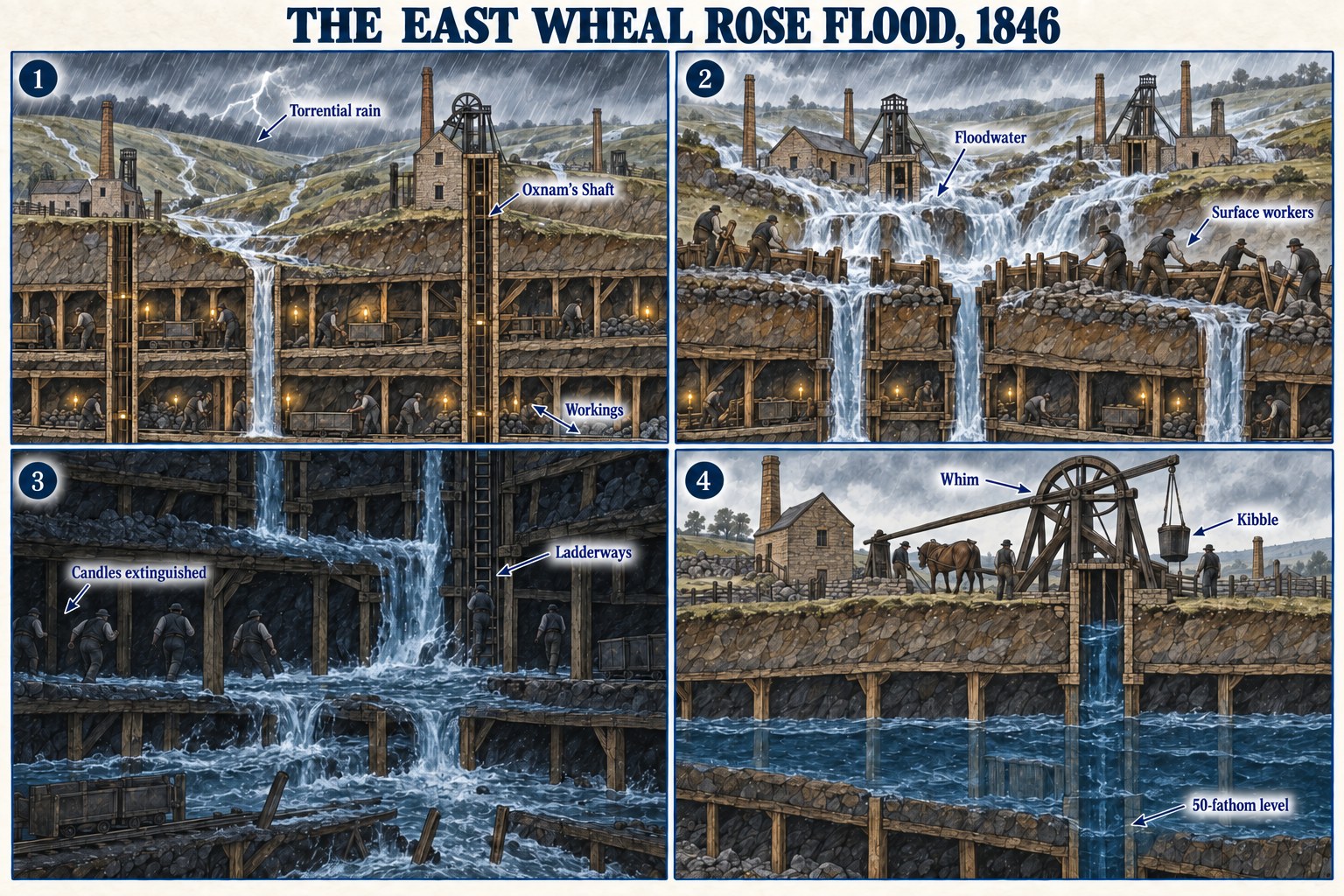
A severe thunderstorm broke over the district shortly after 1pm on 9 July 1846. Mine captain Middleton later testified that 'in less than five minutes the water was descending over the hills in torrents' — floodwater poured off the surrounding hillsides in broad, deep waves and into the mine's shafts, entering first through Oxnam's Shaft and then through others in rapid succession, and flooding the workings to the 50-fathom level with extraordinary speed.
Contributing factors
Around 200 miners were underground at the time, and the sheer speed of the flood gave many little or no warning; rushing water extinguished candles throughout the workings, plunging miners into darkness as they tried to find their way to the surface.
What happened
Surface workers attempted to dam or divert the floodwater away from the shafts as the storm broke, but were quickly overwhelmed. Underground, miners scrambled for any way out: some escaped by climbing the mine's ladderways, others by riding a kibble hauled up on whim machines at the surface. At Gower's Shaft one man lost his grip on the chains he was climbing and fell to his death. Of an estimated 200 miners underground when the flood struck, more than 150 escaped; 38 died at East Wheal Rose and a 39th, Frederick Sanders, died at neighbouring North Wheal Rose.
Rescue & recovery
Recovery operations began the following (Friday) morning, with bodies brought up from as deep as the 50-fathom level over the following days — among them Isaac Bartle, found in the 50-fathom level. The dead ranged from boys of fifteen to seventeen through to married men with children of their own, among them William Pearce, aged sixteen, and his father Francis, who died together.
Investigation & inquiry
An inquest was held in the days following the disaster. The coroner directed the jury toward a verdict of accidental death, stressing that 'every means were used to prevent the water' from entering the workings — testimony consistent with the sheer speed of the flood rather than any evident failure to act. The jury returned that verdict without recorded dissent.
Memorials & commemoration
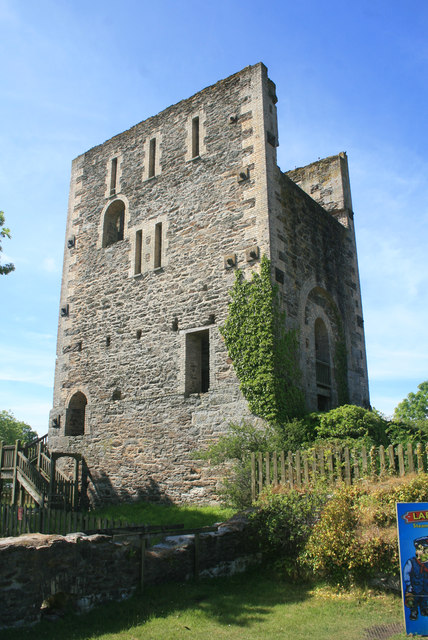
The 39 victims were buried across sixteen parishes throughout Cornwall; only a handful of their gravestones have been positively identified today. On 9 July 2021, on the 175th anniversary of the disaster, a memorial plaque was unveiled at the site. A larger commemorative slate sculpture, 'Hold on to Hope' by Ben Dearnley, was unveiled on 10 March 2023 beside the Engine House North Shaft — carved with the inscription 'Though waters rise, Hold onto Hope, He will not leave you', and dedicated to the more than 150 miners who survived as much as to the 39 who did not.
Recorded claims
Individual factual claims, each attached to the source(s) that support it below. Where sources disagree, both are kept.
- 39 miners died: 38 at East Wheal Rose and a 39th, Frederick Sanders, at neighbouring North Wheal Rose while attempting to escape the same floodwaters. 1,2,3
- The disaster left 22 widows and 60 fatherless children; victims were buried across sixteen parishes throughout Cornwall. 3
Related terminology
Mining terms this disaster is structurally linked to, with the nature of the relationship.
- Captain (contextual relationship)
It was mine captain Middleton who gave the clearest account of how fast it happened — in less than five minutes, he testified, water was coming off the hills in torrents and into the shafts. - Fathom (contextual relationship)
Linked on an exact-phrase match in this record's own text. - Kibble (relevant method/equipment)
The disaster's own recorded narrative explicitly describes miners escaping by riding a kibble hauled up on the surface whim machines. - Wheal (contextual relationship)
Named 4 times in this record, first in the summary: “A sudden, violent thunderstorm flooded East Wheal Rose and the neighbouring North Wheal Rose within minutes on 9 July…” - Winze (contextual relationship)
Named in this record’s memorials: “…House North Shaft — carved with the inscription 'Though waters rise, Hold onto Hope, He will not leave you', and dedicated to the more…”
Sources
- (secondary) East Wheal Rose — Wikipedia
- (primary) East Wheal Rose Flooding - Newlyn - 1846 — Northern Mine Research Society
- (secondary) East Wheal Rose Mining Disaster — Lappa Valley
Record created: 22 August 2026 · Last researched: 22 August 2026