 MineArchive
East Wheal Rose
| Location | St Newlyn East, near Newquay, Cornwall — 50.3620, -5.0410 (exact) |
|---|---|
| Commodities | Lead, Silver, Zinc |
| Type | Metal |
| Worked | 1812 (discovery)–1886 |
| Maximum depth | 150 fathoms (900 feet) |
Overview
East Wheal Rose, in the parish of St Newlyn East, grew within a decade of its 1834 founding into one of Cornwall's largest lead mines — and, on a single afternoon in July 1846, became the site of the worst mining disaster in the county's history, when a flash flood drowned 39 of its workers underground.
History
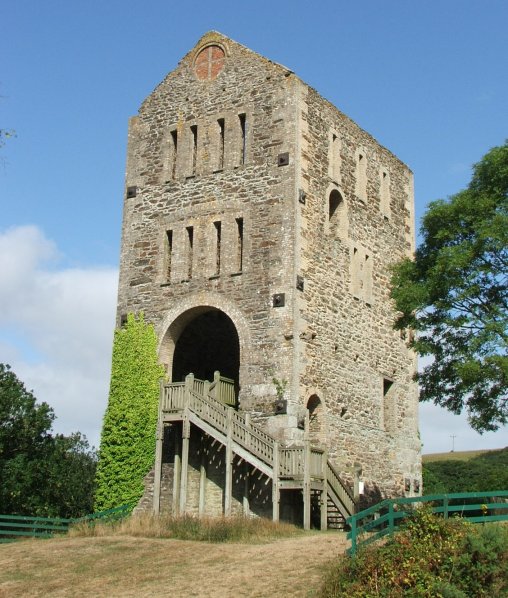
Lead was first identified on the site in 1812, but the mine itself was not formally established until 1834. Growth was rapid: by 1846 East Wheal Rose employed more than 1,200 men, women and children across more than twenty shafts worked on two lodes, reaching a peak in 1845 with 7,883 tons of ore raised containing 4,729 tons of lead. On 9 July 1846 a violent thunderstorm broke over the district, flooding the workings with extraordinary speed and drowning 39 miners — the worst single disaster in Cornish mining history (see Disasters, below). The mine recovered and continued production for another four decades: between 1845 and 1885 it raised 48,200 tons of ore averaging 62% lead, alongside 212,700 ounces of silver and 280 tons of zinc, before finally closing in 1886. A 90-inch Cornish engine — 'Inne's Engine', built by Harvey and Company of Hayle and christened by Lady Innes — began work on 3 June 1882, housed in the engine house that survives today as the largest of its kind in Cornwall; some earlier accounts instead describe a 100-inch engine known as the 'Great Hundred', a discrepancy this record has not been able to resolve.
Geology
The mine worked two lead-bearing lodes within the Cornubian orefield, the same hydrothermal, granite-related mineralisation worked across Cornwall's other major metal-mining districts.
Geological setting: Hydrothermal Deposits (well documented example), Veins and Lodes (well documented example)
Workings
More than twenty shafts were sunk on the mine's two lodes, reaching a maximum depth of 150 fathoms (900 feet); water was raised by the 90-inch Cornish engine 'Inne's Engine', which began work in 1882.
Closure
The mine closed in 1886 after more than four decades of production following its recovery from the 1846 disaster.
What remains
The 1881-82 engine house and its unusually detached 120-foot chimney stack survive intact and are now part of the Lappa Valley Steam Railway heritage attraction.
Related mines
- Tregurtha Downs Mine — The listing of the Tregurtha Downs engine house records it as similar in design to the engine house at East Wheal Rose.
Nearby mines
- West Chiverton Mine — 4.2 miles (6.8 km) SW
- Gravel Hill Mine — 4.7 miles (7.5 km) W
- Wheal Remfry — 5.6 miles (8.9 km) E
- South Terras Mine — 6.3 miles (10.1 km) E
- Cligga Head — 6.4 miles (10.3 km) W
Straight-line distance, within 9 miles (15 km). Show on the map.
Disasters & major incidents
-
East and North Wheal Rose Flooding Disaster
9 July 1846 · Flooding / Inundation · 39 fatalities
A sudden, violent thunderstorm flooded East Wheal Rose and the neighbouring North Wheal Rose within minutes on 9 July 1846, drowning 39 miners in the deadliest single mining disaster in Cornwall's history.
What's uncertain
Points where sources disagree or the record could not be settled; both accounts are kept. All open questions in the archive.
- The Mining Remediation Authority holds abandonment plan OMR77D for silver-lead ore at Wheal Rose. (uncertain) 3
Recorded claims
Individual factual claims, each attached to the source(s) that support it below. Where sources disagree, both are kept.
- By 1846 the mine employed more than 1,200 men, women and children across more than twenty shafts on two lodes; between 1845 and 1885 it raised 48,200 tons of ore averaging 62% lead, alongside 212,700 ounces of silver and 280 tons of zinc. 1
- A 90-inch Cornish engine, 'Inne's Engine', began work in the surviving engine house on 3 June 1882; some other accounts instead describe a 100-inch engine known as the 'Great Hundred', a discrepancy this record has not been able to resolve. 1,2
- After the 90-inch engine from Harvey and Company of Hayle started on 3 June 1882, the clearing of the 900 fathoms of main adit level found several lodes. 1
- The Mining Remediation Authority holds abandonment plan OMR77D for silver-lead ore at Wheal Rose. (uncertain) 3
- Located at about 50.362 N, 5.041 W. 1
Photographs & further reading
The encyclopaedia article on the mine, the 1846 flood and the surviving engine house.
View sourceSources
- (secondary) East Wheal Rose — Wikipedia
- (secondary) East Wheal Rose, St Newlyn East, Cornwall, England, UK — Mindat
- (primary) WHEAL ROSE (Mine Remediation Authority abandonment plan OMR77D, BGS mine plans catalogue) — British Geological Survey / Mining Remediation Authority
- (primary) Wheal Rose mine plans (BGS Mine Plans Catalogue) — British Geological Survey / The Coal Authority
Record created: 22 August 2026 · Last researched: 24 September 2026