 MineArchive
West Chiverton Mine
| Also known as | Ventongimps Mine, Ventongimps Mine |
|---|---|
| Location | Perranzabuloe (near Callestick/Goonhavern), Cornwall — 50.3157, -5.1028 (approximate) |
| Commodities | Lead, Zinc, Copper, Silver |
| Type | Metal |
| Worked | 1846–1886 |
Overview
One of Cornwall's two greatest 19th-century lead mines, West Chiverton produced around 45,800 tons of lead ore and over 1.24 million ounces of silver between 1859 and 1886, paying £157,000 in dividends on a £30,000 purchase price. It began in 1846 as the short-lived Ventongimps Mine before reopening under its better-known name in 1856.
History
The site was first worked from 1846 as Ventongimps Mine, taking its name from the nearby hamlet of Ventongimps in the parish of Perranzabuloe, but closed after only a few years — sources vary on the exact closure year, giving 1848 or 1849. It reopened in 1856 under the name West Chiverton, and grew rapidly into one of the most profitable metal mines in Cornwall during a period when lead mining in the county was otherwise a minor concern next to copper and tin. Northern Mine Research Society's dedicated monograph on the mine (British Mining No. 113) identifies West Chiverton (1863-1876) alongside East Wheal Rose (1840-1851) as "two of the greatest lead mines in the UK, in terms of both output and in dividends paid to shareholders" during the mid-19th century — between 1863 and 1874 the mine paid £157,000 in dividends against a £30,000 purchase price. By 1871 it employed 838 people. Output peaked around 1870, when the mine produced 3,582 tons of lead containing an estimated 160,000 ounces of silver in that year alone; Cornwall Calling's account of the mine's finances records a steep decline in profitability from the early 1870s as lead prices fell under competition from new producers in Wales, Cumberland and the Isle of Man. Zinc, initially a secondary product, took over as West Chiverton's main output through the 1870s and significantly extended the mine's working life, with the mine becoming, by some accounts, one of Britain's largest zinc producers as lead profitability declined. Underground working ceased in 1882; surface operations, including reworking of ore stockpiles, continued until 1886. The mine's success in the 1860s was well known enough that at least twenty-one other, mostly short-lived, mines in the district adopted 'Chiverton' as part of their own names in the hope of attracting the same investor confidence — among them the nearby, much smaller Great West Chiverton prospecting sett near St Agnes, a genuinely separate site from West Chiverton itself despite the near-identical name. The mine's dumps saw some minor reworking between 1917 and 1922, and its stamps house (used for crushing ore) survived until it was demolished by controlled demolition in 1952.
Geology
Lead, with zinc, copper and a great deal of silver, in the lodes of the Perranzabuloe district — one of Cornwall's two greatest 19th-century lead mines.
Workings
Working was concentrated on three roughly parallel lodes (referred to in different sources as North/Elizabeth, Middle, and South/William's), reached via a group of named shafts including Hawke's, Batter's, Glubb's, Burgess's and Susanna's. Batter's Shaft, the site of the surviving engine house, is recorded by Cornish Mine Images as having reached a depth of 90 fathoms (roughly 165 metres); other reported shaft depths in secondary sources are inconsistent enough between each other that no further exact figures are given here. A small amount of copper — 16 tons at around 6.25% copper content — was also raised between 1847 and 1874, alongside the much larger lead, silver and zinc output.
Closure
Underground working ended in 1882 and surface operations, including processing of existing ore stockpiles, continued until final closure in 1886. A 26-inch engine was sold on from West Chiverton to another mine in 1881 as operations wound down, and the mine's main 80-inch pumping engine went on to further use elsewhere after 1886. Minor reworking of the mine's dumps took place between 1917 and 1922.
What remains
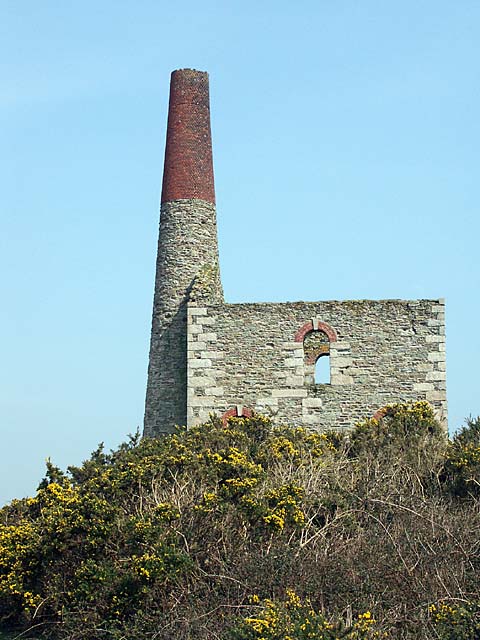
The three-storey engine house at Batter's Shaft survives in good condition and is a well-known local landmark, considered one of the finest surviving Cornish engine houses; it housed an 80-inch cylinder pumping engine built by Harvey's of Hayle and installed in 1869, unusual for having its chimney built into the centre of the back wall rather than a corner, which forced the main cylinder door onto a side wall instead. An adit still discharges water at the site, and extensive tailings and scattered building remains survive across the wider mine site. The former stamps house was demolished by controlled demolition in 1952 and no longer survives. As of a 2026 report, the engine house had recently gained planning permission for conversion into residential housing.
Nearby mines
- Droskyn Mine — 3.0 miles (4.8 km) NW
- Perran St George — 3.0 miles (4.8 km) NW
- Cligga Head — 3.8 miles (6.1 km) NW
- East Wheal Rose — 4.2 miles (6.8 km) NE
- Penhalls Mine — 4.3 miles (6.9 km) W
Straight-line distance, within 9 miles (15 km). Show on the map.
Recorded claims
Individual factual claims, each attached to the source(s) that support it below. Where sources disagree, both are kept.
- The site was first worked from 1846 as Ventongimps Mine, named after the nearby hamlet, and closed after a short period — sources differ on the exact closure year, giving 1848 or 1849 — before reopening under the name West Chiverton in 1856. 1,2
- Between 1859 and 1886 West Chiverton produced around 45,800 tons of lead ore, containing over 33,000 tons of metallic lead, over 1.24 million ounces of silver, 22,676 tons of zinc ore and 15 tons of copper ore. 3
- Several other secondary sources independently cite closely comparable but not identical figures: 45,100 tons of lead, 22,000 tons of zinc, and 1,221,200 ounces of silver for the same 1859-1886 working period — the same underlying output, reported with different rounding or an ore/metal distinction not made explicit in every source. 1,2,4
- Between 1863 and 1874 the mine paid £157,000 in dividends against a purchase price of £30,000, making it, along with East Wheal Rose (1840-1851), one of "two of the greatest lead mines in the UK, in terms of both output and in dividends paid to shareholders" of the mid-19th century. 3
- Output peaked around 1870, when the mine produced 3,582 tons of lead estimated to contain over 160,000 ounces of silver in that year alone. Profitability declined steeply from the early 1870s as lead prices fell in the face of competition from new lead producers in Wales, Cumberland and the Isle of Man; zinc, previously a secondary product, took over as the mine's main output through the 1870s and significantly extended its working life. 5
- By 1871 the mine employed 838 people, reflecting its status as one of the district's major employers. 2
- Underground working ceased in 1882; surface operations, including processing of ore stockpiles, continued until final closure in 1886. Minor reworking of the mine's dumps took place between 1917 and 1922. 1,2
- The surviving three-storey engine house at Batter's Shaft housed an 80-inch cylinder pumping engine built by Harvey's of Hayle and installed in 1869. It is unusual in having its chimney built into the centre of the back wall rather than a corner, which forced the main cylinder doorway onto a side wall instead — a layout considered one of the finest surviving examples of its kind in the district. 1,4
- The mine's stamps house, used for crushing ore, was demolished by controlled demolition in 1952 and no longer survives. 4
- West Chiverton's success in the 1860s was well known enough that at least twenty-one other, mostly short-lived, mines in the district adopted 'Chiverton' as part of their own name in the hope of attracting similar investor confidence — most failed to pay their costs. The nearby Great West Chiverton, a much smaller prospecting sett near St Agnes, is one of these — a genuinely separate site from West Chiverton itself despite the near-identical name. 3
- The engine house survives in good condition beside a public footpath and is a well-known local landmark; an adit still discharges water at the site, with extensive tailings and scattered building remains across the wider site. As of a 2026 report, the engine house had recently been granted planning permission for conversion into residential housing. 2,4
Sources
- (secondary) West Chiverton (Mine Explorer database entry) — Buddlepit / Mining History Trust
- (secondary) West Chiverton Mine — Explore Cornwall
- (secondary) British Mining No. 113: The Chiverton Lead Mines of Cornwall — Northern Mine Research Society
- (observational) West Chiverton Mine — Cornish Mine Images (Simon Jones)
- (secondary) Great West Chiverton Mine, Cornwall — Cornwall Calling
Record created: 29 August 2026 · Last researched: 29 August 2026