 MineArchive
Droskyn Mine
| Also known as | Wheal Droskyn |
|---|---|
| Location | Droskyn Point, Perranporth, Cornwall — 50.3437, -5.1546 (approximate, low confidence) |
| Commodity | Tin |
| Type | Metal |
| Worked | to c. 1830s |
| Maximum depth | 50 fathoms (Engine shaft) |
Overview
Old tin workings in the cliffs of Droskyn Point at the west end of Perranporth beach, perhaps among the oldest in Cornwall, worked until about the 1830s. A waterwheel chamber was cut into the rock, fed by a 700-foot tunnel; by the 1850s Droskyn was part of the Perran St George group.
History
Wheal Droskyn worked the cliffs of Droskyn Point at the western end of Perranporth beach. Shallow surface workings on the point are thought to be perhaps the oldest in Cornwall, cut by fire-setting: the rock was heated, cooled suddenly with water and split with wooden wedges. The workings were mined for tin on two north-east lodes, among them the Droskyn and St Katherine's lodes, and were worked until about the 1830s, when the tin price and the lack of pumping machinery stopped them.
The mine was drained by waterwheels, which lowered the water about 60 feet. One, 22 feet across, stood in a chamber carved from the rock and was fed by a 700-foot tunnel under Tywarnhayle Road from a leat bringing water two miles from Perran Coombe; the spent water drove a second wheel at another shaft. Seven old shafts, a Wheal Drain shaft and an Engine shaft of 50 fathoms with a 36-inch engine were sunk.
By the 1850s Droskyn had been merged with Perran St George, Wheal Perran, Perran United and Good Fortune.
Geology
Two north-east tin lodes, among them the Droskyn and St Katherine's lodes.
Workings
Shallow fire-set surface workings, adits along the cliff, seven old shafts, a Wheal Drain shaft and an Engine shaft of 50 fathoms; a rock-cut waterwheel chamber for a 22-foot wheel fed by a 700-foot tunnel and a two-mile leat.
Closure
Work stopped around the 1830s because the waterwheels could not drain the mine deep enough and the tin price was low.
What remains
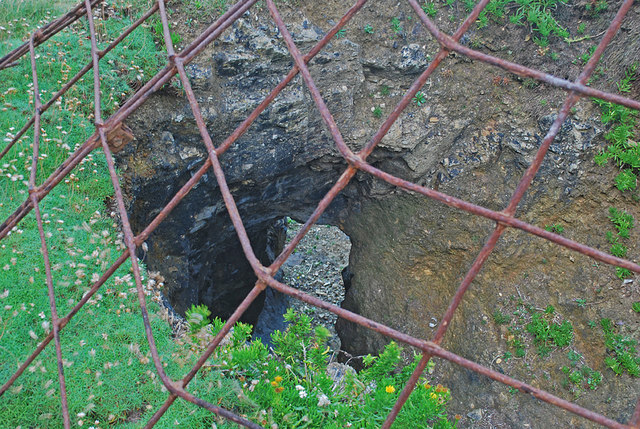
Adit openings and holes in the rocks of Droskyn Point are visible from the beach at low tide; many have been grated, and a shaft on the point is covered. The mine buildings have gone; the Droskyn Sundial, built for the millennium, stands on former mine ground on the cliff top.
Rock-cut adits, a grated wheel pit, a capped shaft and fire-set surface workings on Droskyn Point.
Redevelopment
Part of the cliff-top mine ground was landscaped for the Droskyn Sundial, built to mark the millennium.
Related mines
- Perran St George — Droskyn was worked with Great St George and merged into the Perran St George group by the 1850s.
Nearby mines
- Perran St George — 0.0 miles (0.0 km) N
- Cligga Head — 1.2 miles (1.9 km) W
- Gravel Hill Mine — 2.2 miles (3.6 km) N
- Penhalls Mine — 2.8 miles (4.5 km) SW
- Wheal Kine — 2.8 miles (4.5 km) SW
Straight-line distance, within 9 miles (15 km). Show on the map.
Recorded claims
Individual factual claims, each attached to the source(s) that support it below. Where sources disagree, both are kept.
- The surface workings at Droskyn Point are thought to be among the oldest in Cornwall. 1,2
- A 22-foot waterwheel stood in a rock-cut chamber, fed by a 700-foot tunnel under Tywarnhayle Road. 2
- Work stopped around the 1830s for want of pumping power and a low tin price. 1
- By the nineteenth century the mine had been merged into the Perran St George group. 1,2
- The Droskyn Sundial stands on former mine ground on the cliff top. 3
Photographs & further reading
A short account of the waterwheel chamber and the ancient workings on Droskyn Point.
View sourceSources
- (secondary) Explore Cornwall: Droskyn — Explore Cornwall
- (secondary) iWalk Cornwall: Wheal Droskyn — iWalk Cornwall
- (secondary) Cornwall Calling: Droskyn Mine — Cornwall Calling
- (primary) BGS / Mining Remediation Authority mine plan: St George Great and Droskyn United, Good Fortune (tin ore), abandoned 11 August 1913 — British Geological Survey
Record created: 11 October 2026 · Last researched: 11 October 2026