 MineArchive
Perran St George
| Also known as | Great St George, Perran St George Mine |
|---|---|
| Location | Cliffs between Perranporth and Cligga Head, Perranzabuloe parish, Cornwall — 50.3437, -5.1546 (approximate, low confidence) |
| Commodities | Copper, Tin |
| Type | Metal |
| Worked | By 1589–1909 (Good Fortune shaft) |
| Maximum depth | 106 fathoms (Letcher's shaft) |
| Operators | English Mining Association (1825–1838) |
Overview
The copper mines on the cliffs between Perranporth and Cligga Head, worked under many names, chief among them Great St George, first mentioned in 1589. Under the English Mining Association from 1825 they found a rich pillar of copper, but a lawsuit in 1838 closed them, and only small workings followed into the twentieth century.
History
The cliffs from Perranporth to Cligga Head are riddled with old workings that ran under several names and often together: Great St George, Perran St George, Wheal Perran, Perran United, Good Fortune and Droskyn. Great St George was mentioned as early as 1589, and its ground was disputed in 1779.
From 1825 the sett was held by the English Mining Association with Wheal Leisure, and in the first half of the nineteenth century these two great copper complexes dominated Perranporth. Over the next decade the miners worked a rich pillar of very pure copper ore. In 1831 a new shaft was sunk with Droskyn but found no copper, and by 1836 Wheal Leisure was failing.
In 1838 the Association lost a lawsuit to Captain Vivian, who had taken the grant and won substantial damages; Wheal Leisure closed, and St George soon after. Locals then gathered fallen ore from the cliffs. An amalgamation was tried in 1857, small amounts of tin and tungsten were raised into the twentieth century, and the last work, at Good Fortune shaft in 1901-09, ended its history.
Geology
Many lodes, among them Droskyn, Kernick's North and South, Calloway's, Dashwood's, Lemon, Truscott's, Coom's, Hawk's, Way's, Letcher's, Good Fortune and Wheal Prudence, carrying copper with some tin, tungsten, zinc and pyrite.
Workings
About thirty named shafts along the cliffs, the deepest Letcher's at 106 fathoms and South Engine at 93 fathoms, with many old adits in the cliff face.
Closure
The lawsuit of 1838 and the loss of the grant closed Wheal Leisure and then St George; an amalgamation in 1857 did not revive them, and the last trial at Good Fortune shaft ended in 1909.
What remains
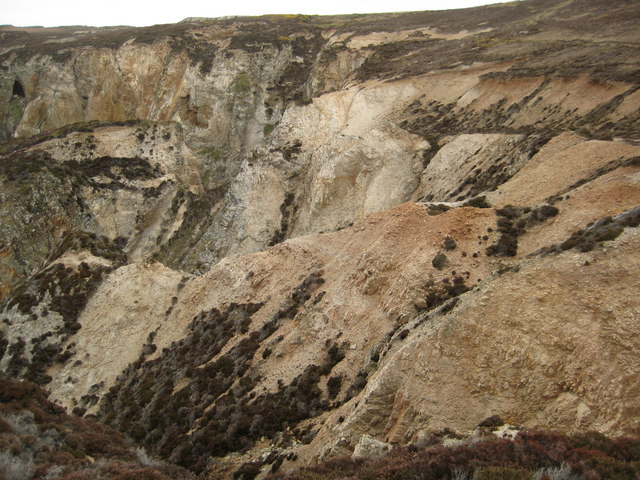
Scarred ground, capped shafts and old adits along the cliffs west of Perranporth.
Shafts, spoil and adit openings along the cliff top and face between Perranporth and Cligga Head.
Redevelopment
Unknown.
Related mines
- Cligga Head — Bought with Perran St George by the English Mining Association in 1825.
- Droskyn Mine — Droskyn was worked with Great St George and merged into the Perran St George group by the 1850s.
- Wheal Prudence — Both were worked by the English Mining Association from 1825, and the 1862 Prudence working took in the western end of Perran St George.
Nearby mines
- Droskyn Mine — 0.0 miles (0.0 km) N
- Cligga Head — 1.2 miles (1.9 km) W
- Gravel Hill Mine — 2.2 miles (3.6 km) N
- Penhalls Mine — 2.8 miles (4.5 km) SW
- Wheal Kine — 2.8 miles (4.5 km) SW
Straight-line distance, within 9 miles (15 km). Show on the map.
Recorded claims
Individual factual claims, each attached to the source(s) that support it below. Where sources disagree, both are kept.
- Great St George was first mentioned in 1589. 1
- From 1825 the sett was worked by the English Mining Association with Wheal Leisure. 1
- In the first half of the nineteenth century Perranporth was dominated by two great copper mines, Wheal Leisure and Perran St George. 2
- Wheal Leisure sued Perran St George for encroachment. 2
- In 1838 the English Mining Association lost a legal dispute with Captain Vivian, after which the mines closed. 1
- The last work was at Good Fortune shaft in 1901-09. 1,3
Photographs & further reading
The history, shafts, lodes and output of the Perranporth cliff mines.
View sourceThe beach's geology and mining history, including the Wheal Leisure and Perran St George dispute.
View sourceSources
- (secondary) Explore Cornwall: Perran St George — Explore Cornwall
- (secondary) Coastal Care: Perranporth Beach, Cornwall, England — Coastal Care
- (primary) BGS / Mining Remediation Authority mine plan: St George Great and Droskyn United, Good Fortune (tin ore), abandoned 11 August 1913 — British Geological Survey
Record created: 11 October 2026 · Last researched: 11 October 2026