 MineArchive
Shaft Capping
| Also known as | Mine cap (general usage), Shaft treatment (industry usage), Capped shaft (used of the result) |
|---|---|
| Category | Mine Workings & Access |
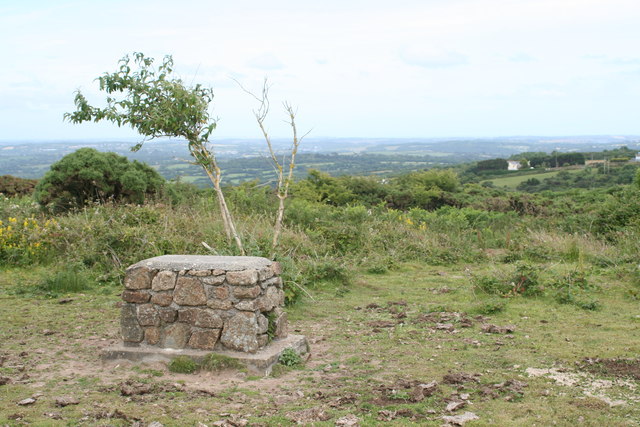
The permanent treatment of a disused shaft so that it cannot swallow anything — a concrete cap, a steel grille, a plug or an engineered fill, placed over or in the shaft top and designed to outlast everyone who remembers the mine was there.
Historical usage
For most of British mining history shafts were simply left, or covered with timber baulks and a layer of soil and rock — a treatment that looks solid for a generation and then rots. The resulting hidden voids are why so many 'new' shafts appear as sudden collapses in fields, gardens and roads, sometimes more than a century after the mine closed. Systematic capping in Britain is largely a product of the later 20th century and of the bodies that inherited responsibility for abandoned workings — for coal, the Coal Authority and its successor the Mining Remediation Authority, which still caps shafts and treats collapses as a routine part of its work.
How it worked
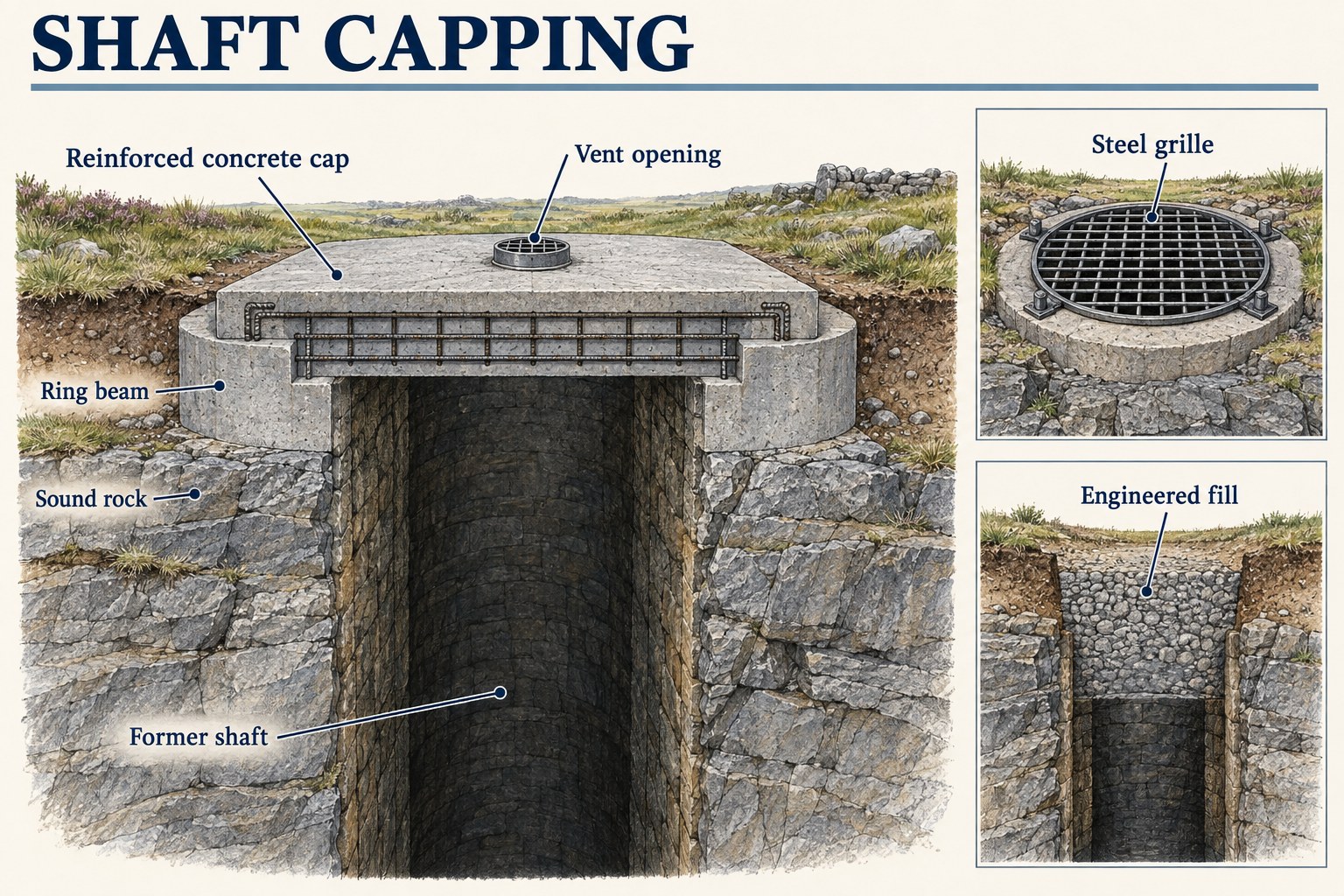
A reinforced concrete cap remains the standard for a vertical shaft, typically bearing on sound rock or on a ring beam built around the shaft collar rather than on the loose ground immediately around it. Where human entry is not wanted, tapered expanding-foam plugs and engineered fills are increasingly used instead. A steel grille is the alternative where the shaft or adit needs to stay open in some sense — it lets mine gas ventilate, lets water drain from an adit, and lets bats through, and can be designed to be opened for inspection or for cave and mine exploration. Caps are often built with deliberate openings for exactly these purposes: a slot for bats, a hole for airflow, a lockable door for access.
Why it was used
Because an open or unsoundly covered shaft is the single most dangerous thing an abandoned mine leaves behind, and because the danger is invisible — the hazard is not the hole you can see but the plug of rotting timber and soil you cannot. Capping also matters for what lives underground: many abandoned workings are important bat roosts, and a solid cap that seals a roost is a poor outcome even when it is a safe one.
Risks & limitations
A cap is only as good as what it bears on and only as permanent as its materials: old caps fail, and unrecorded shafts cannot be capped at all, which is why shaft location work usually precedes shaft treatment. Capping also seals the historical record — once a shaft is filled, whatever was in it is gone — and where a mine has any heritage value there is a real tension between securing it and keeping it legible.
Regional variation
The coalfields have the most systematic treatment, inherited by a national body with a duty and a budget for it. Metal-mining districts are patchier: in Cornwall, the Peak District and the North Pennines, shaft capping is often done by landowners, local authorities or mining-heritage groups, and thousands of shafts remain with nothing more than a fence and a warning notice.
Related terminology
Adit, Care and Maintenance, National Coal Board, Shaft, Spoil Heap, Subsidence
Mines associated with this term
5 examples chosen from 44 linked records — the term page is not an index.
- Muirshiel Barytes Mine — Renfrewshire (surviving physical example)
Muirshiel's deep shafts were capped after the mine closed in 1969, and the capped shaft sites survive as surface features within Clyde Muirshiel Regional Park. - Snowdown Colliery — Kent (surviving physical example)
Two of the three Snowdown shafts are capped and marked at surface by inscribed obelisks. - Auchencairn Mine — Dumfries and Galloway (surviving physical example)
The main shaft was re-collared and capped in concrete, and survives as such. - Minnie Pit — Staffordshire (well documented example)
Named twice in this record, first in the current condition: “…and memorial seats, photographed in 2017, 2020 and 2023, with a capped shaft beside the road; a plaque in Halmer End Methodist Church names the…” - Alderley Edge Mines — Cheshire (well documented example)
Named in this record’s surface remains: “…the rock face. Rock-cut workings, a mine entrance, spoil heaps and capped shafts survive along about 150 m of the vein. At Wood Mine and West Mine…”
Disasters associated with this term
Included only where MineArchive's own research gives a reasonable evidential basis, with the nature of the relationship stated — not every disaster where this term might plausibly apply.
- Loveston Colliery Inrush (contextual relationship)
Named in this record’s memorials: “…press has reported a pilgrimage to the disaster site, around the capped shaft in woodland, but that report was not fetched for this record and the…”
Sources
- (secondary) Mine Shaft Treatment, Cross Hands — Earth Science Partnership
- (secondary) Mine caps — Wikipedia
Record created: 25 August 2026 · Last researched: 25 August 2026