 MineArchive
Loveston Colliery Inrush
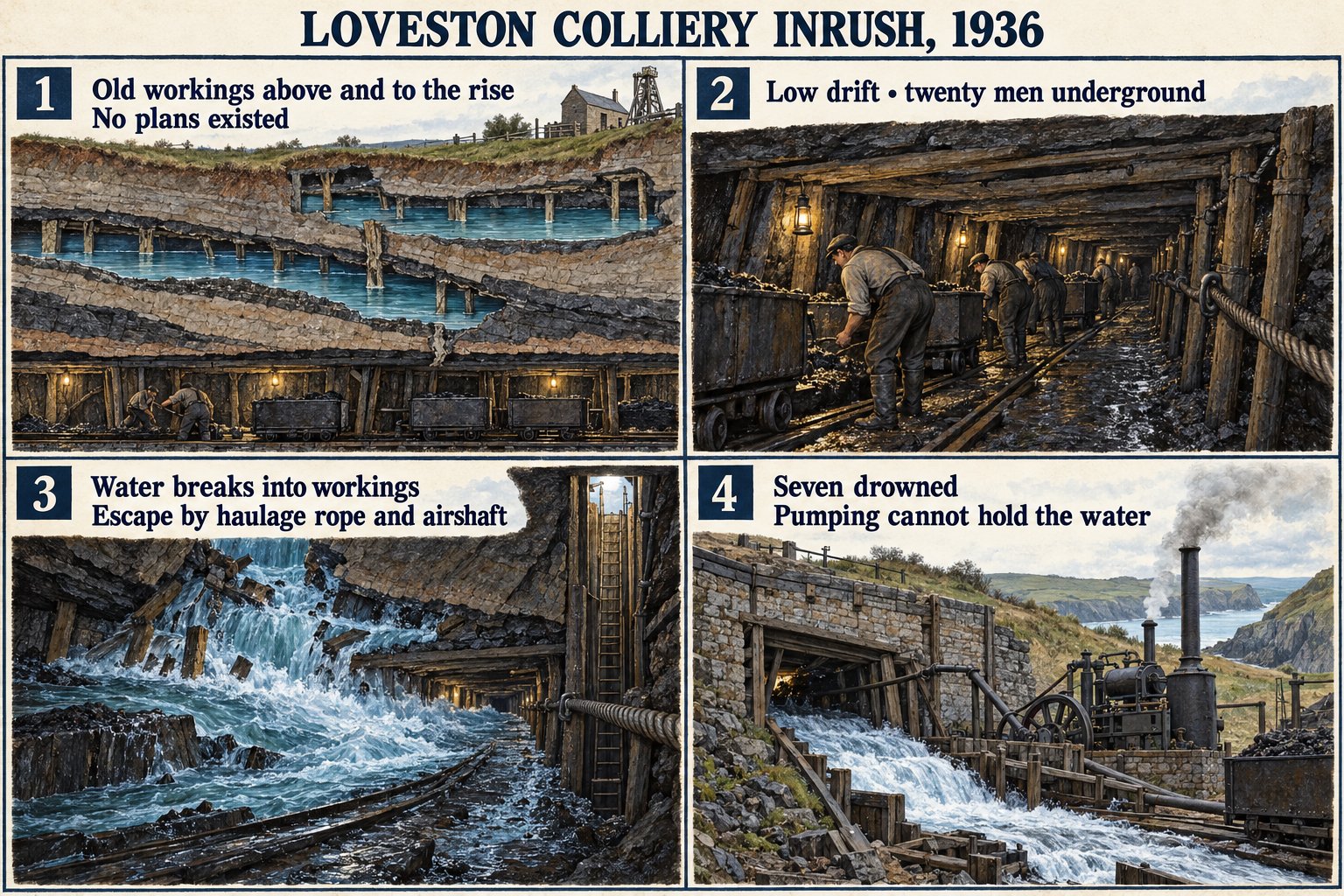
On the morning of 26 May 1936 water burst into the workings of Loveston Colliery, a small anthracite slant near Jeffreyston in south Pembrokeshire, from old workings above and to the rise of which no plans existed. Twenty men were underground, several of them crawling in a drift only four feet high. Thirteen got out, some by seizing an iron haulage rope as the water rose over their heads and others through an airshaft. Seven were drowned. One of them, Joseph Phillips, had already reached safety and turned back for his younger brother Ernest; both died. The water rose 150 yards up the 390-yard slant and could not be held. The colliery closed the following July.
| Date | 26 May 1936 |
|---|---|
| Mine | Loveston Colliery |
| Region | Pembrokeshire |
| Primary type | Flooding / Inundation |
| Associated types | Entrapment |
| Fatalities | 7 (Seven men drowned: Frederick Beynon of Cresselly, John Hillings of Kilgetty, William Thomas Jenkins of Saundersfoot, Thomas Lloyd of Jeffreyston, the brothers Ernest and Joseph Phillips of East Williamston, and Robert George Williams of Saundersfoot. Welsh Coal Mines and the Durham Mining Museum give different ages for several of them, so ages are not stated here. Between them the seven left a number of widows and at least fifteen children.) |
| Context | During active mining |
Cause
An inrush of water from old workings. His Majesty's Inspectors of Mines reported in 1937 that no plans of those workings had ever been found, and doubted that plans would have helped: an isolated area of thick coal below the old water level had been worked and would almost certainly not have been shown on them.
Contributing factors
The colliery had been opened in 1932 in ground already worked, which is the situation the hazard belongs to. The inspectors made the general point plainly: it is never safe to assume that earlier workers were unable to work to the dip of their water levels, because they did so in dry seasons and did not always show such workings on their plans. The workings were also cramped and hard to escape from, a drift four feet high approached by a slant 390 yards long.
What happened
Twenty men were at work when the water came in. The six at the deeper end of the drift were directly in its path. Joseph Phillips ran forward to warn the men higher up the road, then went back down to his brother. Those who escaped ran ahead of the water; some reached an iron haulage rope and hauled themselves clear as the flood rose above their heads, and others got out through an airshaft. One body was recovered shortly afterwards.
Pumping began at once. By the following day the water had risen 150 yards up the slant, appeared to have reached its maximum, and was being pumped out as fast as possible, but it was not expected that the remaining bodies could be recovered for several days.
Rescue & recovery
Desperate efforts were made for several hours to pump the mine out in the hope that the missing men had reached ground above the flood. The water rose steadily instead, and late on the day of the inrush all hope was abandoned. Recovery of the bodies depended on unwatering the slant and was expected to take days.
Investigation & inquiry
The Secretary for Mines, Captain Crookshank, reported the accident to the House of Commons on 27 May 1936 in answer to a private notice question from Major Lloyd George, and announced that His Majesty's inspectors would make a full investigation as soon as possible; the Deputy Chief Inspector was already at the colliery. Asked by E. J. Williams whether the colliery had been inspected before it was reopened, Crookshank required notice of the question. The inspectors' conclusions were published in 1937.
Legal & regulatory aftermath
Pressed again in the Commons on 16 June 1936, Crookshank noted that protection against inrushes of water from old workings was already compulsory under Section 68 of the Coal Mines Act 1911, and said he was considering what further measures could be taken to relieve the anxiety of the workmen in Pembrokeshire. No change in the law is traceable to Loveston.
Memorials & commemoration
No memorial has been confirmed. The local press has reported a pilgrimage to the disaster site, around the capped shaft in woodland, but that report was not fetched and the account of it is not relied on.
Recorded claims
Individual factual claims, each attached to the source(s) that support it below. Where sources disagree, both are kept.
- Seven men were drowned by an inrush of water from old workings on 26 May 1936. Twenty men were underground and thirteen escaped. 1,2
- The water rose 150 yards up the 390-yard slant by which the workings were approached, appeared to have reached its maximum by the following day, and was being pumped out as quickly as possible. 1
- The men who got out ran ahead of the water; some reached an iron haulage rope and pulled themselves to safety as the flood rose above their heads, and others escaped through an airshaft. Joseph Phillips warned the men higher up the road, then returned for his brother Ernest and died with him. 2
- His Majesty's Inspectors of Mines reported in 1937 that no plans of the old workings had been discovered, and that even had they been it was doubtful they would have shown that an isolated area of thick coal below the old water level had been worked by the 'old men'. 3
- Answering the House on 16 June 1936, the Secretary for Mines noted that protection against inrushes from old workings was already compulsory under Section 68 of the Coal Mines Act 1911 and said he was considering what further measures could be taken to relieve the anxiety of the workmen in Pembrokeshire. 3
Related terminology
Mining terms this disaster is structurally linked to, with the nature of the relationship.
- Anthracite (contextual relationship)
Named in this record’s summary: “…May 1936 water burst into the workings of Loveston Colliery, a small anthracite slant near Jeffreyston in south Pembrokeshire, from old workings…” - Coal Mines Act 1911 (contextual relationship)
Named in this record’s aftermath: “…from old workings was already compulsory under Section 68 of the Coal Mines Act 1911, and said he was considering what further measures could be taken to…” - Inrush (contextual relationship)
Named 3 times in this record, first in the cause: “An inrush of water from old workings. His Majesty's Inspectors of Mines…” - Shaft Capping (contextual relationship)
Named in this record’s memorials: “…press has reported a pilgrimage to the disaster site, around the capped shaft in woodland, but that report was not fetched for this record and the…” - Slant (contextual relationship)
Named 5 times in this record, first in the summary: “…burst into the workings of Loveston Colliery, a small anthracite slant near Jeffreyston in south Pembrokeshire, from old workings above and…”
Photographs & further reading
This page doesn't try to reproduce everything — these are the best original sources found for this disaster.
The colliery's short history, the names of the seven men drowned, Captain Crookshank's Commons statement of 16 June 1936 and the 1937 conclusion of His Majesty's Inspectors of Mines on working below old water levels.
View sourceThe Secretary for Mines reporting the inrush to the Commons the day after it happened, with the height of the water in the slant, the state of the recovery work and the announcement of an inspectors' investigation.
View sourceContemporary newspaper account of the inrush, transcribed by the Durham Mining Museum: the four-foot drift, the escape along the haulage rope and through the airshaft, and Joseph Phillips turning back for his brother.
View sourceSources
- (primary) Colliery Accident, Pembrokeshire, HC Deb 27 May 1936 vol 312 cc2017-8 — Hansard, UK Parliament
- (primary) Miner Gives Life For Brother: Heroic Sacrifice In Flooded Pit, 27 May 1936 — Contemporary newspaper report, transcribed by the Durham Mining Museum
- (secondary) Loveston — Welsh Coal Mines
- (primary) Loveston Colliery — Durham Mining Museum
Record created: 10 September 2026 · Last researched: 10 September 2026