 MineArchive
Anthracite
| Also known as | Stone Coal, Hard Coal |
|---|---|
| Category | Commodities |
| Commodity page | Anthracite → |
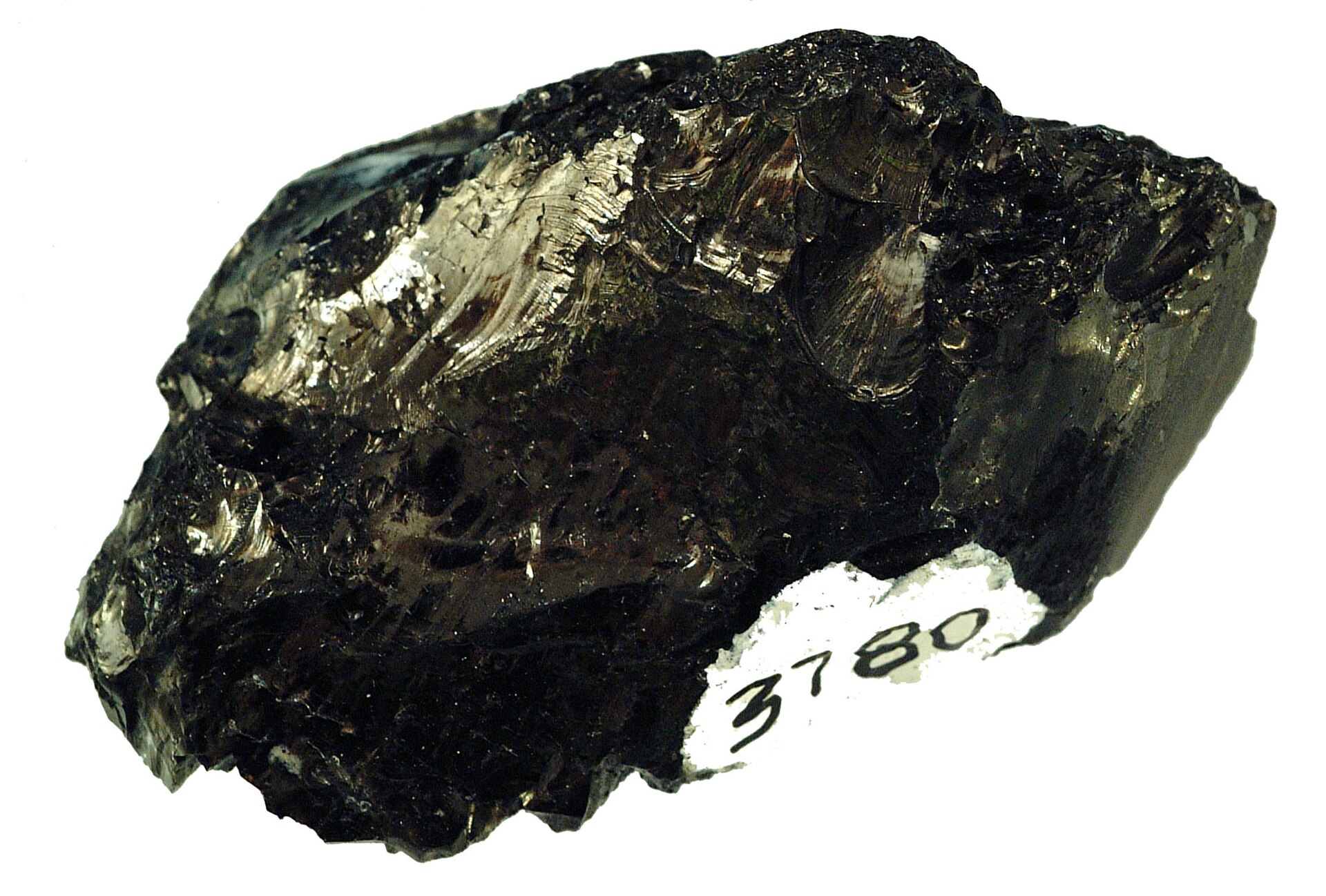
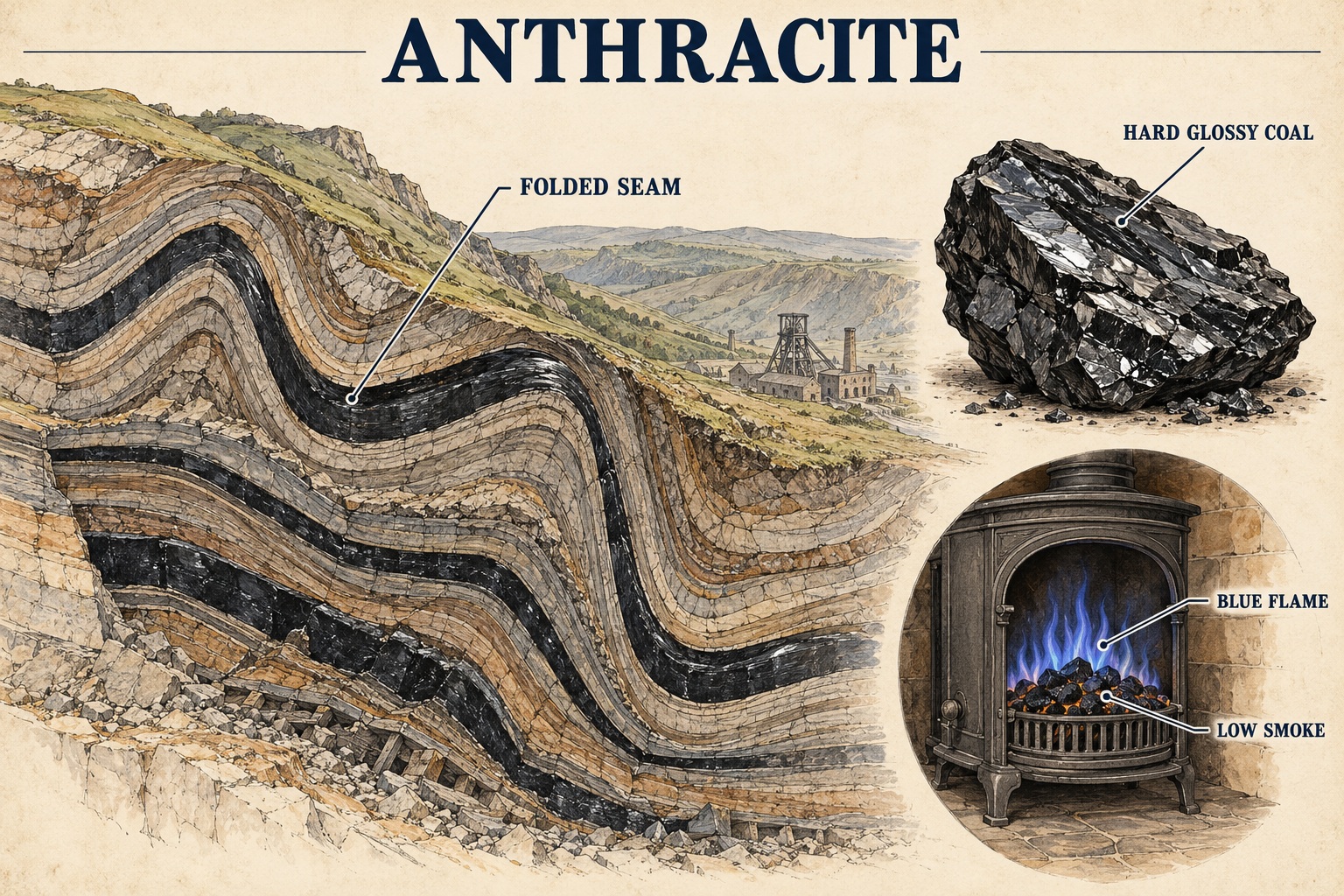
The highest rank of coal — 86 to 97 per cent carbon, with the fewest impurities and the least volatile matter — a hard black coal with a semi-metallic lustre and a conchoidal fracture that ignites with difficulty and burns with a short, blue, smokeless flame. In Britain it occurs in quantity only in the western part of the South Wales coalfield, west of Swansea and Llanelli, and in the small Pembrokeshire field beyond it.
Historical usage
Anthracite is what happens to a bituminous coal when its volatile matter is driven off by pressure and heat, so it is found where the Coal Measures have been most disturbed: in South Wales the anthracite belt is confined to the contorted ground west of Swansea, the central and eastern valleys producing steam, coking and house coals instead, and the same measures reach their westernmost and most anthracitic end in Pembrokeshire, where Kilgetty and Grove worked it from the 1840s. It was a difficult coal to sell as long as the market wanted a fire that lit easily, and the anthracite district's collieries stayed small: their miners organised separately from 1872, met again from 1881 under Mabon, and joined the South Wales Miners' Federation in 1898 as its own Anthracite District. The trade's great period was the 1920s, when Alfred Mond floated Amalgamated Anthracite Collieries in 1923 and, with United Anthracite the same year, ended the era of small firms; by 1934 the company worked 26 pits with 13,779 men. Large quantities went abroad for power, to France, Switzerland and Germany, through Swansea, and the loss of that export trade after 1940 was a blow to the port. In the 1950s the anthracite pits were losing heavily and near the end; the Clean Air Act and the spread of central heating then made smokeless anthracite a fuel the country could not get enough of, and it was mined on a large scale in the western coalfield until the late twentieth century.
How it worked
Anthracite is worked like any other coal, but in seams that are steeply folded, faulted and often thin, in ground that holds its gas under pressure. It is graded by carbon content and by size — lumps for domestic stoves and for industrial processes where it replaces metallurgical coke, fines for sintering and pelletising — and the older grades of house coal were sold by name and size.
Why it was used
It burns hotter and longer than any other coal, with almost no smoke and little ash, which made it the fuel for malting, for domestic stoves and, once smoke control came in, for every hearth in a smoke control area; its high fixed carbon also makes it a substitute for coke in metallurgy.
Value over time
For most of the nineteenth century anthracite sold at a discount to the steam coals of the central valleys: it was hard to light and the domestic market wanted a bright fire. Its price rose with the export trade in power anthracite to the Continent and with the consolidation of the 1920s, when Amalgamated Anthracite could set a price for a million tons a year, but the loss of the export markets after 1940 and the general decline of coal after the war left the anthracite section of the coalfield the weakest part of the industry, losing money and facing closure in the 1950s. The Clean Air Act of 1956 reversed that overnight: anthracite was an authorised smokeless fuel, central heating spread, and Welsh anthracite commanded a premium as the one coal that could legally be burned in a smoke control area — a premium it kept until oil and gas took the domestic market.
Hazards & challenges
Anthracite's own hazard is the outburst: in the contorted, gas-charged ground of the western coalfield, coal and methane can burst from the face without warning, filling the roadways with fine coal and firedamp, and the archive's record of the Cynheidre–Pentremawr outburst of 1971 is the type case. Anthracite dust is the finest and hardest of coal dusts and its miners suffered pneumoconiosis at high rates. Otherwise the hazards were those of any deep colliery — explosion, roof falls, haulage — in seams whose steepness made falls and runaways more likely.
Risks & limitations
The seams are folded, faulted and thin, the ground is gassy, and the coal was for a century worth less than the steam coal next door; the anthracite district's economics depended on markets — Continental export, then smoke control — that lay outside the industry's control, and it was twice near extinction, in the 1930s and the 1950s, before the last large-scale working ended.
Regional variation
Almost entirely a South Wales coal: the anthracite belt runs from the Gwendraeth and Amman valleys through the Swansea and Neath valleys to the Pembrokeshire coalfield in the west. Small quantities occur in Scotland. In north Devon the thin culm seams beside Bideford Black are anthracitic, and were worked locally as fuel.
Related terminology
Cannel Coal, Coal, Coal Measures, Mineral Black
Mines associated with this term
5 examples chosen from 36 linked records — the term page is not an index.
- Cynheidre Colliery — Carmarthenshire (notable incident)
The Gwendraeth anthracite colliery whose 1971 outburst of coal and gas is the archive's type case of the hazard peculiar to the anthracite district. - Ammanford Colliery — Carmarthenshire (well documented example)
Named 6 times in this record, first in the summary: “Two anthracite collieries on Betws Mountain rather than one. Ammanford No. 1, the…” - Blaencaegurwen Colliery — Neath Port Talbot (well documented example)
Named 3 times in this record, first in the summary: “An anthracite drift mine of three slants near Brynamman, at the head of the Amman…” - Bonville's Court Colliery — Pembrokeshire (well documented example)
Named 4 times in this record, first in the summary: “Bonville's Court was the largest colliery of the Pembrokeshire anthracite coalfield, half a mile inland from the sea at Saundersfoot and named…” - Brynhenllys Colliery — Powys (well documented example)
Named 6 times in this record, first in the summary: “Brynhenllys was an anthracite colliery at Upper Cwmtwrch, on the Brecknockshire side of the upper…”
See every mine that worked anthracite →
Disasters associated with this term
5 examples chosen from 10 linked records, most direct relationship first.
- Ammanford Colliery explosion, 1935 (contextual relationship)
Named in this record’s narrative: “…five shots were fired in a cross-measure heading at the Amalgamated Anthracite Collieries' Ammanford Colliery, and no more work was done there…” - Cadean Slant manrider accident (contextual relationship)
Named in this record’s narrative: “…to fifteen near faults. The colliery raised about 200 tons of anthracite a day on three shifts. Men rode in and out in a train of eleven…” - Carway Colliery outburst, 1944 (contextual relationship)
Named twice in this record, first in the cause: “…under pressure, a hazard largely confined in Great Britain to the anthracite area of the South Wales Coalfield -- occurred at 12.30 am on the…” - Gellyceidrim Colliery runaway journey, 1897 (contextual relationship)
Named in this record’s narrative: “Gellyceidrim was an anthracite colliery at Glanamman worked by slants, inclined roadways up which…” - Glynhebog Colliery explosion, 1900 (contextual relationship)
Named in this record’s summary: “…a roof fall where a pillar was being worked out in the Pumpquart anthracite seam at Glynhebog Colliery slant, Pontyberem, released gas that the…”
Sources
- (primary) BGS Rock Classification Scheme: Anthracite — British Geological Survey
- (primary) Cynheidre Colliery — welshcoalmines.co.uk
- (primary) Cynheidre-Pentremawr Outburst, Llanelli, 1971 — Northern Mine Research Society
- (secondary) Amalgamated Anthracite Collieries — Wikipedia
- (secondary) Anthracite — Wikipedia
- (secondary) Anthracite Miners' Association — Wikipedia
Record created: 7 September 2026 · Last researched: 8 September 2026