 MineArchive
Mineral Black
| Also known as | Bideford Black, Biddiblack |
|---|---|
| Category | Commodities |
| Commodity page | Mineral Black → |
An earth pigment: a soft, clay-like carbonaceous shale of carbon with silica and alumina, ground to a dense, non-reflective black. Worked in Britain almost only in north Devon, where it ran beside the thin anthracitic culm seams of the Bideford Formation and was sold as Bideford Black or Biddiblack.
Historical usage
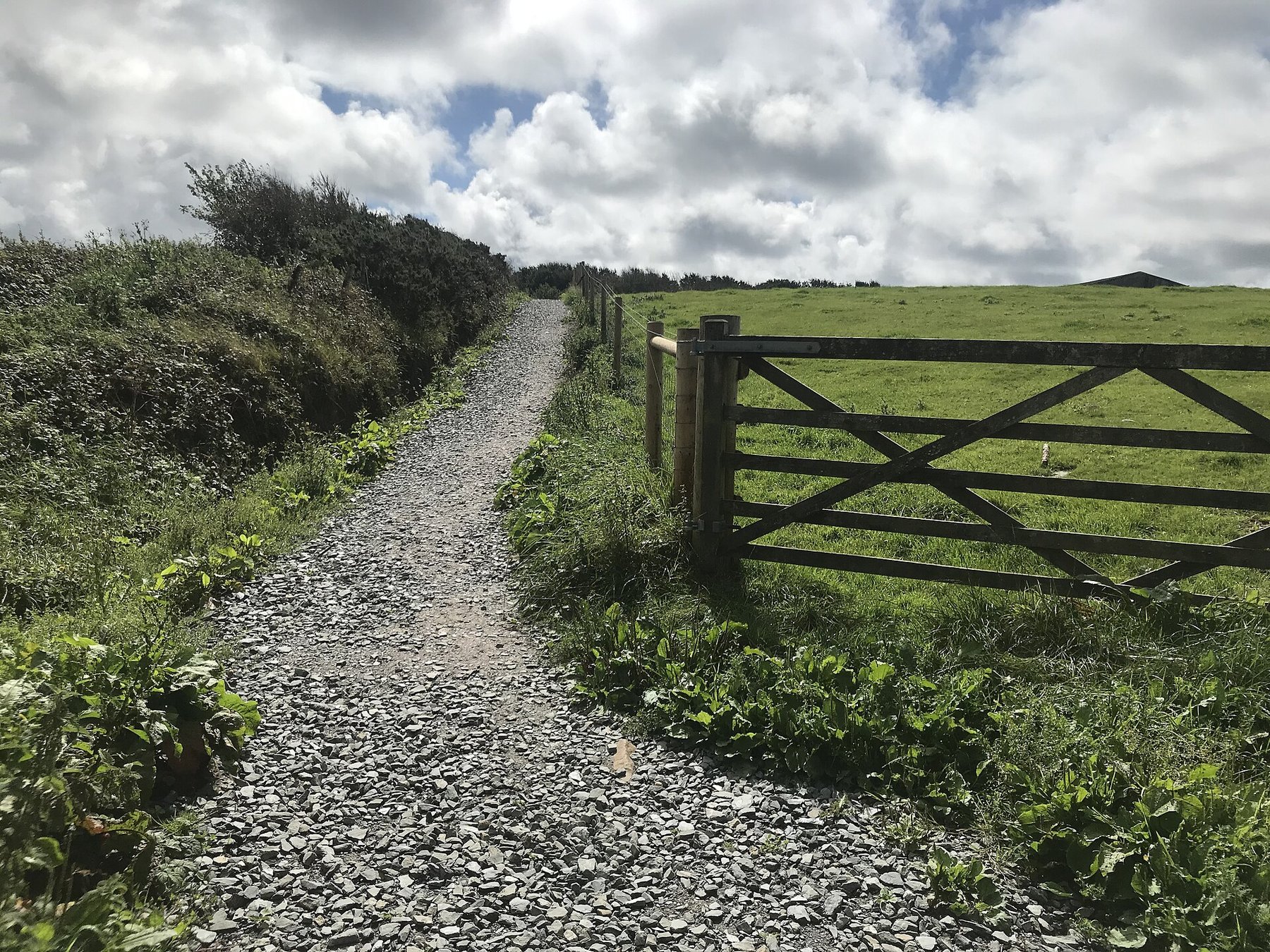
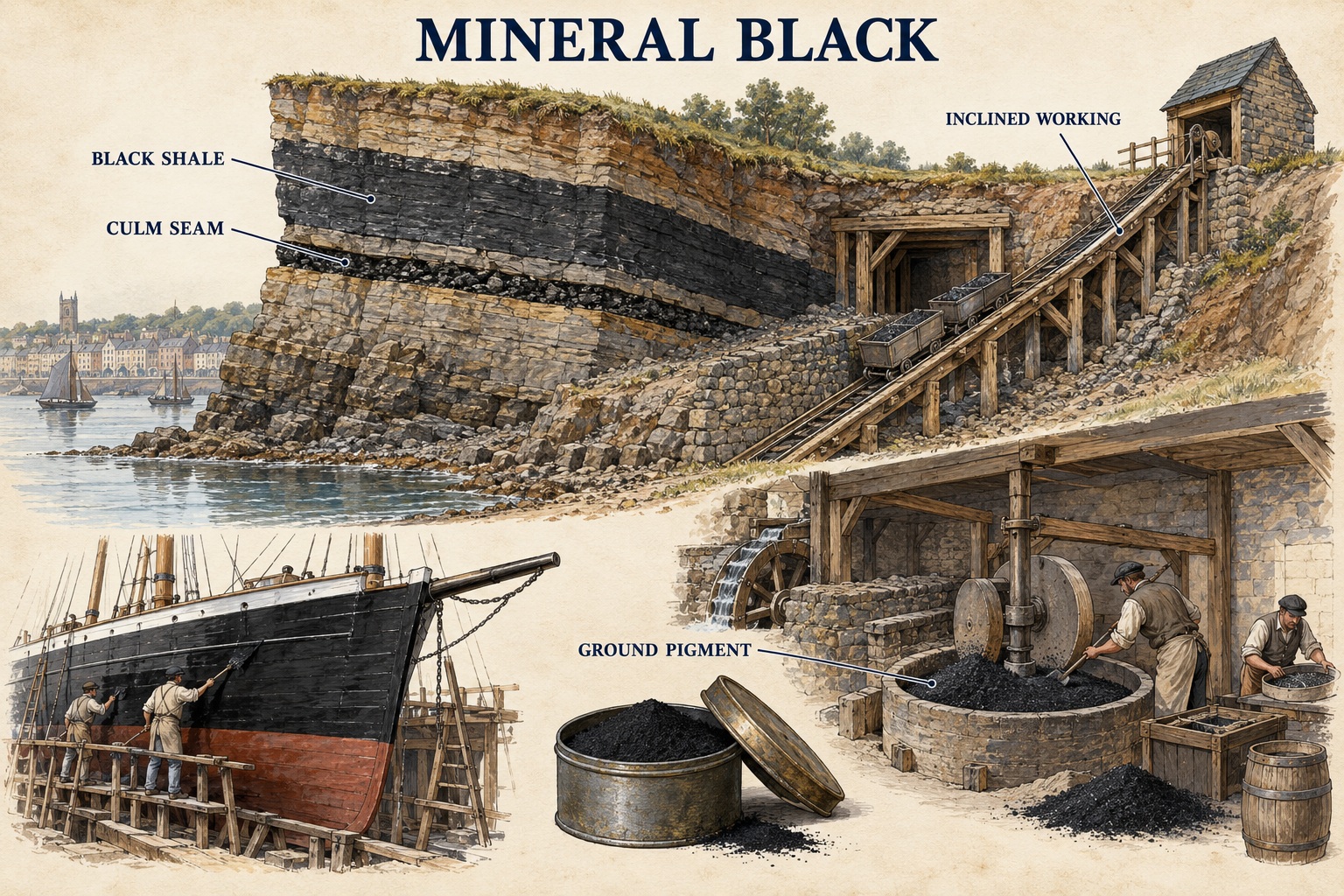
The seam runs from Greencliff on the coast west of Bideford eastward under the town to Hawkridge Wood near Umberleigh in the Taw valley, and was worked for about two hundred years — from adits at Greencliff, where both the pigment and the culm outcrop on the shore, and from inclined shafts and levels at East-the-Water in Bideford itself. Anthracite was being dug in north Devon by the mid-seventeenth century and the softer black material beside it was in use as a pigment earlier still, as a base for the paint on ships' keels. By 1875 the mine was worked by the Bideford Black Paint Company, and the Bideford Black Mining Company later produced Biddiblack powder at its processing works at Chapel Park, East-the-Water. The pigment went into boat paint, rubber, paper, pencils and, in the Second World War, the camouflage paint on tanks; Max Factor bought it for mascara. Cheap synthetic carbon blacks undercut it in the 1960s and the last mine, at Chapel Park, closed in 1969 — the end of coal working in Bideford as well as of the pigment.
How it worked
The pigment was got like the culm beside it, by adits into the cliff at Greencliff and by inclined shafts and levels under East-the-Water, then ground and processed at the works at Chapel Park into powder and paint. The seam is intermittent, undulating and variable, so the workings followed it where it was thick enough to pay.
Why it was used
It made a dense, matt, cheap black that would take to oil and water alike, which is what a ship's keel, a tank's flank, a rubber mix or a mascara wanted; and it came out of the ground ready-made, needing only grinding.
Value over time
Bideford Black was a local trade with occasional national markets: steady sales to boatbuilders and rubber makers for a century, a wartime surge when the army wanted camouflage paint, and a curious afterlife in cosmetics. It could not survive the synthetic carbon blacks of the post-war chemical industry, which were cheaper, purer and made anywhere; by 1968 the mining was uneconomic and it stopped in 1969. It has since become a heritage and artists' material, with the Burton Art Gallery's project reviving its story.
Hazards & challenges
The hazards were those of the small culm mines it shared: unsupported ground in soft shale, bad air in shallow adits, and the dust of a carbonaceous rock. Nothing specific to the pigment is recorded, and no fatal incident at the Bideford workings is in the archive.
Risks & limitations
A single seam, intermittent and variable, worked by one or two small companies for a product that a chemical plant could make better once it tried; the industry had no second market to fall back on when synthetic blacks arrived.
Regional variation
Unique to north Devon. The name mineral black is the trade's; locally it was Bideford Black or Biddiblack, and Bideford's street names — Mines Road, Pitt Lane — still record the industry.
Related terminology
Mines associated with this term
Included only where MineArchive's own research gives a reasonable evidential basis — not every mine where this might plausibly apply.
- Bideford Black Mine — Devon (well documented example)
Named 5 times in this record, first in the summary: “…as fuel at all and was instead ground into a pigment. That pigment — mineral black, sold commercially as Biddiblack — was worked for around two hundred…”
See every mine that worked mineral black →
Sources
- (primary) BGS Lexicon of Named Rock Units: Bideford Formation — British Geological Survey
- (secondary) Bideford — Wikipedia
- (secondary) Coal Mining in Devon — report of Dr Chris Cornford’s talk, February 2015 — Open University Geological Society, South West Branch
- (secondary) Memory’s Seams: Scarcity, Preciousness, and Earth in Bideford Black (Museum & Society 22(3), 2024) — Eugenia Kisin, University of Leicester
- (secondary) The Story of Bideford Black: History — The Burton Art Gallery & Museum
Record created: 6 September 2026 · Last researched: 8 September 2026