 MineArchive
Bideford Black Mine
| Also known as | Biddiblack, Chapel Park Mine, The Paint Mines, Bideford Mineral Black Works |
|---|---|
| Location | East-the-Water, Bideford, and the coast at Greencliff, Abbotsham, Devon — 51.0202, -4.2681 (approximate) |
| Commodities | Mineral Black, Coal |
| Type | Mineral |
| Worked | By the 13th century–1969 |
| Maximum depth | Unknown. Worked by adit and inclined shaft rather than deep shafts; levels in Cleave Wood ran 400–800 m east from their entrances. |
| Operators | Bideford Black Mining Company |
Overview
Two thin east–west seams run from the North Devon coast at Hartland and Abbotsham south-eastwards beneath Bideford and inland as far as Umberleigh. The northern one is a genuine anthracite, known in Devon as culm, but too sulphurous for domestic use; the southern one, the Paint Seam, is a carbonaceous shale that was never much use as fuel at all and was instead ground into a pigment. That pigment — mineral black, sold commercially as Biddiblack — was worked for around two hundred years from adits at Greencliff on the coast and from inclined shafts and levels at East-the-Water in Bideford itself. It coated ships’ hulls for the Navy, camouflaged tanks in the Second World War, coloured rubber, paper and cement, and was bought by Max Factor for mascara. The last mine, at Chapel Park, closed in 1969, undercut by cheaper synthetic blacks.
History
Anthracite was being worked in north Devon by at least the middle of the seventeenth century, and the softer black material running alongside it was in use as a pigment considerably earlier: it was found to make an ideal base for the paint put on the keels of sailing ships, and was still being used for that purpose in Nelson’s navy and through the first half of the nineteenth century. Commercial mining ran for roughly two centuries from the 1760s. Interest in the seams sharpened in the 1820s, when the spread of stratigraphy prompted a search for coal in Devon and the two Bideford seams were identified and traced.
The workings were modest and scattered, following lenses of material rather than a continuous bed. Inclined shafts and adits in Cleave Wood at East-the-Water have been recorded extending east for 400 to 800 metres; at Greencliff, where both seams are exposed at the coast, adits were driven that intersected the pair of them. Labourers cut both the culm and the pigment with pickaxes into the twentieth century, when air drills took over. Milling and refining were done in the town: the Bideford Black Mining Company processed the raw material into a powder at Chapel Park, East-the-Water, later refinements producing the grades sold as Biddiblack and Bettablack, and the miners were housed nearby at Springfield Terrace.
The pigment’s uses widened steadily. It went into boatbuilding paint, as an antioxidant coating for iron-clad ships, and into pencils, car tyre filler, paper, cement and rubber. In the Second World War it was used to conceal tanks and ships. Its most improbable customer was Max Factor, which used its intense colour and oily texture in the cake mascara applied with a small comb. Then the market that had carried it for two centuries disappeared inside a decade: from the 1960s synthetic carbon blacks were blacker, more consistent and cheaper, and the seam at Chapel Park was running out. The last mine closed in 1969, and with it Devon’s only commercial coal industry.
Geology
The material comes from the Culm Measures of the north Devon Carboniferous basin, laid down on a coastal plain crossed by rivers feeding lagoons. Two east–west seams were identified near Bideford. The northern, the coal seam proper, presents not as a continuous bed but as a series of lenses; its composition — cellulose debris characteristic of vitrinite, with no plant spores, the spores having been washed away — points to its having formed from log jams and abandoned meanders in an ancient river system rather than from a peat swamp. The southern, the Paint Seam, is a carbonaceous shale, carbargillite: a mineral black composed of carbon with alumina and silica, which is why it grinds to a pigment rather than burning as a fuel. Deep burial and high-temperature maturation under the thrusts of the Variscan Orogeny drove off most of the bituminous content of the culm; the pigment seam came through as a clay-like solid that art historians have called the mother of coal.
Geological setting: Sedimentary Beds and Seams (well documented example)
Workings
Working was by adit and inclined shaft rather than by deep winding. At Greencliff, on the coast between Abbotsham and Cornborough, both seams outcrop in the cliff and levels were driven in from the foreshore to intersect them. At East-the-Water, on the Bideford side of the Torridge, horizontal levels were driven into the Bideford Black, with inclined shafts and adits recorded in Cleave Wood running east for between 400 and 800 metres. The lenticular form of the northern seam meant working was always sporadic: there was no continuous face to follow, and a lens once exhausted gave no guide to where the next one lay. Extraction was by pickaxe until air drills were introduced in the twentieth century. The material went to the company’s works at Chapel Park to be dried, ground and graded.
Closure
The industry was killed by chemistry rather than by geology, though both played a part. From the 1960s synthetic carbon blacks — and later the laboratory-grown superblacks — were blacker and more consistent than any earth pigment, and cheaper to make at scale; camouflage and mascara alike moved to polymers. The Chapel Park seam was also becoming depleted. The last mine closed in 1969, although some accounts give 1968.
What remains
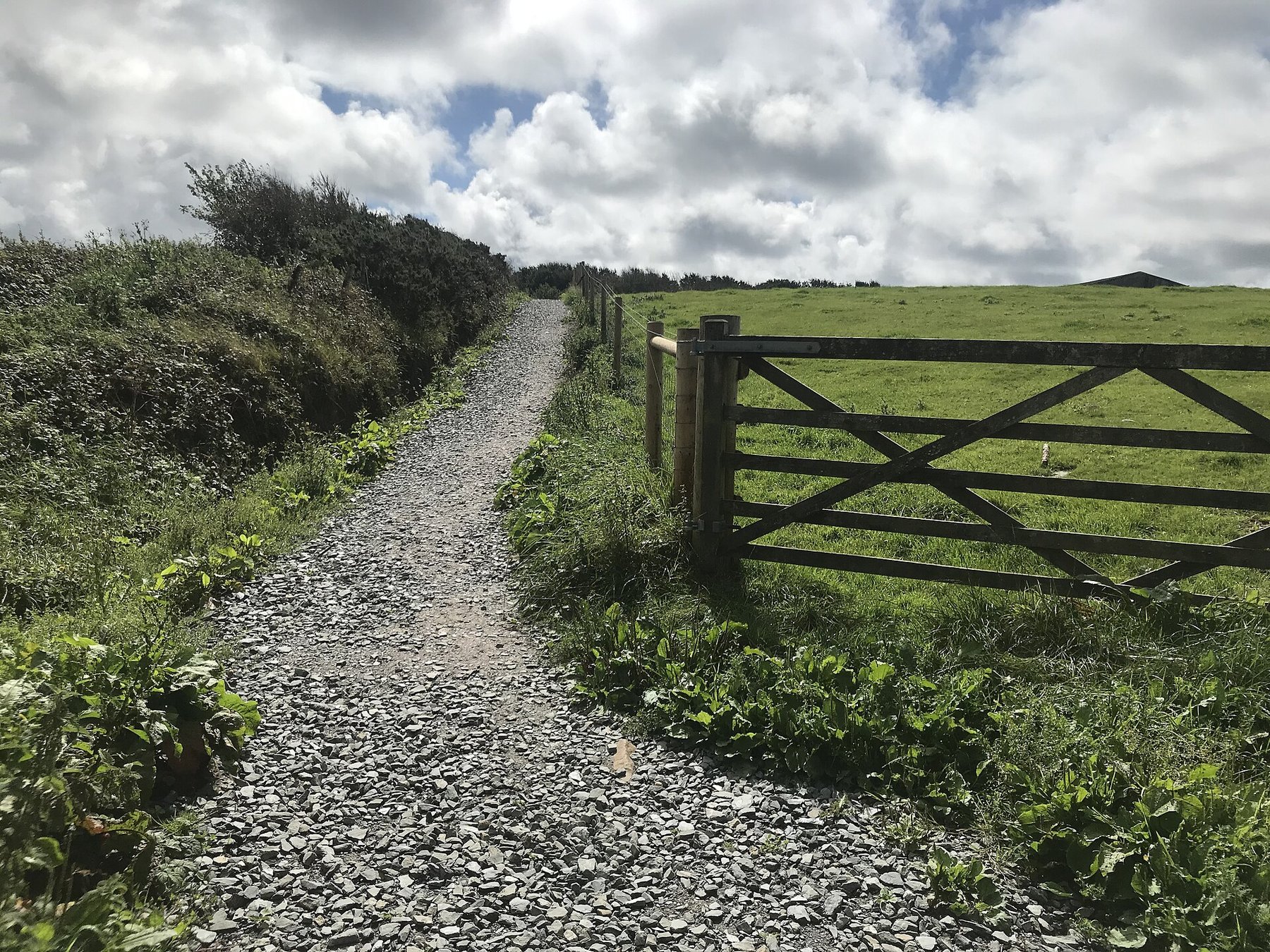
Nothing is worked commercially, and the East-the-Water ground has been steadily built over: by 2015 the Cleave Wood site was for sale with planning permission for housing. The seam itself is still there and still accessible where it reaches the coast. An artist visiting Greencliff in April 2022 walked down to the pebble beach, found the black seam in the cliff, took pigment from it, and packed the hole with rock and clay to limit further erosion — much the same operation, on a much smaller scale, that the mines were doing two centuries earlier.
Old mine entrances survive around East-the-Water, along with the miners’ houses at Springfield Terrace and the buildings of the Chapel Park processing works. The industry is better recorded in the street names than in any monument: Mines Road, Pitt Lane and Biddiblack Way all take their names from it.
Redevelopment
Bideford Black has had an afterlife as an art material. The Burton Art Gallery & Museum in Bideford ran a project on the pigment from 2013, and specimens now sit in pigment libraries including that of the Slade School of Fine Art. Artists dig it by hand from the Greencliff outcrop, dry it, grind it and bind it with PVA or gum arabic — a slower and more erratic form of the same extraction, and one that has turned an industrial by-product into a piece of local biocultural heritage.
What's uncertain
Points where sources disagree or the record could not be settled; both accounts are kept. All open questions in the archive.
- Sources disagree on the closing year: 1969 is given by the Open University Geological Society report, the GooseyGoo site record and Kisin’s 2024 article, while the Story of Bideford Black project and accounts drawing on it give 1968. (disputed) 3,1,2,4
Recorded claims
Individual factual claims, each attached to the source(s) that support it below. Where sources disagree, both are kept.
- Two east–west seams were identified near Bideford: the northern coal seam, which occurs as a series of lenses of vitrinite formed from log jams in an ancient river system, and the southern Paint Seam, a carbonaceous shale called carbargillite. 1,2
- Bideford Black is a mineral black composed of carbon, alumina and silica — in geological terms carbargillite, a carbonaceous shale — and has been called the mother of coal. 3
- Horizontal levels were driven into the Bideford Black at East-the-Water and adits at Greencliff intersected both seams; inclined shafts and adits in Cleave Wood have been recorded extending east for 400 to 800 metres. 1,2
- The pigment was used on ships’ hulls, as an antioxidant coating for iron-clad ships, in pencils, car tyre filler, rubber, paper and cement, for camouflage on tanks and ships in the Second World War, and by Max Factor in mascara. 3,1
- Sources disagree on the closing year: 1969 is given by the Open University Geological Society report, the GooseyGoo site record and Kisin’s 2024 article, while the Story of Bideford Black project and accounts drawing on it give 1968. (disputed) 3,1,2,4
- The pigment was mined for at least 200 years, with commercial working generally dated from the 1760s, although mineral black was being used as a paint base in the region considerably earlier. 2,4
- The seam still outcrops accessibly at Greencliff: a visitor in April 2022 reached it on foot from the lime kiln, took pigment from the cliff and refilled an earlier excavation to limit erosion. 5
- The Mining Remediation Authority catalogue holds an abandonment plan (catalogue 17989) for 'Bideford Mine' in the Bideford Black seam. 6
Photographs & further reading
The Burton Art Gallery & Museum’s project site on the pigment, with photographs of the old mine entrances, Mines Road, Pitt Lane, Springfield Terrace and the Chapel Park processing works as they stood in 2010.
View sourceThe clearest short account of why Devon has coal at all: the two Bideford seams, the log-jam origin of the northern one, the carbargillite of the Paint Seam, and how the Variscan thrusts cooked the bituminous content out of both.
View sourceSources
- (secondary) Coal Mining in Devon — report of Dr Chris Cornford’s talk, February 2015 — Open University Geological Society, South West Branch
- (observational) Bideford Black — industrial heritage site record — GooseyGoo Industrial Explorer
- (secondary) Memory’s Seams: Scarcity, Preciousness, and Earth in Bideford Black (Museum & Society 22(3), 2024) — Eugenia Kisin, University of Leicester
- (secondary) The Story of Bideford Black: History — The Burton Art Gallery & Museum
- (observational) Greencliff and Bideford Black (24 April 2022) — Al Brown
- (primary) BGS / Mining Remediation Authority mine plans: BIDEFORD MINE — British Geological Survey / Mining Remediation Authority
Record created: 6 September 2026 · Last researched: 6 September 2026