 MineArchive
Outburst
| Category | Ground Conditions & Hazards |
|---|
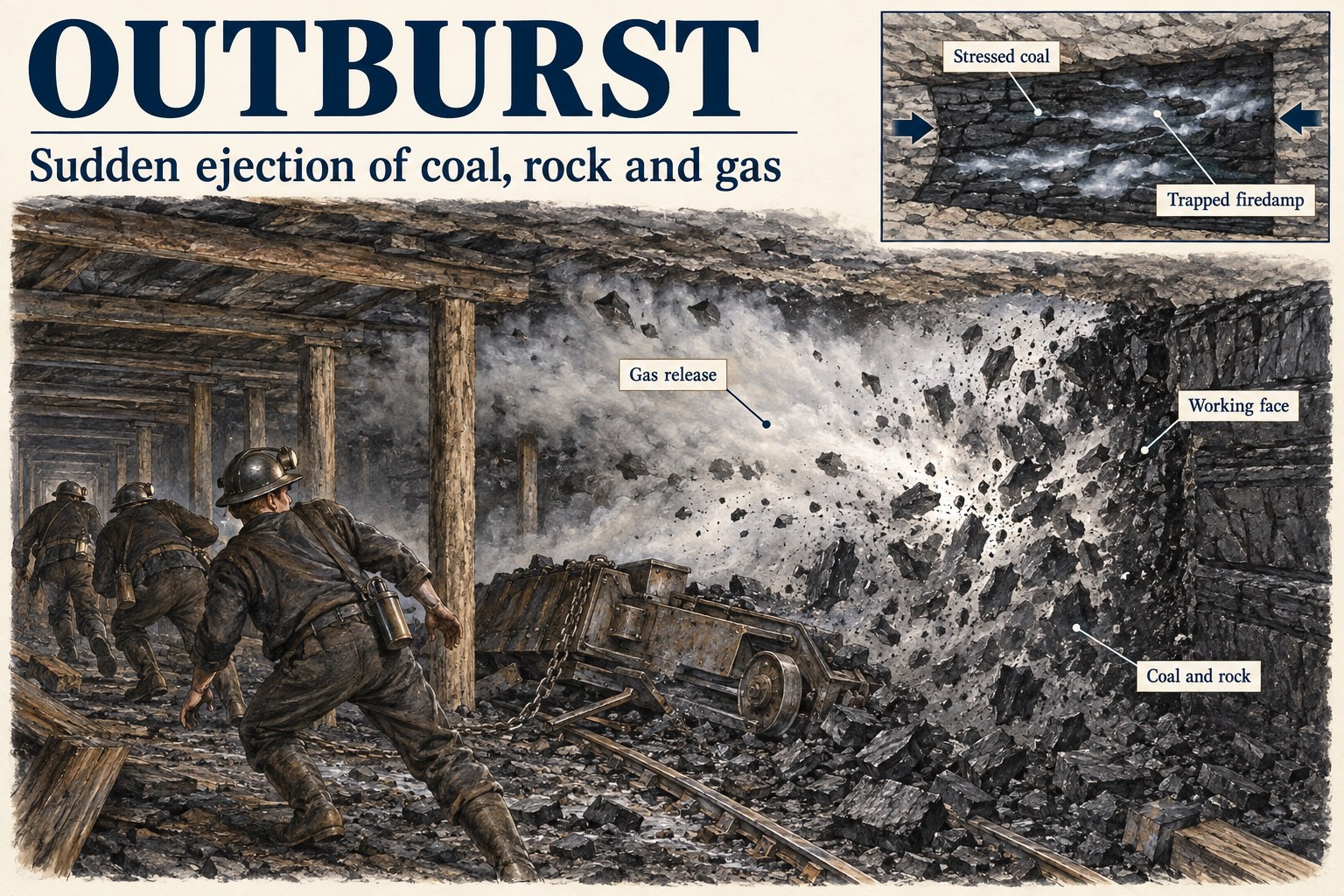
The sudden, violent ejection of coal, rock and gas from a working face into the workings — hundreds or thousands of tonnes of coal reduced to powder and thrown out with tens of thousands of cubic metres of firedamp, in seconds and without warning.
Historical usage
Outbursts are a hazard of deep, gassy, structurally disturbed coal, and in Britain they belong above all to the anthracite districts of the western South Wales coalfield. Cynheidre, sunk to make deep anthracite mining viable, was the site of the worst coal-and-gas outburst disaster in British history: on 6 April 1971 an outburst there killed six men, pulverising and ejecting some 400 tonnes of coal along with 57,000 cubic metres of firedamp. The word is older than that and did not always mean this. Barrowman’s 1886 glossary of Scotch mining terms gives two senses side by side: "OUTBURST, The outcrop" and "OUTBURST, A sudden accession of water or fire-damp" — so in Scottish usage the same word served for the place a seam reaches the surface and for a sudden inrush.
How it worked
Gas in coal is not only in the cracks; much of it is adsorbed within the coal itself, held there by the pressure of the surrounding strata. Where a seam is gassy, poorly permeable and geologically disturbed, cutting into it can release that pressure faster than the gas can bleed away through the coal. The seam then fails explosively into the opening, shattering as it goes and liberating the gas it held — which is why the coal comes out as dust rather than lumps, and why the volume of gas released tracks the tonnage of coal ejected.
Why it was used
Not a technique but a hazard; the entry exists because outburst-prone seams had to be worked differently. Where outbursts were expected, ground was destressed by firing shots into it in advance, or worked by methods that kept men out of the immediate face area.
Risks & limitations
The severity ranges from barely noticeable to the destruction of an entire district, throwing machinery weighing tens of tonnes several metres. The gas is the second danger after the coal: an outburst fills the district with firedamp in moments, so that men who survive the ejection itself may not survive what follows. The predisposing factors are reasonably well understood — high gas content, low permeability, and geological structures such as faults, dykes and zones of crushed coal — but the specific event has never been reliably predictable.
Regional variation
In Britain the outburst-prone ground is the anthracite belt of west Wales; the deeper and more disturbed the seam, the greater the risk, which is precisely what made Cynheidre’s reserves both valuable and dangerous. The Scottish sense recorded by Barrowman, meaning the outcrop, is a genuine and quite separate usage and is now obsolete.
Related terminology
Mines associated with this term
5 examples chosen from 20 linked records — the term page is not an index.
- Abram Colliery — Greater Manchester (well documented example)
Named 3 times in this record, first in the summary: “…the Wigan Nine Feet and then 650 yards to the Arley, where a sudden outburst of gas in the Yard seam killed 48 in 1881; it was merged into…” - Barrow Colliery, Bryncethin — Bridgend (well documented example)
Named twice in this record, first in the summary: “…a shaft-sinking accident that killed five men in 1874, and a gas outburst that killed three more in 1911 (see Disasters, below).” - Barrwood Colliery — North Lanarkshire (well documented example)
Named in this record’s history: “…nine widows and 29 children passed £1,100. On 20 December 1889 an outburst of gas at the face of a level running beside a large fault reached…” - Brynmally Colliery — Wrexham (well documented example)
Named in this record’s history: “…men and boys. The cause was put down to a fall bringing down an outburst of firedamp which was ignited by a naked flame. The dead included…” - Cae Duke Colliery — Swansea (well documented example)
Named 3 times in this record, first in the summary: “…which employed over 400 men in 1923, had a district closed by outbursts and served as an airway and training centre after production stopped…”
Disasters associated with this term
5 examples chosen from 41 linked records, most direct relationship first.
- Cwmaman Colliery gas explosion, 1911 (direct cause)
An outburst of gas in the main intake. - Easton Colliery explosion, 1886 (direct cause)
The Inspector suspected a sudden outburst of gas. - Great Mountain Colliery outburst, 1935 (direct cause)
An outburst of fine coal and methane. - Great Mountain Colliery outburst, 1958 (direct cause)
A sudden outburst of coal and gas. - Old Boston Pit shaft-sinking explosion, 1900 (direct cause)
Gas burst from the shaft floor.
Sources
- (primary) Glossary of Scotch Mining Terms — James Barrowman (1886), via Scottish Mining Website
- (secondary) Cynheidre Colliery — Wikipedia
- (secondary) Outburst (mining) — Wikipedia
Record created: 8 September 2026 · Last researched: 8 September 2026