 MineArchive
Barrow Colliery, Bryncethin
| Location | Bryncethin, Bridgend — 51.5481, -3.5647 (approximate) |
|---|---|
| Commodity | Coal |
| Type | Coal |
| Worked | 1870–1921 |
| Maximum depth | 400 yards (366 m) — No.3 pit, sunk 1873. |
| Operators | Barrow-in-Furness Hematite Steel Co. (1873–1886), Glassbrook (1870–1873), Bryncethin Colliery Co. Ltd (1905–1915) |
Overview
A steam-coal colliery at Bryncethin sunk in 1873 by the Barrow-in-Furness Hematite Steel Co. to reach deep seams beneath older house-coal levels. Two fatal incidents mark its history: a shaft-sinking accident that killed five men in 1874, and a gas outburst that killed three more in 1911 (see Disasters, below).
History
Small drift mines and levels had worked the shallow Red Ash seam at Bryncethin for house coal on a small scale for generations before any shaft was sunk — a 1954 interview with David Bayliss (born 1877) recalls Robert Watson's small sinkings on the mountain in the 1830s ('Robert Watson's Pits', also known as Pwll yr Engine) and a small colliery at Tynycoed sunk around 1830 by Robert Rees's grandfather and his three brothers, in which the grandfather was killed. No.1 pit proper was sunk in 1870 by a Swansea colliery company, Glassbrook, to an eighteen-foot seam of coal that earlier outcrop working had already made easy to find. In 1873 Glassbrook sold the colliery, for £30,000 against the £10,000 they had spent finding the coal, to the Barrow Company of Wigan — formally the Barrow-in-Furness Hematite Steel Co. Ltd — who wanted the more profitable steam-coal seams that lay at much greater depth than the house-coal levels already worked in the area. Reaching them meant sinking new vertical shafts: the Barrow Company sank two, No.2 and No.3, on a field called Waungoch, to 380 and 400 yards respectively, and built a brickworks alongside. It was during this sinking that five men died when a scaffold gave way over the flooded shaft bottom on 26 September 1874 (see Disasters, below). No.1 pit closed around 1885, and No.2 and No.3 around 1886. The pits were reopened in 1905 to a shallower depth of 290 yards, working seams higher up the shaft, and by 1908 the colliery — by then in the hands of the Bryncethin Colliery Co. Ltd — employed 200 men across the two pits. On 22 July 1911 a gas outburst during roadway development killed three men; the collier George Edwards was awarded the Edward Medal, 2nd Class, for his repeated attempts to reach them (see Disasters, below). The colliery closed at the end of 1915. It was reopened as New Bryncethin, but the venture failed: a French-backed company and then a Belgian-backed company each lost heavily trying to reopen the pits, and the colliery closed for the last time in 1921. The company's final, separate effort was at Tynywaun, where a 180-yard pit and a slant on the No.3 seam were driven, opened by John Brace around 1904.
Geology
Bryncethin's shallow levels worked the outcropping Red Ash house-coal seam; the deep Barrow shafts of 1873 were sunk specifically to reach the more valuable steam-coal measures beneath it, at depths of 380 and 400 yards.
Workings
Two shafts, No.2 (380 yards) and No.3 (400 yards), sunk on a field called Waungoch from 1873, alongside the earlier, shallower No.1 pit (1870). Reopened in 1905 to a shallower 290-yard stage to work seams higher in the shaft. A separate, later shaft and slant were driven at Tynywaun, on the No.3 seam.
Closure
No.1 pit closed around 1885 and No.2/No.3 around 1886; all were reopened in 1905 and worked until the end of 1915. A reopening as New Bryncethin, backed in turn by French and Belgian capital that was lost in the attempt, closed for the last time in 1921.
What remains
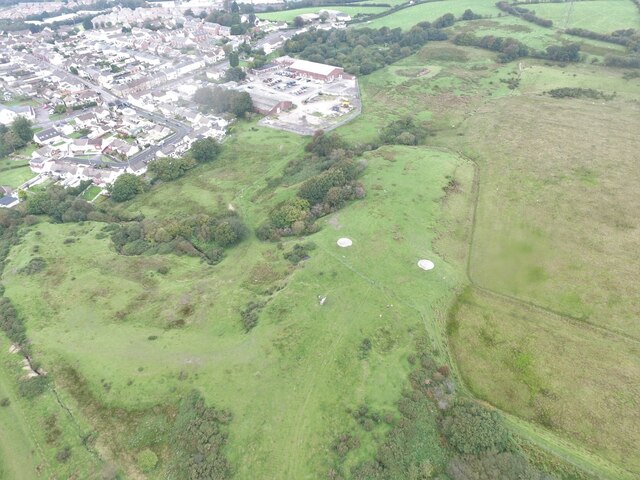
The two shafts stand capped off; a 2020 aerial photograph shows the capped shaft heads and the line of a former railway siding running between them into the adjoining brickyard (see image, below).
Capped shaft heads are visible; the associated brickworks site adjoins them.
Redevelopment
Not established from the sources read for this pass.
Nearby mines
- Park Slip Colliery — 4.4 km W
- Wyndham Western Colliery — 5.1 km N
- Lluest Colliery — 5.6 km N
- Ffaldau Colliery — 7.2 km N
- Bryndu Colliery — 7.8 km W
Straight-line distance, within 15 km. Show on the map.
Disasters & major incidents
-
Barrow Colliery shaft accident, 1874
26 September 1874 · Winding / Shaft Accident · 5 fatalities
Five masons and sinkers drowned when a scaffold platform collapsed and dropped them 30 feet into the flooded sump of a shaft then being sunk for the new Barrow pits at Bryncethin, after a cast-iron crab winch failed. -
Barrow Colliery gas outburst, 1911
22 July 1911 · Gas / Asphyxiation · 3 fatalities
A sudden outburst of gas through a borehole overcame the manager and three men driving a roadway to release an accumulation of gas at Barrow Colliery; the three men died. Collier George Edwards was awarded the Edward Medal, 2nd Class, for repeated attempts to reach them.
Recorded claims
Individual factual claims, each attached to the source(s) that support it below. Where sources disagree, both are kept.
- Small-scale house-coal working at Bryncethin — Robert Watson's pits in the 1830s and a small colliery at Tynycoed sunk c.1830 — predates the deep Barrow shafts by decades. (uncertain) 1
- No.1 pit was sunk in 1870 by the Glassbrook Company of Swansea to an 18-foot seam; in 1873 Glassbrook sold the colliery for £30,000 to the Barrow Company, who spent £10,000 finding the coal and were, per the 1954 interview, the only company to make money from coal mining at Bryncethin. 1
- The Barrow Company sank No.2 and No.3 pits on Waungoch field from 1873, to 380 and 400 yards respectively, and built a brickworks; No.1 closed c.1885 and No.2/No.3 c.1886. 1
- The pits were reopened in 1905 to a shallower 290-yard stage; by 1908 the Bryncethin Colliery Co. Ltd employed 200 men across No.2 and No.3. 1
- The colliery closed at the end of 1915; a reopening as New Bryncethin under French, then Belgian, backing failed, and the colliery closed for the last time in 1921. 1
- Five men died on 26 September 1874 when a scaffold gave way over the flooded sump of a shaft then being sunk for the colliery (see Disasters, below). 1,2
Photographs & further reading
History, ownership and closure, plus a 1954 interview transcript on earlier small-scale Bryncethin mining.
View sourceNorthern Mine Research Society account of the 1874 shaft-sinking accident, with inquest evidence.
View sourceSources
- (secondary) Barrow Colliery Bryncethin (Welsh Coal Mines) — Welsh Coal Mines
- (secondary) Bryn Cethin Colliery Shaft Accident - Bridgend - 1874 — Northern Mine Research Society
Record created: 13 September 2026 · Last researched: 14 September 2026