 MineArchive
Slant
| Dialect | Welsh |
|---|---|
| Category | Mine Workings & Access |
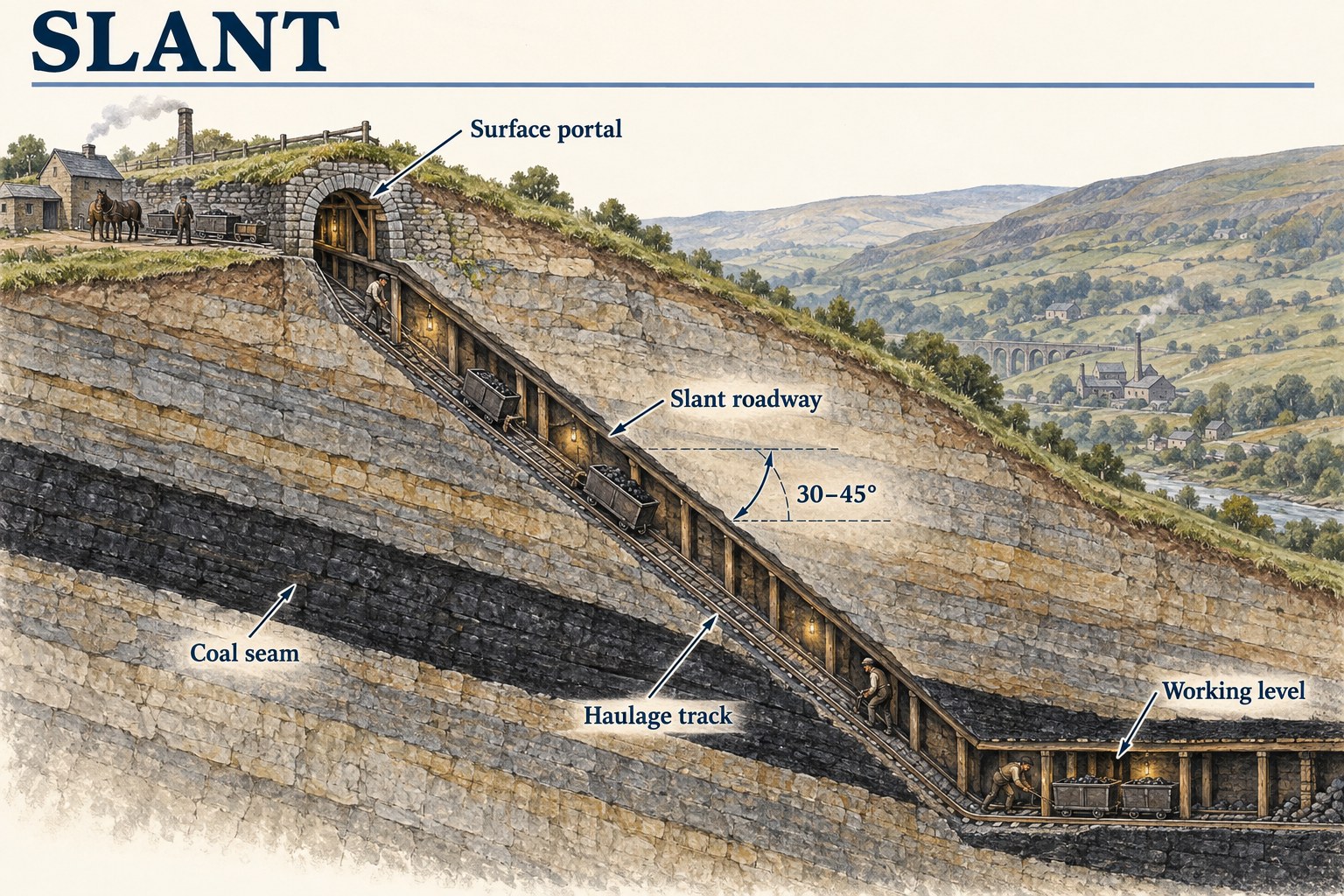
A roadway or working driven at a steep angle into a coal seam, used in Wales in place of a vertical shaft where the geology allowed it.
Historical usage
Where a coal seam's angle and depth suited it, South Wales collieries could be opened and worked entirely through a slant, avoiding the cost of sinking a vertical shaft altogether. Pentremawr Colliery, in the Gwendraeth valley, is a documented example: driven as a slant mine, it worked its anthracite through three initial slants — Capel Ifan Nos.1, 2 and 3 — with a fourth added in 1913, needing no shaft at all. The word was used as part of a colliery's working name, not merely as a description of it. Aberpergwm Colliery in the Vale of Neath was the name given to a group of slant mines rather than to one pit, with a mine of that name in the records as far back as 1811 and the modern Aberpergwm slant opened in 1906. Others in the same valley were named the same way: the Rock Slant, whose men transferred to the new Pentreclwydau drift when it closed in 1959, and the Ladysmith Red Vein Slant, worked by the Ynisarwed Collieries Company from 1923 to 1925. When the National Coal Board reorganised the Glyn-neath mines in the late 1950s it opened new slants at Cwmgwrach and Pentreclwydau and built a central washery at Aberpergwm to serve them.
How it worked
A slant was driven at roughly 30 to 45 degrees from the surface (or from a level roadway) down into the seam, following its natural angle rather than cutting straight down through it; within a working district, similar angled roadways also connected gate roads to the main haulage, cutting down on how much level roadway had to be maintained.
Why it was used
Where the coal seam's own angle made it practical, a slant let a colliery reach its coal without the far greater capital cost, and time, of sinking and lining a vertical shaft.
Risks & limitations
Slant mines remained exposed to the same underground hazards as any colliery — at Pentremawr, geological faults and gas accumulation limited commercial extraction despite the mine's access advantages.
Regional variation
'Slant' is the Welsh term for this kind of angled roadway; equivalent workings elsewhere in Britain were known by other regional names, including 'downbrow' in some coalfields and 'gug' in Somerset. In practice the same working could be called either a slant or a drift by different sources and at different dates — Aberpergwm's slants are catalogued today under the name Aberpergwm Drift — so the two words should be read as overlapping rather than as a strict distinction.
Related terminology
Mines associated with this term
5 examples chosen from 112 linked records — the term page is not an index.
- Abernant Colliery — Neath Port Talbot (well documented example)
Named in this record’s history: “…In 1968 men transferred from the closed Yniscedwyn Colliery, used to slants, refused to go down a shaft; in 1970 the NCB spent a further £4.5…” - Park Slip Colliery — Bridgend (well documented example)
Named 3 times in this record, first in the history: “…coalfield's southern outcrop. The colliery was worked through two slants fifteen yards apart, and by 1892 had eight horizontal levels off the…” - Aber Colliery — Bridgend (well documented example)
Named twice in this record, first in the history: “…were fined £10 and £5 under the Mines Act. The No. 2 Rhondda slant was closed in 1894, and by 1896 Cory Brothers owned the colliery…” - Aberbaiden Colliery — Neath Port Talbot (well documented example)
Named 13 times in this record, first in the summary: “Baldwins' slant mine north of Kenfig Hill, opened out in 1906 with the Pentre Slant…” - Ammanford Colliery — Carmarthenshire (well documented example)
Named 6 times in this record, first in the summary: “…were imprisoned, and No. 1 was closed in reprisal. The Ammanford Slant was replaced by the Betws New Mine in 1975 and closed on 10…”
Disasters associated with this term
5 examples chosen from 29 linked records, most direct relationship first.
- Aberaman Colliery roof fall, 1908 (contextual relationship)
Named twice in this record, first in the cause: “Loosening a bridge of cliff released a mass of rock from a concealed slant above the road.” - Aberbaiden Colliery Pentre Slant explosion, 1944 (contextual relationship)
Named 5 times in this record, first in the summary: “An explosion in the Pentre Slant of Aberbaiden Colliery, north of Kenfig Hill, on the night shift of…” - Aberpergwm Colliery runaway tram, 1901 (contextual relationship)
Named in this record’s narrative: “…Robson, said a banksman should have been stationed at the top of the slant. The jury returned a verdict of accidental death and added the…” - Brynamman Colliery Inrush, 1933 (contextual relationship)
Named twice in this record, first in the summary: “Water broke into a slant at Brynamman Colliery, trapping miners in the dark and flooding the…” - Cadean Slant manrider accident (contextual relationship)
Named 3 times in this record, first in the summary: “…of the manrider train broke as the day shift rode out of the Cadean Slant at Trimsaran, 850 yards inside the drift. The side chains meant to…”
Sources
- (secondary) Aberpergwm Drift, Glynneath — Welsh Coal Mines
- (secondary) Glossary of coal mining terminology — Wikipedia
- (secondary) Pentremawr Colliery — Wikipedia
Record created: 27 August 2026 · Last researched: 9 September 2026