 MineArchive
Cadean Slant manrider accident
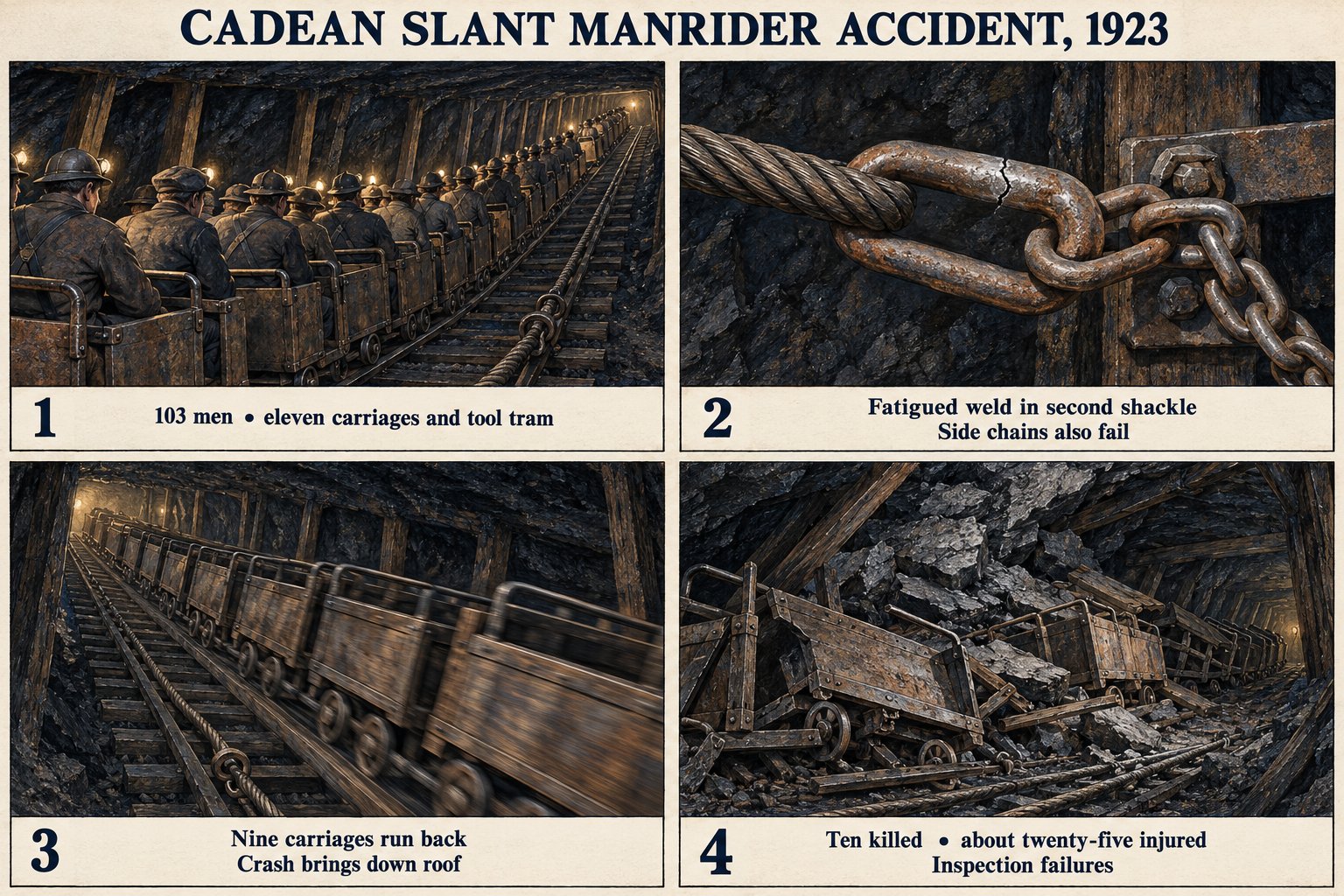
A link in the second shackle of the manrider train broke as the day shift rode out of the Cadean Slant at Trimsaran, 850 yards inside the drift. The side chains meant to hold the carriages failed too, nine carriages and the tool tram ran back down the slope and crashed into the side of a heading, bringing down the roof. Ten of the 103 men aboard were killed.
| Date | 26 April 1923 |
|---|---|
| Mine | Trimsaran Colliery |
| Region | Carmarthenshire |
| Type | Haulage / Transport |
| Fatalities | 10 (Ten, given by both the Northern Mine Research Society's account of the inspector's report and by Welsh Coal Mines, which names the same men. The Daily Mail reported nine the following morning, seven killed outright and two who died on the way to hospital.) |
| Context | During active mining |
Cause
One link of the second shackle from the front of the train failed through a fatigued weld. The side chains fitted to comply with the Coal Mines Act then gave way under the weight of nine carriages and the tool tram.
Contributing factors
The inquiry found that the company had not treated the design of the manrider train as weak and had examined it only cursorily. The shackle that broke was about nine years old and had been on the train for three; it had been annealed in October 1922 and again five weeks before the accident, but only the first annealing was recorded. Defects were also found afterwards in the woodwork of the carriages. The manager and the mechanic were held to have failed to make the inspections the Act required.
What happened
The Cadean Slant had been opened in 1908 to work the Yard and Big Vein seams down from the outcrop, and by 1923 the main slant ran 1,350 yards at an average of ten inches to the yard, steepening to fifteen near faults. The colliery raised about 200 tons of anthracite a day on three shifts. Men rode in and out in a train of eleven carriages and a tool tram, known locally as a spake, hauled by a Robey drop-valve steam engine standing 400 yards from the drift mouth. The speed limit for hauling men was three miles an hour against six for coal, fixed by the manager and posted in the engine house.
At the end of the day shift on 26 April 1923 the spake was waiting at 14 East to take the men out from Nos. 15 and 17 Levels. It stopped at the No. 10 West heading to pick up eighteen more, and went on with 103 men aboard. About 850 yards from the drift mouth a link of the second shackle from the front gave way. The weight of nine carriages and the tool tram came onto the side chains, which also failed, and all but two carriages ran back. After 130 yards they crashed into the side of a heading and brought down a great fall of roof. Most of the men jumped clear and were slightly hurt in doing so; others were caught and dragged. Ten were killed and a great number injured, though only two of the injured seriously.
Rescue & recovery
The dead were William Jenkins, the under-manager, aged 42; Harold Parry, 25; Harold Probert, 16; Morgan Davies, 22; Thomas Williams, 48; Thomas John, 68; David Tom Davies, 20; William John Rees, 24; Sidney Williams, 25; and Thomas Rogers, 21. Around twenty-five were injured and taken to Llanelly hospital; it was hours before all of them could be got out of the wreckage.
Investigation & inquiry
J. M. Carey reported on the accident for the Mines Inspectorate, and all interested parties were represented at the coroner's inquest. The prime cause was found to be the failure of one link of the second shackle through faulty welding, with the side chains failing to hold.
Legal & regulatory aftermath
The manager and the mechanic were prosecuted for a breach of the Coal Mines Act.
Changes to practice & legislation
Recommendations were made about the construction of manrider trains.
What's uncertain
Points where sources disagree or the record could not be settled; both accounts are kept. All open questions in the archive.
- Ten men were killed. The Northern Mine Research Society's account of J. M. Carey's report and Welsh Coal Mines both give ten and name the same men; the Durham Mining Museum also gives ten. The Daily Mail of 27 April 1923 reported nine, seven killed outright and two who died on the way to hospital, a count taken before every death was known. (disputed) 1,2,3
- Carey's report gives the main slant as 1,350 yards on the date of the accident. Welsh Coal Mines, following the contemporary newspaper account, gives 1,400 yards. (disputed) 2,3
Recorded claims
Individual factual claims, each attached to the source(s) that support it below. Where sources disagree, both are kept.
- Ten men were killed. The Northern Mine Research Society's account of J. M. Carey's report and Welsh Coal Mines both give ten and name the same men; the Durham Mining Museum also gives ten. The Daily Mail of 27 April 1923 reported nine, seven killed outright and two who died on the way to hospital, a count taken before every death was known. (disputed) 1,2,3
- One link of the second shackle from the front of the train failed through a fatigued weld, and the side chains fitted to comply with the Act gave way under the load. 3
- Carey's report gives the main slant as 1,350 yards on the date of the accident. Welsh Coal Mines, following the contemporary newspaper account, gives 1,400 yards. (disputed) 2,3
Related terminology
Mining terms this disaster is structurally linked to, with the nature of the relationship.
- Anthracite (contextual relationship)
Named in this record’s narrative: “…to fifteen near faults. The colliery raised about 200 tons of anthracite a day on three shifts. Men rode in and out in a train of eleven…” - Man-riding (contextual relationship)
Named 3 times in this record, first in the summary: “A link in the second shackle of the manrider train broke as the day shift rode out of the Cadean Slant at…” - Slant (contextual relationship)
Named 3 times in this record, first in the summary: “…of the manrider train broke as the day shift rode out of the Cadean Slant at Trimsaran, 850 yards inside the drift. The side chains meant to…” - Tub (contextual relationship)
Named 4 times in this record, first in the summary: “…meant to hold the carriages failed too, nine carriages and the tool tram ran back down the slope and crashed into the side of a heading,…” - Undermanager (contextual relationship)
Named in this record’s rescue and recovery: “The dead were William Jenkins, the under-manager, aged 42; Harold Parry, 25; Harold Probert, 16; Morgan Davies, 22;…”
Photographs & further reading
This page doesn't try to reproduce everything — these are the best original sources found for this disaster.
The Northern Mine Research Society's account of J. M. Carey's report, with the dimensions of the slant, the construction of the manrider carriages and shackles, the sequence of the accident and the findings of the inquest. Reached through the Internet Archive because the society's live site now redirects deep links to its home page.
View sourceThe colliery's three drifts and their seams, the names and family circumstances of the ten men killed in 1923, and the Daily Mail's report of the accident printed the following morning.
View sourceSources
- (primary) Trimsaran Colliery — Durham Mining Museum
- (secondary) Trimsaran Colliery — Welsh Coal Mines
- (primary) Report by J. M. Carey on the accident at Cadean Slant, Trimsaran, 26 April 1923 — Northern Mine Research Society, via the Internet Archive
Record created: 11 September 2026 · Last researched: 11 September 2026