 MineArchive
Blower
| Category | Ventilation & Mine Gases |
|---|
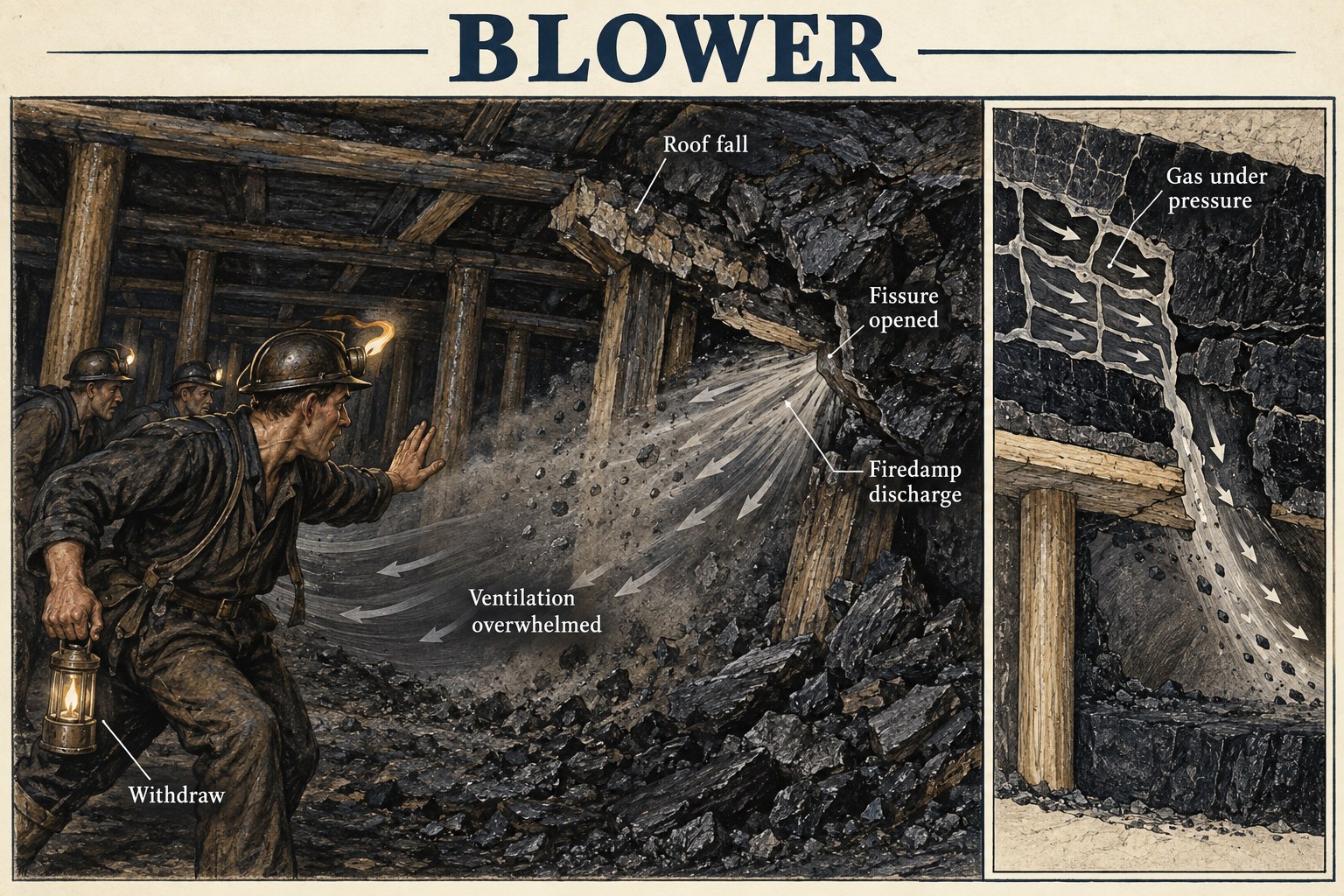
A sudden and violent discharge of firedamp into the workings from the coal, the roof or the floor — gas arriving all at once from a fissure instead of seeping steadily.
Historical usage
All three of the great nineteenth-century coalfield glossaries carry it in nearly the same words. Greenwell, for Northumberland and Durham, has 'a sudden and violent discharge of gas from the roof, seam of coal, or floor'. Barrowman, for Scotland, adds that it can be heard: 'the abundant and audible emission of fire-damp from a fissure; the point of issue.' Gresley, writing nationally, is the fullest: a sudden emission or outburst of firedamp, the gas generally coming out of the coal, frequently continuing to flow for many days or weeks, at pressures at first not infrequently of three or four hundred pounds to the square inch, and sometimes in volumes great enough to fill a large part of an extensive set of workings.
How it worked
Gas held under pressure in the pores and cleats of the coal, or in a fissure behind it, escapes when the working or a fall opens a path to it. The pressure falls away as the gas comes off, so a blower is at its most dangerous in the minutes and hours after it starts, and may then go on quietly discharging for weeks. A fall of roof can start one without any warning to the men working near it.
Why it was used
The word matters because it names a particular failure mode. A colliery could be well ventilated for the gas it normally made and still be overwhelmed by a blower, which is why the inspectors' reports distinguish between an explosion caused by inadequate ventilation and one caused by a sudden discharge that no ordinary ventilation would have carried away in time.
Risks & limitations
A blower puts an explosive mixture into the workings faster than the air current can clear it, and it goes where the air goes — including towards a furnace at the bottom of an upcast shaft, or towards the naked lights that many collieries still allowed. The explosion that killed sixty-four men at Middle Duffryn in 1852 was attributed to exactly this: a fall in the deep heading dislodged gas, which rushed towards the ventilating furnace or met an open light on the way.
Regional variation
General British usage: the northern, Scottish and national glossaries all use the same word for the same thing. Greenwell cross-refers it to a bag of gas, the pocket the discharge comes out of.
Related terminology
Chokedamp, Firedamp, Naked Light, Outburst
Mines associated with this term
5 examples chosen from 7 linked records — the term page is not an index.
- Bryn Hall Colliery — Greater Manchester (well documented example)
Named in this record’s geology: “…and Wigan Nine Feet seams. The Nine Feet gave off gas from several blowers and its coal was unusually hard.” - Crimea Colliery — Neath Port Talbot (well documented example)
Named twice in this record, first in the history: “…dry dock at Lock 17. The pit had raised little coal when, in 1858, blowers of gas were met; an explosion about four months earlier had burned a…” - Edmunds Main Colliery — South Yorkshire (well documented example)
Named twice in this record, first in the history: “…with gunpowder. On 8 December 1862 a shot at the dip end opened a blower of gas, which took fire. Men fought the flames and tried to rebuild…” - Gospel Oak Colliery — West Midlands (well documented example)
Named in this record’s history: “…of firedamp burned Thomas Bright, a bandsman, and John Dunning, a blower, who died over the following ten days. A pikeman named Tabrah was…” - Middle Duffryn Colliery — Rhondda Cynon Taf (well documented example)
Named in this record’s geology: “…dislodged from the roof by falls — what the reports of 1852 called a blower — is the recurring cause in the colliery's accident record.”
Disasters associated with this term
5 examples chosen from 33 linked records, most direct relationship first.
- Blaenhirwaun Colliery explosion, 1955 (direct cause)
A roof blower issued about 400 cubic feet a minute. - Moorfield Colliery explosion, 1883 (direct cause)
A blower near a fault supplied the gas. - Felling Colliery explosion, 1813 (hazard involved)
Blowers in the southern boards discharged gas. - Lower Duffryn Colliery explosion, 1858 (hazard involved)
The seam gave off sudden blowers. - Middle Duffryn Colliery explosion, 1850 (hazard involved)
A witness thought a blower had broken out.
Sources
- (primary) G. C. Greenwell, A Glossary of Terms used in the Coal Trade of Northumberland and Durham (first published 1849; 1888 edition) — G. C. Greenwell, colliery viewer; digitised by the Internet Archive
- (primary) Glossary of Scotch Mining Terms — James Barrowman (1886), via Scottish Mining Website
- (primary) W. S. Gresley, A Glossary of Terms used in Coal Mining (1883) — W. S. Gresley; digitised by the Internet Archive
Record created: 4 September 2026 · Last researched: 4 September 2026