 MineArchive
Naked Light
| Also known as | Naked flame, Midgie (North East England), Open light |
|---|---|
| Category | Structures & Machinery |
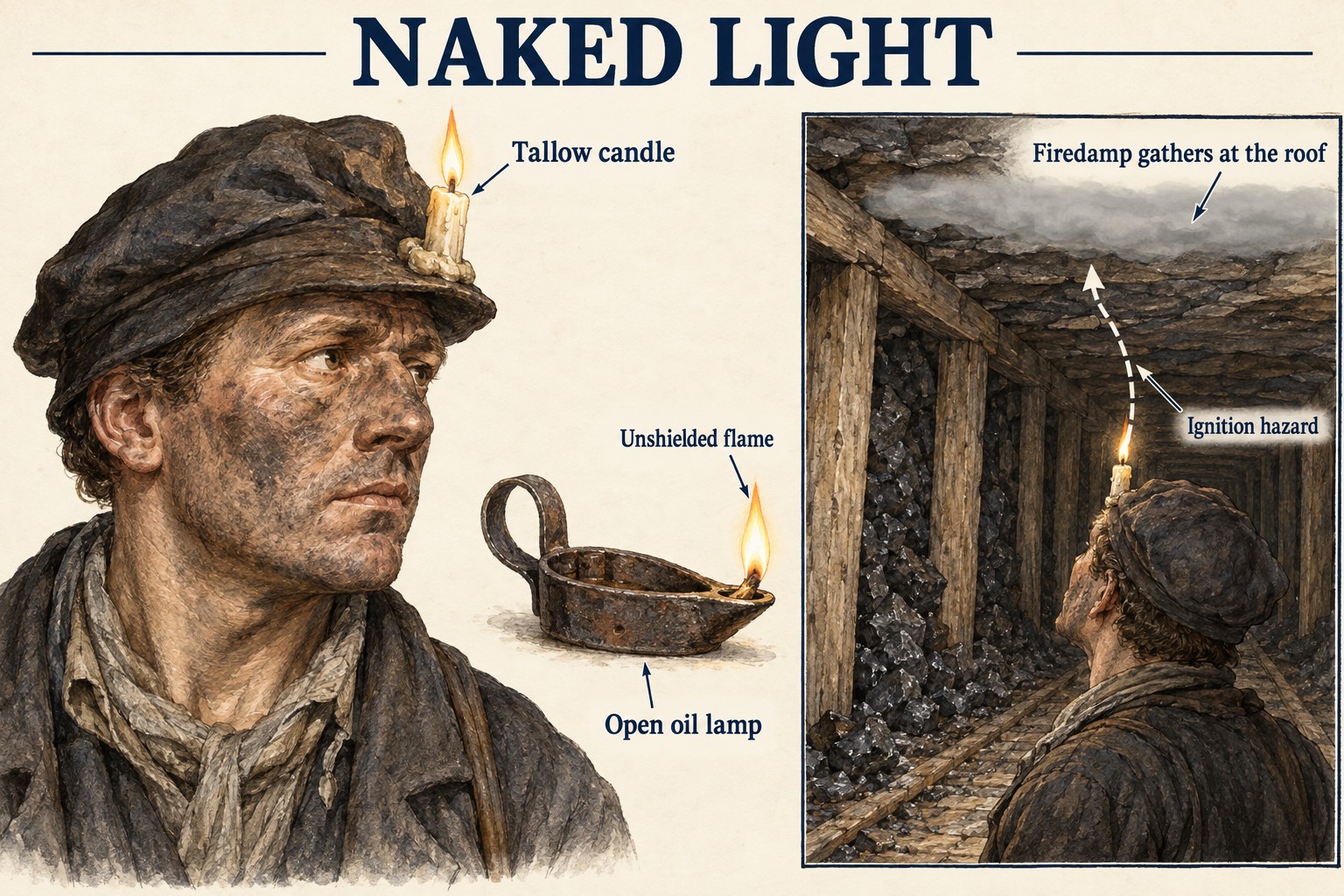
Any unshielded flame carried underground for light — a tallow candle, an open oil lamp, or a torch. Before the safety lamp there was nothing else, and in a mine carrying firedamp a naked light is an ignition source moving about the workings at head height.
Historical usage
Miners took open flames underground as a matter of course, and the phrase 'naked light' enters the record mainly through the reports written after they set something off. It is a standing presence in the disaster accounts in this archive. Sir Roger Mostyn's account of the firedamp explosion at Mostyn Colliery on 3 February 1675 is among the earliest first-hand descriptions anywhere of what such an ignition does.
The Felling pit disaster of 1812 near Gateshead, in which 92 men died, was among the stimuli for inventing a lamp that would give light without igniting gas, and the Davy lamp, the Geordie lamp and Clanny's lamp followed. Prohibition did not follow neatly from invention. Rules requiring safety lamps were in principle strict but in practice were neither observed nor enforced, because miners preferred the better light a naked flame gave. The compromise reached in many pits was geographic rather than absolute: at Trimdon Grange in 1882 the official report records that the only lamp in general use was the old Davy pattern, and that naked lights called 'midgies' were carried by the driver boys and permitted as far as caution boards set at a safe distance from the working places.
How it worked
A candle was fixed to the hat, wedged in a crevice, or stuck to a timber with its own tallow. Beyond lighting, the flame was also an instrument: before safety lamps, a candle was the standard test for firedamp. The candle was trimmed and the excess fat removed, held at arm's length at floor level with the other hand shielding all but the tip of the flame, and raised slowly while the tip was watched. If it stayed unchanged the air was safe; if it turned bluish-grey and drew up into a thin extended point of deeper blue, firedamp was present.
Why it was used
Light. A naked flame is far brighter than the same flame behind gauze, and the safety lamp's gauze cut its output badly — which is exactly why men went on using candles in pits where they were forbidden. In a mine known not to be gassy, or in the parts of a gassy mine thought safe, a naked light was simply the cheapest and best illumination available.
Risks & limitations
It ignites firedamp, and firedamp is explosive between roughly five and fifteen per cent in air. That is the whole of the risk and it is sufficient. The disaster records in this archive turn repeatedly on where naked lights were permitted, how far the caution boards stood from the face, and whether anyone had checked the air lately. A naked light is also useless as a warning: unlike a safety lamp, whose flame lengthens and blues in gas and can be read by anyone trained to look, an open candle carried into a body of firedamp gives no notice at all before it fires it.
Related terminology
Blower, Deputy, Firedamp, Overman, Safety Lamp, Shot-firing
Mines associated with this term
5 examples chosen from 66 linked records — the term page is not an index.
- Gethin Colliery — Merthyr Tydfil (well documented example)
Named twice in this record, first in the geology: “…in a heading that the ventilation could not clear, in a pit where naked lights were still in general use.” - Abercrave Colliery — Powys (well documented example)
Named twice in this record, first in the history: “…from firedamp: Thomas Rees in 1895, burned with three others when naked lights fired gas in the Big Vein on the night shift, and Thomas Thomas in…” - Bartonholm Colliery — North Ayrshire (well documented example)
Named in this record’s workings: “…— the 'cube' at the bottom of the upcast shaft, lit daily — and naked lights were still carried underground. The colliery had at least three…” - Black Vein Colliery — Caerphilly (well documented example)
Named twice in this record, first in the history: “…death pit. Mechanical ventilation replaced the furnace in 1858, but naked lights were still in use underground. On 1 December 1860 an explosion in…” - Blackrod Colliery — Greater Manchester (well documented example)
Named in this record’s history: “…gives that pit as Mr Blundell's, worked with safety lamps but with naked lights taken in too (see Disasters, below); the museum's own dating of this…”
Disasters associated with this term
5 examples chosen from 168 linked records, most direct relationship first.
- Bamfurlong Colliery fire, 1892 (direct cause)
An open paraffin torch started the fire. - Black Vein Colliery explosion, 1846 (direct cause)
A candle's naked flame was the ignition source. - Black Vein Colliery explosion, 1853 (direct cause)
A naked candle was used instead of a safety lamp. - Blairmuckhill Colliery explosion, 1915 (direct cause)
All three men carried naked lamps in their caps. - Bryndu Colliery explosion, 1852 (direct cause)
The men carried candles.
Sources
- (primary) Report of T. W. Snagge on the Explosion at Trimdon Grange Colliery, 16 February 1882 — The National Archives
- (secondary) Safety lamp — Wikipedia
Record created: 3 September 2026 · Last researched: 3 September 2026