 MineArchive
Downcast Shaft and Upcast Shaft
| Also known as | Downcast Shaft (The intake half of the shaft pair), Upcast Shaft (The return/exhaust half of the shaft pair), Upcast, Downcast |
|---|---|
| Category | Ventilation & Mine Gases |
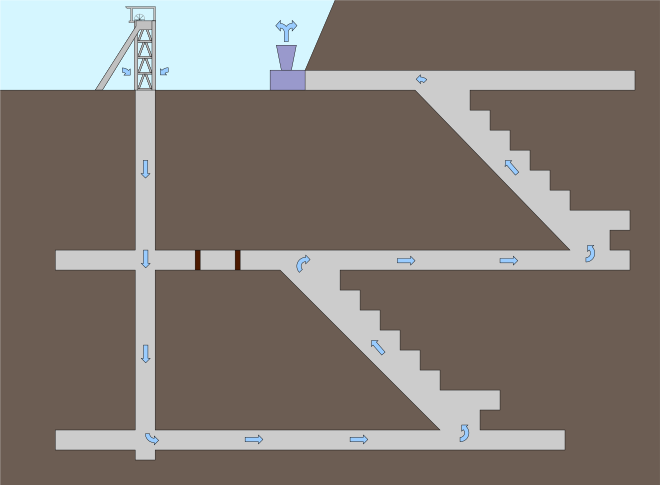
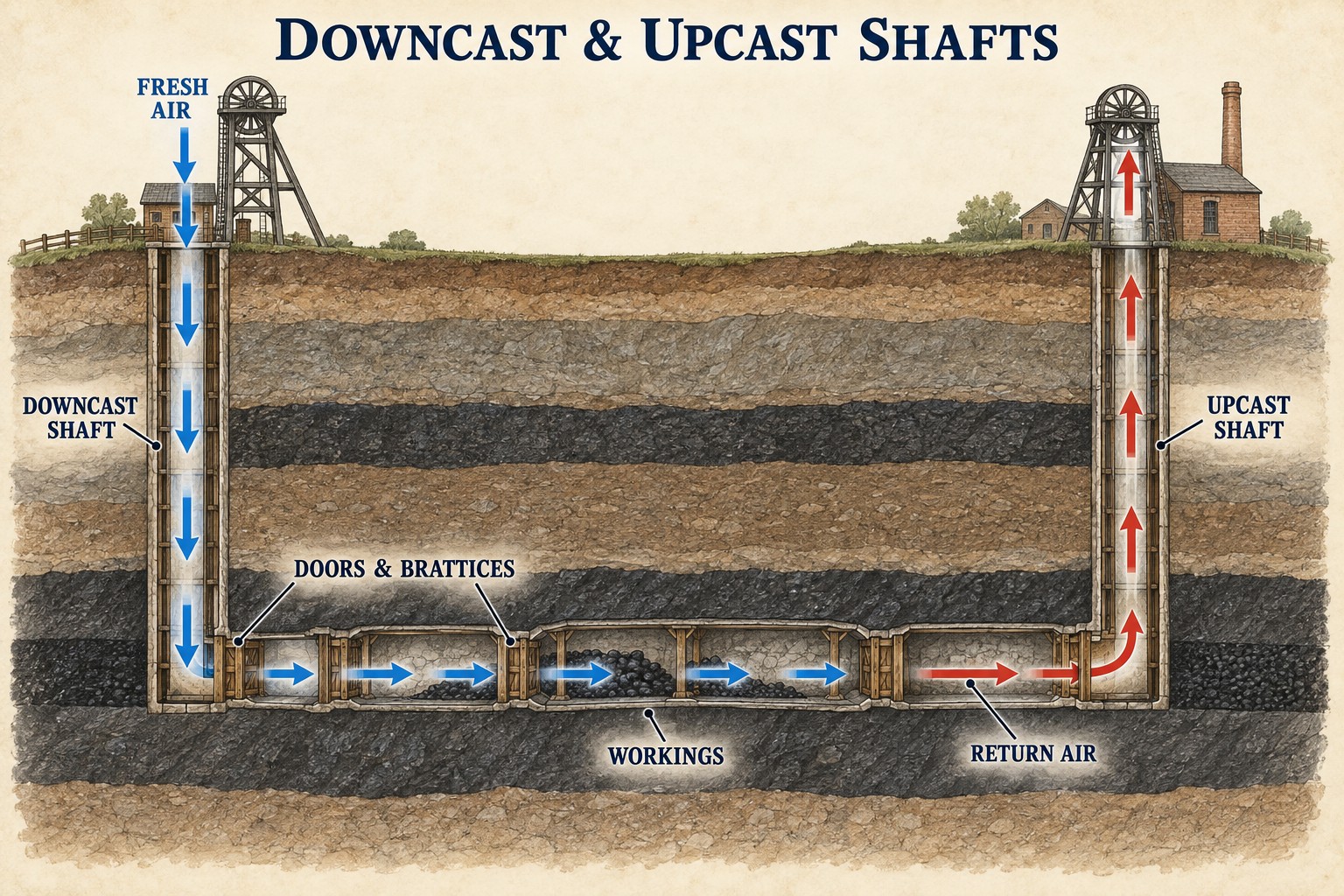
The paired shafts of a mine's ventilation circuit: the downcast shaft, down which fresh air is drawn into the workings, and the upcast shaft, up which that same air — now warmed, damp and contaminated — is expelled back to the surface.
Historical usage
Sinking shafts at different points so that air would naturally rise in one and fall in the other was among the earliest deliberate ventilation techniques in British mining, already in use as collieries grew beyond what a single shaft could adequately air.
How it worked
Fresh air entering the downcast shaft was directed through the workings by doors and brattices — historically opened and closed by boy trappers — before returning to the upcast shaft. Natural ventilation relied on the temperature difference between the two air columns, the warmer, lighter air in the upcast rising and drawing replacement air down the cooler downcast shaft; a fire or furnace lit at the upcast shaft's foot, or a brazier hung near its mouth, was often used to strengthen this effect. In 1813 the engineer John Buddle introduced two significant refinements: 'splitting the air' — dividing the ventilating current into several parallel circuits rather than one single loop — and the 'dumb furnace', a design intended to draw air without the furnace itself sitting directly in the shaft. Mechanical fans later replaced furnace ventilation entirely, but the basic downcast/upcast pairing remained the operating principle.
Why it was used
A mine cannot ventilate itself through one opening alone — air needs a path in and a separate path out, or it simply stagnates. Splitting a mine's shafts into an intake and a return let ventilation be directed and controlled through the workings, rather than left to chance.
Risks & limitations
Furnace ventilation was a serious hazard in its own right: the upcast shaft carried the mine's used, gas-laden return air directly past an open flame, and furnace ignition of firedamp was a recurring cause of explosions before mechanical fans took over. Natural ventilation alone was also unreliable, weakening in mild or still weather when the temperature difference between the two shafts was small.
Related terminology
Firedamp, Furnace Ventilation, Return Airway, Shaft, Thirling, Winding Engine
Mines associated with this term
5 examples chosen from 211 linked records — the term page is not an index.
- Abercynon Colliery — Rhondda Cynon Taf (well documented example)
Named 4 times in this record, first in the history: “…Valley saw. Two shafts went down to the Nine Feet seam — South, the upcast, at 740 yards and North, the downcast, at 753 yards — their winding…” - Abernant Colliery — Neath Port Talbot (well documented example)
Named 4 times in this record, first in the history: “…North pit on 25 January; sinking was finished in 1958. The North (upcast) shaft reached 836 or 837 yards and the South (downcast) 987 yards,…” - Blaenserchan Colliery — Torfaen (well documented example)
Named in this record’s history: “…and using the neighbouring Llanerch Colliery as its ventilation (downcast) shaft. The shaft was deepened to 362 yards in 1899 to reach the…” - Cambrian Colliery — Rhondda Cynon Taf (well documented example)
Named twice in this record, first in the geology: “…probably through exhaustion. No.3 shaft, serving as the return air upcast, reached 1,577 feet at the Lower Five Feet/Gellideg level, making it…” - Cardowan Colliery — North Lanarkshire (well documented example)
Named twice in this record, first in the history: “…mid-1930s and around 2,000 by the mid-1950s. A third shaft, No.3 (downcast), was sunk in 1958, its 23-metre steel-framed tower, built by…”
Disasters associated with this term
5 examples chosen from 50 linked records, most direct relationship first.
- Oakley pit explosion, 1856 (contributing factor)
An opening in the midwall short-circuited the air. - Albion Colliery shaft collapse, November 1886 (contextual relationship)
Named in this record’s narrative: “By November 1886 the Albion's upcast shaft had been sunk to about 470 yards and walled with brick. On 4…” - Aldwarke Main Colliery shaft accident, 1904 (contextual relationship)
Named twice in this record, first in the contributing factors: “Steam and slightly salt water in the upcast shaft; corrosion inside the rope that daily examination could not see.” - Bent Grange Colliery explosion, 1850 (contextual relationship)
Named in this record’s narrative: “…the colliery was ventilated by a fan; a second shaft, used as the downcast, was finished in February 1851. Bent Grange exploded again in July…” - Bent Grange Colliery explosion, 1853 (contextual relationship)
Named in this record’s narrative: “…a second shaft was sunk, finished in February 1851, and used as the downcast, with steam jets in the old shaft to draw the air. The 1853…”
Sources
- (primary) Ventilation of the Mine — Durham Mining Museum
- (secondary) Definition of downcast shaft — Mindat
- (secondary) Definition of upcast shaft — Mindat
- (secondary) Ventilation in North East mines 1800-1850 — North East Bylines
Record created: 25 August 2026 · Last researched: 25 August 2026