 MineArchive
Thirling
| Category | Ventilation & Mine Gases |
|---|
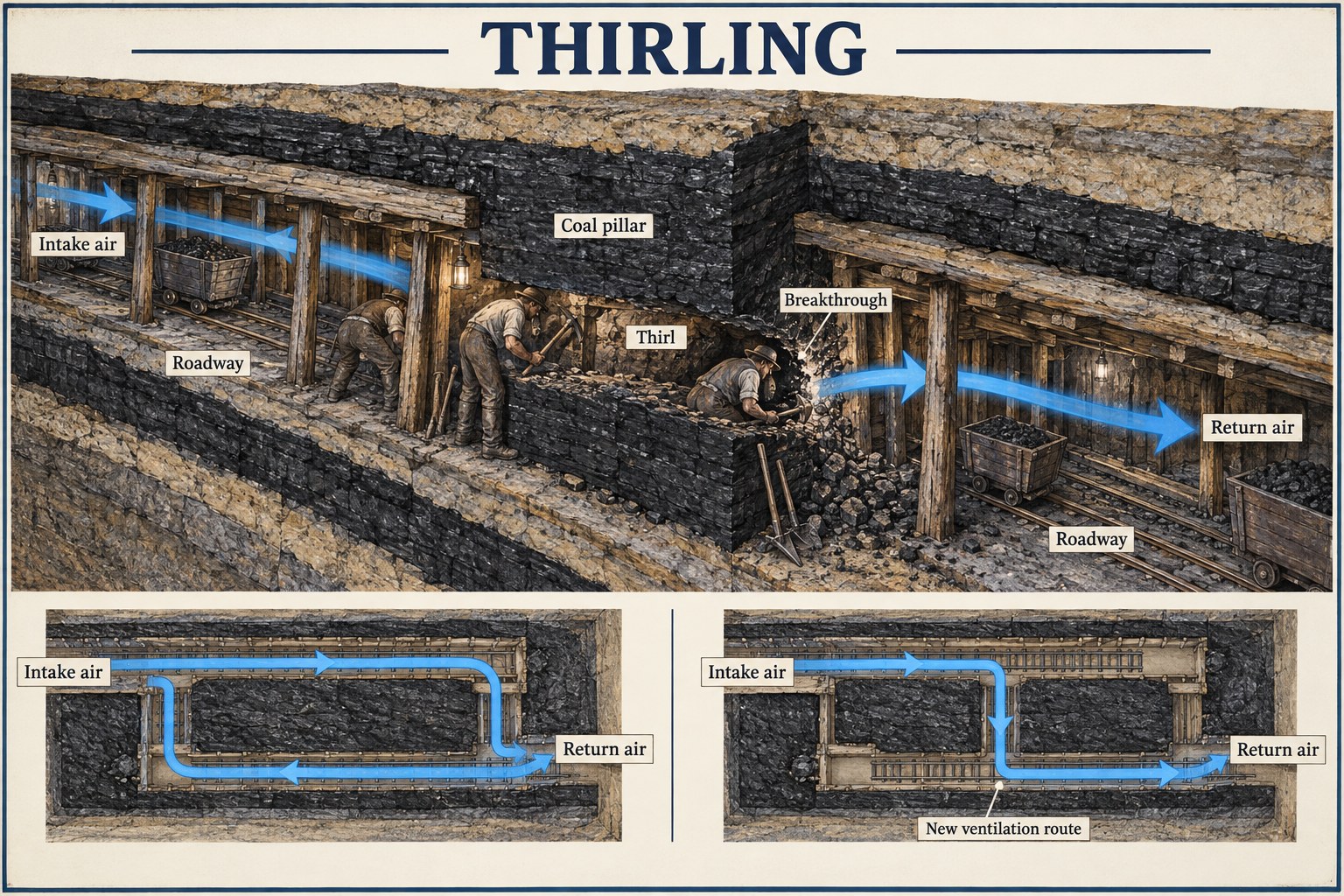
The driving of a short connecting passage — a thirl — between two adjacent underground roadways or workings, most often to complete or improve a ventilation circuit.
Historical usage
An old term: a 1486 South Yorkshire mining lease already describes coal pits being driven "of new thyreled", and the word remained in ordinary use well into the twentieth century. Ann Lister's 1833 diary of Halifax coalpit business describes air being carried into the main shaft "by thirls at about 25 to 30 yds from each other" — regularly spaced connecting passages used deliberately as a ventilation system.
How it worked
A thirl connects two roadways that are being driven towards each other, or links an existing roadway to an adjacent one, opening a new path for air to circulate between a mine's downcast shaft and upcast shaft. Cutting one shortens or reroutes the path air has to travel before reaching a shaft or ventilating furnace/fan.
Why it was used
Thirling let a mine's ventilation circuit be extended or adjusted without sinking a new shaft — a comparatively cheap way to bring air to a new working area, or to correct a ventilation layout as workings advanced.
Risks & limitations
Because a thirl changes how air flows through a mine, cutting one carelessly could shorten the distance available to dilute firedamp before it reached a source of ignition such as a ventilating furnace — exactly the failure identified as a likely contributing factor in the Apedale Colliery Explosion of 1878, where a new thirling cut the day before the disaster reduced the return air route's length.
Related terminology
Downcast Shaft and Upcast Shaft, Firedamp
Mines associated with this term
Included only where MineArchive's own research gives a reasonable evidential basis — not every mine where this might plausibly apply.
- Apedale Colliery — Staffordshire (notable incident)
A new thirling cut the day before the 1878 Burley Pit explosion shortened the return air route, identified as a likely contributing factor in the disaster that killed 23 men and boys.
Disasters associated with this term
5 examples chosen from 8 linked records, most direct relationship first.
- Leycett Colliery explosion, 1879 (contributing factor)
The levels were driven beyond the thirlings. - Apedale Colliery Explosion, 1878 (contextual relationship)
Named twice in this record, first in the cause: “…which, though a ventilation change made the day before (a new 'thirling', or connecting air passage, that shortened the return air route)…” - Apedale Colliery Sladderhill No. 3 Pit explosion, 1891 (contextual relationship)
Named in this record’s contributing factors: “…station too near the face; dust from 'riddling' coal down the thirlings; management the jury called most lax and negligent.” - Bunker's Hill Colliery Explosion, 1875 (contextual relationship)
Named in this record’s cause: “…concluded that the explosion was caused by the firing of a shot in a thirling on the east side of the Engine-brow, the flame of the blast reaching…” - Leycett Colliery explosion, 1871 (contextual relationship)
Named in this record’s investigation: “…being what they were, and recommended greater care in pushing the thirlings forward, which the manager undertook to act on.”
Sources
- (primary) Apedale Colliery Explosion — Newcastle-under-Lyme — 1878 — Northern Mine Research Society
- (secondary) Thirl — Yorkshire Historical Dictionary — University of York
Record created: 2 September 2026 · Last researched: 2 September 2026