 MineArchive
Apedale Colliery Explosion, 1878
An explosion at the No. 1 Burley Pit of Apedale Colliery, near Newcastle-under-Lyme, killed twenty-three men and boys — the worse of two major explosions to strike the pit within a decade.
| Date | 27 March 1878 |
|---|---|
| Mine | Apedale Colliery |
| Region | Staffordshire |
| Type | Explosion |
| Fatalities | 23 (Twenty-three men and boys killed; recovery of the last body took nearly two years.) |
| Context | During active mining |
Cause
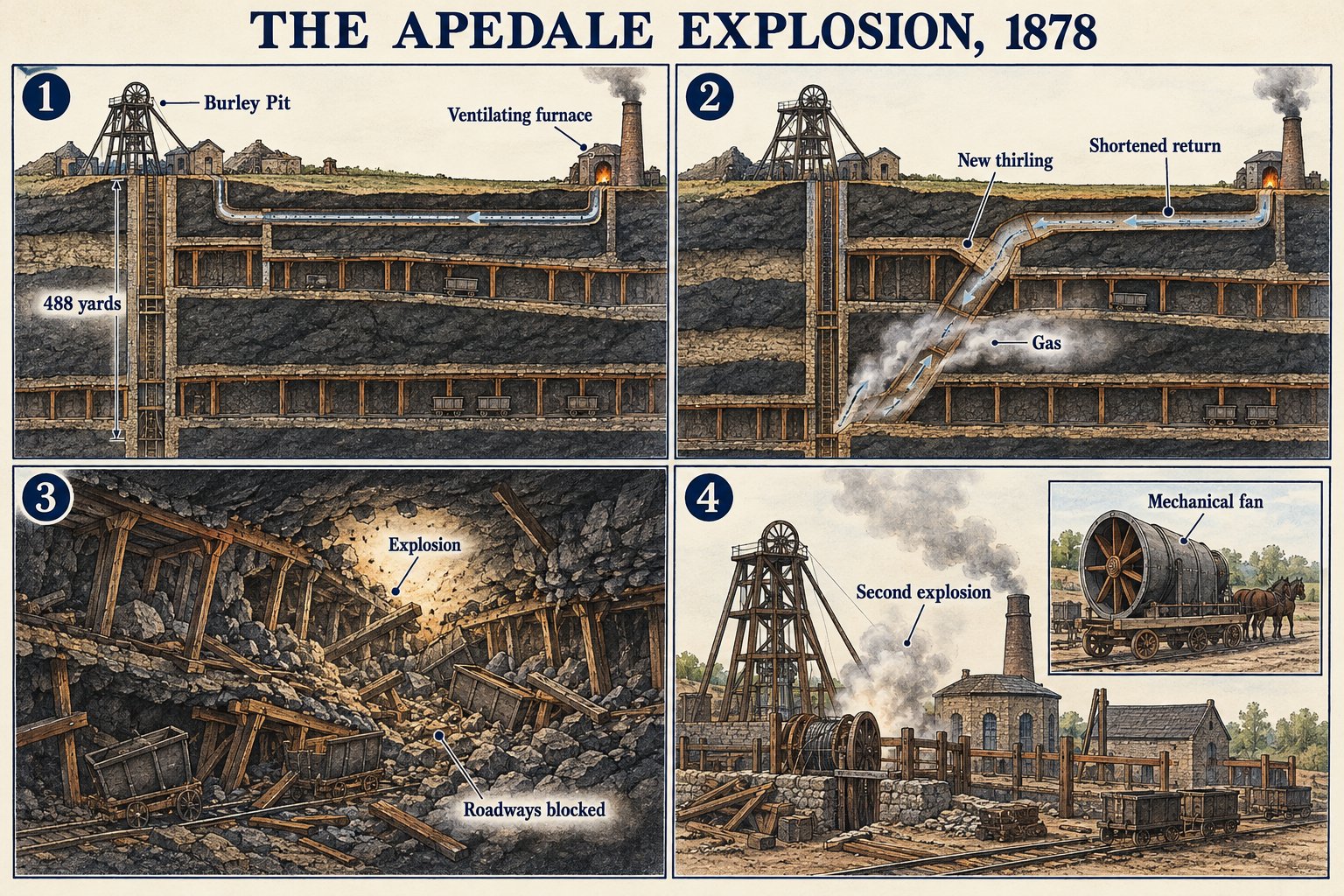
Gas ignited by either a shot fired in the furnace dip, return air passing over the ventilating furnace, or a defective lamp — the inquest could not determine which, though a ventilation change made the day before (a new 'thirling', or connecting air passage, that shortened the return air route) was identified as a likely contributing factor.
Contributing factors
A new thirling cut on 26 March, the day before the explosion, shortened the return air route and reduced the distance available to dilute gas before it reached the furnace fire used for ventilation. The pit was known to be 'fiery' and worked at a depth of 488 yards.
What happened
At around 1:30-1:45pm on 27 March 1878, an explosion tore through the No. 1 Burley Pit of Apedale Colliery, Newcastle-under-Lyme, then owned by Stainer and Company. The blast was powerful enough to be felt and heard some distance away, in Chesterton. Ninety miners were working underground at the time; sixty made it out alive. The search for the remaining thirty proved extremely difficult, as the explosion had brought down quantities of coal and debris, blown out timbers, overturned wagons and blocked roadways throughout the affected workings. Five bodies were recovered in the first search — Caleb Walley, John Walley and his son, Joseph Baggalay, and a boy named William Bostock — and a boy named Handy, injured in the blast, died the following Wednesday night. A second explosion occurred during the recovery operation, narrowly missing HM Inspector of Mines Wynne, who was present. Recovery work continued for over three months, with bodies still being found into early July, and one final victim was not found for almost two years, discovered buried in three feet of dry dust and dirt.
Rescue & recovery
Sixty of the ninety men underground survived, escaping or being brought out in the immediate aftermath. Recovery of the dead was hampered by extensive debris and took over three months, complicated by a second explosion during the operation; the final victim's body was not located until nearly two years after the disaster.
Investigation & inquiry
An inquest concluded that the men had died in a gas explosion, but that there was no positive evidence establishing how or where the gas had accumulated or been ignited; management was found blameless. A separate, subsequent formal inquiry examined whether the colliery manager, James Henry Price, held the proper competency for his role.
Legal & regulatory aftermath
A mechanical ventilation fan, already being considered before the disaster, arrived at the colliery the day after the explosion, intended to replace the furnace-based ventilation system implicated in the accident.
Changes to practice & legislation
No specific national legislative change is recorded as resulting directly from this disaster, though it took place amid the wider nineteenth-century move away from furnace ventilation and toward mechanical fans in British collieries.
Memorials & commemoration
No dedicated memorial to this disaster specifically is known; Apedale Colliery's site is preserved as the Apedale Heritage Centre.
Recorded claims
Individual factual claims, each attached to the source(s) that support it below. Where sources disagree, both are kept.
- Ninety miners were underground at the time of the explosion; sixty survived and twenty-three were killed, including several named victims (Caleb Walley, John Walley and his son, Joseph Baggalay, William Bostock and a boy named Handy). 1
- A second explosion occurred during the recovery operation, narrowly missing HM Inspector of Mines Wynne, who was present at the colliery. 1
- HM Inspector of Mines identified three possible causes — a shot fired in the furnace dip, return air passing over the ventilating furnace, or a defective lamp — and noted that a new thirling cut the day before the explosion had shortened the return air route. 2
- Recovery of the dead took over three months, with the final victim's body not discovered until nearly two years after the disaster, found buried in three feet of dry dust and dirt. 1
Related terminology
Mining terms this disaster is structurally linked to, with the nature of the relationship.
- Firedamp (direct cause)
The explosion is attributed to firedamp ignited during the pit's furnace-ventilation operation, most likely by a shot, the return air path over the furnace itself, or a defective lamp. - Furnace Ventilation (contextual relationship)
Named in this record’s changes to practice: “…it took place amid the wider nineteenth-century move away from furnace ventilation and toward mechanical fans in British collieries.” - HM Chief Inspector of Mines (contextual relationship)
Named in this record’s narrative: “…explosion occurred during the recovery operation, narrowly missing HM Inspector of Mines Wynne, who was present. Recovery work continued for over three…” - Shot-firing (contributing factor)
HM Inspector of Mines identified a shot fired in the furnace dip as one of three possible ignition sources for the explosion. - Thirling (contextual relationship)
Named twice in this record, first in the cause: “…which, though a ventilation change made the day before (a new 'thirling', or connecting air passage, that shortened the return air route)…”
Sources
- (secondary) Burley Pit Number 1 Apedale Explosion 1878, Researched — Newcastle-under-Lyme/Apedale local heritage research
- (primary) Apedale Colliery Explosion — Newcastle-under-Lyme — 1878 — Northern Mine Research Society
Record created: 2 September 2026 · Last researched: 2 September 2026