 MineArchive
Apedale Colliery
| Location | Chesterton, near Newcastle-under-Lyme, Staffordshire — 53.0257, -2.2649 (approximate) |
|---|---|
| Commodity | Coal |
| Type | Coal |
| Worked | By 1855, possibly earlier–1998 |
| Maximum depth | 484 yards (Burley Pit) |
| Operators | J. E. Heathcote (1855–1865), Apedale Iron Company (1869–1869), Stanier & Co. (1870–1885), Midland Coal, Coke and Iron Company (1890–?) |
Overview
A colliery of several interconnected pits at Chesterton, near Newcastle-under-Lyme, worked at a steep incline through the North Staffordshire coalfield's Bullhurst, Eight Foot, Seven Foot and Ten Foot seams — the site of two major explosions, in 1878 and 1885, before closing in 1998 as one of the last two Staffordshire pits preserved for the public, now the Apedale Heritage Centre.
History
Apedale Colliery worked several interconnected pits in the North Staffordshire coalfield, sunk into seven or eight seams — the Bullhurst, Eight Foot, Seven Foot and Ten Foot among them — set at an unusually steep incline of around forty degrees. Ownership passed through a succession of companies over the nineteenth century: J. E. Heathcote from 1855, the Apedale Iron Company by 1869, Stanier & Co. from 1870, and the Midland Coal, Coke and Iron Company from 1890. The colliery's No. 1 Burley Pit was the site of two of the district's worst mining disasters, an explosion in 1878 that killed twenty-three men and boys and a second in 1885 that killed nine more (see Disasters, below, for both). The colliery continued working into the twentieth century and was not finally closed until 1998, by which point it was one of only two historic sites preserved from the Staffordshire coalfield, alongside the much larger Chatterley Whitfield Colliery.
Geology
The seams worked at Apedale lay at an unusually steep incline of around forty degrees, part of the structurally complex, folded North Staffordshire coalfield.
Geological setting: Anticlines and Synclines (historical documentary reference)
Workings
Several interconnected pits reaching seven or eight seams, the deepest shaft (Burley Pit) at 484 yards, ventilated in the nineteenth century by a furnace rather than mechanical fan.
Closure
Closed in 1998, ending well over a century of continuous working; the site is one of only two former Staffordshire collieries preserved and open to the public, the other being Chatterley Whitfield.
What remains
Preserved as the Apedale Heritage Centre within Apedale Community Country Park, run by volunteers, opened in 2001; the centre offers underground tours through the real former workings.
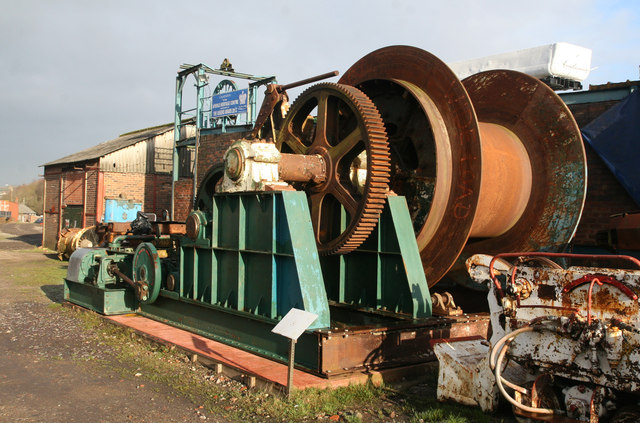
Surviving colliery buildings and mining equipment, including a compressed-air winch, are on public display at the heritage centre.
Related mines
- Burley Pit — NMRS records the Burley as Apedale Colliery's deepest pit, connected underground with the rest of the group.
- Glasshouse Colliery — Midland Coal, Coke and Iron Co. collieries.
- Minnie Pit — Both belonged to the Midland Coal, Coke and Iron Company's Podmore Hall and Apedale combine, with its ironworks at Apedale.
Nearby mines
- Silverdale Colliery — 0.7 miles (1.1 km) S
- Holditch Colliery — 0.8 miles (1.3 km) NE
- Glasshouse Colliery — 1.6 miles (2.6 km) N
- Leycett Colliery — 1.9 miles (3.1 km) W
- Minnie Pit — 2.0 miles (3.3 km) NW
Straight-line distance, within 9 miles (15 km). Show on the map.
Disasters & major incidents
-
Apedale Colliery Explosion, 1878
27 March 1878 · Explosion · 23 fatalities
An explosion at the No. 1 Burley Pit of Apedale Colliery, near Newcastle-under-Lyme, killed twenty-three men and boys — the worse of two major explosions to strike the pit within a decade. -
Apedale Colliery Explosion, 1885
20 June 1885 · Explosion · 9 fatalities
A second major explosion at Apedale Colliery's Burley Pit, seven years after the 1878 disaster, killed nine men. -
Apedale Colliery Sladderhill No. 3 Pit explosion, 1891
1891 · Explosion · 11 fatalities
During the afternoon shift of 2 April 1891 a blown-out shot of gelatine dynamite fired gas in the Bullhurst seam of the Sladderhill No. 3 Pit, Apedale, and coal dust carried the explosion through the district. Eleven died, most of them boys and young men.
Recorded claims
Individual factual claims, each attached to the source(s) that support it below. Where sources disagree, both are kept.
- The colliery worked seven or eight seams, including the Bullhurst, Eight Foot, Seven Foot and Ten Foot, set at an incline of around forty degrees. 1
- Ownership passed from J. E. Heathcote (from 1855) to the Apedale Iron Company (by 1869), Stanier & Co. (from 1870) and the Midland Coal, Coke and Iron Company (from 1890). 2
- Apedale Colliery closed in 1998 and is now one of only two preserved historic Staffordshire coalfield sites, alongside Chatterley Whitfield, run as the volunteer-operated Apedale Heritage Centre with underground tours. 3
- The Holditch Mine Company operated Apedale up to the 1947 nationalisation of the coal industry; the National Coal Board then ran it until November 1969, when Great Row Colliery Co Ltd took over. A 1994 management buy-out, Aurora Mining Ltd, ran the site until its final closure on 28 August 1998. 4
- During the 1980s, seven drifts were in operation at Apedale, making it the largest private mining concern then operating in the UK. 4
Photographs & further reading
Mine-exploring community page on Apedale Colliery, with photos and the fuller 20th-century ownership chain used in this record.
View sourceSources
- (primary) Apedale Colliery Explosion — Newcastle-under-Lyme — 1878 — Northern Mine Research Society
- (secondary) Apedale Colliery, Newcastle-under-Lyme, Staffordshire — Mindat
- (secondary) Burley Pit Number 1 Apedale Explosion 1878, Researched — Newcastle-under-Lyme/Apedale local heritage research
- (observational) Apedale Coal Mine — information and photos — AditNow
Record created: 2 September 2026 · Last researched: 2 September 2026