 MineArchive
Apedale Colliery Explosion, 1885
A second major explosion at Apedale Colliery's Burley Pit, seven years after the 1878 disaster, killed nine men.
| Date | 20 June 1885 |
|---|---|
| Mine | Apedale Colliery |
| Region | Staffordshire |
| Type | Explosion |
| Fatalities | 9 (Nine men killed: Samuel Hampton (27), Thomas Heath (41), Henry Heath (20), James Kestevan (44), Joseph Underwood (20), Thomas Jones (17), Isaac Jones (47), John Barker (34) and Thomas Lear (36).) |
| Context | During active mining |
Cause
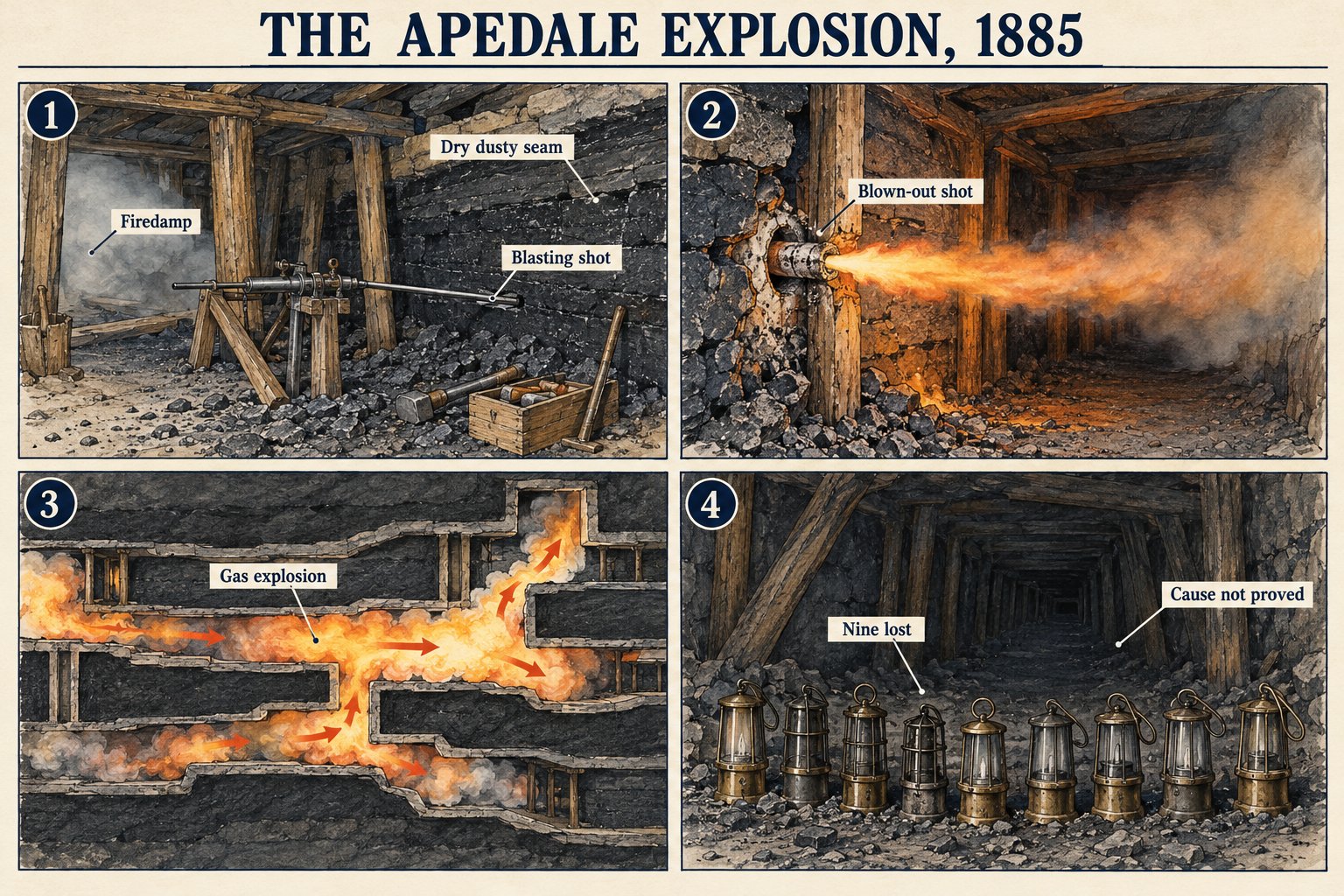
A jury inquest concluded the men died from an explosion of gas, though the exact trigger was not established. HM Inspector of Mines Wynne suggested it was likely caused by a blown-out or semi-blown-out shot, noting that explosions remained possible wherever powder was used for blasting in dry, dusty, gas-producing seams.
What happened
On 20 June 1885, an explosion at Apedale Colliery's Burley Pit — the same pit that had killed twenty-three men and boys seven years earlier — killed nine more men. At the time the colliery was the property of Stanier and Company (referred to in some contemporary accounts as Messrs. Stainer). The nine victims, ranging in age from seventeen to forty-seven, were Samuel Hampton, Thomas Heath, Henry Heath, James Kestevan, Joseph Underwood, Thomas Jones, Isaac Jones, John Barker and Thomas Lear.
Investigation & inquiry
A jury inquest concluded that the men had died from an explosion of gas, but could not establish exactly how or where it had been triggered. HM Inspector of Mines Wynne suggested a blown-out or semi-blown-out blasting shot was the likely cause, and observed generally that explosions remained possible wherever gunpowder was used for blasting in seams that were both dry, dusty and prone to producing gas.
Memorials & commemoration
No dedicated memorial to this disaster specifically is known.
Recorded claims
Individual factual claims, each attached to the source(s) that support it below. Where sources disagree, both are kept.
- Nine men were killed: Samuel Hampton (27), Thomas Heath (41), Henry Heath (20), James Kestevan (44), Joseph Underwood (20), Thomas Jones (17), Isaac Jones (47), John Barker (34) and Thomas Lear (36). 1
- A jury inquest found the men died from a gas explosion without establishing an exact cause; HM Inspector of Mines Wynne considered a blown-out or semi-blown-out blasting shot the likely trigger. 1
- Of the twelve men working in the affected area, nine were missing; rescue parties led by colliery manager James Cadman and underlooker Thomas Hulme found the workings shattered by roof falls and concluded none of the missing men could have survived, though afterdamp made recovering the bodies slow and hazardous. 2
Related terminology
Mining terms this disaster is structurally linked to, with the nature of the relationship.
- Colliery (contextual relationship)
Named 3 times in this record, first in the summary: “A second major explosion at Apedale Colliery's Burley Pit, seven years after the 1878 disaster, killed nine men.” - Firedamp (direct cause)
The nine deaths resulted from an explosion of gas, per the jury's inquest finding. - HM Chief Inspector of Mines (contextual relationship)
Named twice in this record, first in the cause: “…an explosion of gas, though the exact trigger was not established. HM Inspector of Mines Wynne suggested it was likely caused by a blown-out or…” - Shot-firing (contributing factor)
HM Inspector of Mines Wynne considered a blown-out or semi-blown-out blasting shot the likely ignition source.
Sources
- (primary) Apedale Colliery Burley Pit Explosion — Newcastle-under-Lyme — 1885 — Northern Mine Research Society
- (secondary) Burley Pit Explosion 1885 — healeyhero.co.uk (John Lumsdon mining history collection)
Record created: 2 September 2026 · Last researched: 2 September 2026