 MineArchive
Bunker's Hill Colliery Explosion, 1875
About one in the afternoon of 30 April 1875 a shot fired in a heading at Bunker's Hill Colliery near Talke ignited firedamp and killed forty-three men and boys. Everyone underground in that part of the pit died, so the cause had to be reconstructed afterwards. The inspector's report said the explosion was caused by the use of gunpowder and that the reason for the change from wedging to blasting had been simply that the owner could not compete with neighbours who blasted.
| Date | 30 April 1875 |
|---|---|
| Mine | Bunker's Hill Colliery |
| Region | Staffordshire |
| Type | Explosion |
| Fatalities | 43 (Forty-three men and boys, named in the Durham Mining Museum's transcription of the inspector's report. The North Staffordshire gazetteer gives forty-two; every other source gives forty-three.) |
| Injuries | The manager George Sumner's son was badly injured in the explosion. No other injuries are recorded. |
| Context | During active mining |
Cause
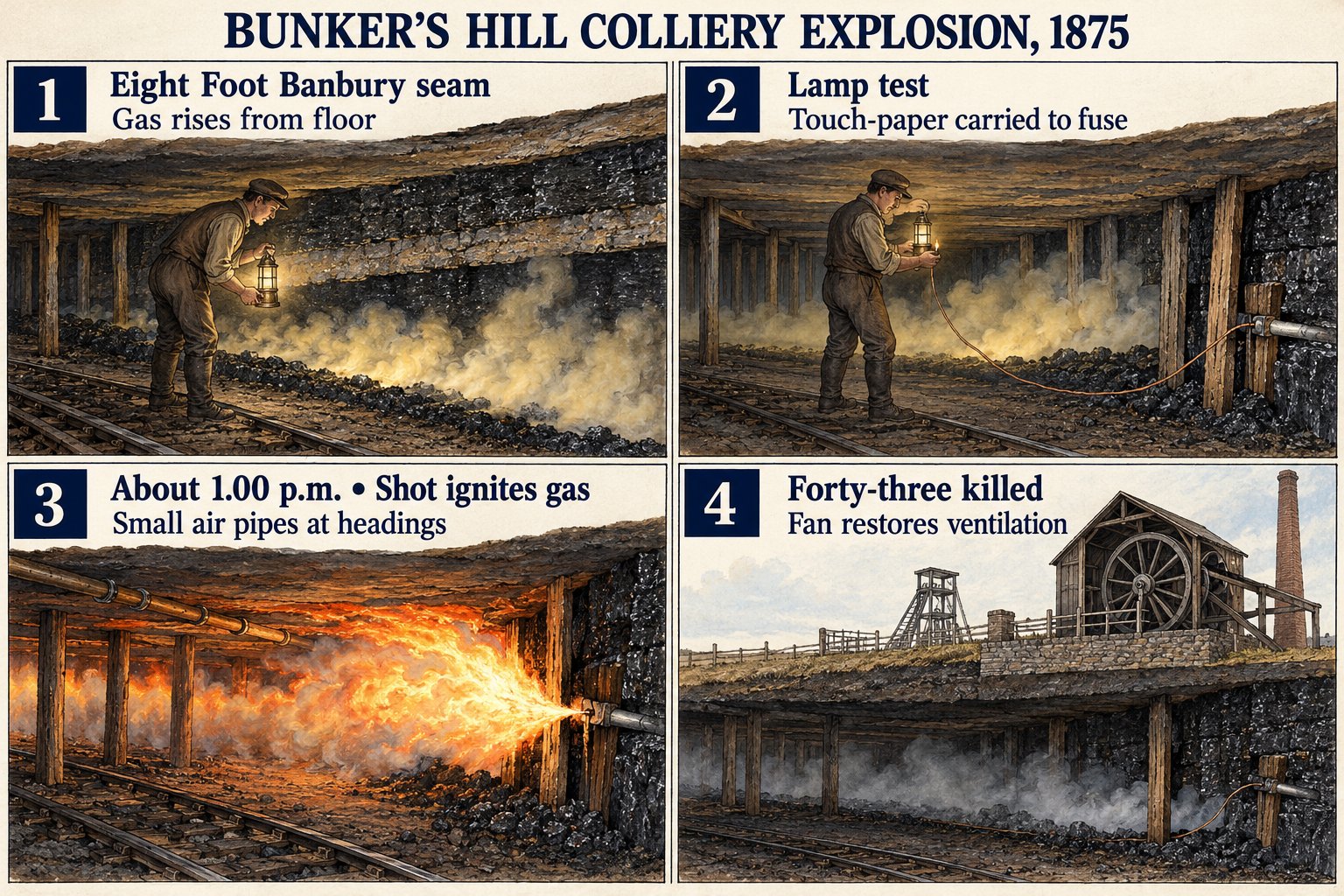
Firedamp ignited by shot-firing. The barrister who reported on the inquest concluded that the explosion was caused by the firing of a shot in a thirling on the east side of the Engine-brow, the flame of the blast reaching gas that had come off the floor.
Contributing factors
The way the shots were lit. Having tested the place with his lamp, the fireman withdrew to what he judged a safe spot, opened his lamp there, lit touch-paper at it and carried that alight back to the fuse. Gas came off the floor near this heading fast enough that it could have filled the place in the interval between the fireman's test and the shot. Ventilation to the far ends of the workings was by small air pipes rather than brattice, which the inquest jury and the reporting counsel both called defective. And there was a belief among the miners that a shot which fired inwards and did not blow out carried no risk of explosion, which this case disproved.
What happened
About a hundred men went down that morning, thirty-five of them into the Eight Foot Banbury seam to work some eight hundred yards from the shaft. The explosion came at about one o'clock and did some damage to the headgear. Everyone who was in the mine at the seat of it perished, so nothing could be learnt from witnesses about the moment itself and the cause had to be read from the workings afterwards.
The fan saved the recovery. The engine, given a slight increase of speed, restored the air current almost at once and a party was able to go in, refix the stoppings, bring out the bodies and establish the extent of the disaster with little delay. The inspector, Thomas Wynne, made a point of writing that up as an argument for fans over every other means of ventilating a mine.
Two six-hundred-yard downbrows that had been driven by wedging rather than blasting stood up to the blast completely: not a hundredweight of coal was brought down in them, and the parts of the levels driven without powder were undamaged. Wynne used that as his argument against blasting altogether.
Rescue & recovery
The ventilating fan was undamaged and the engine was speeded slightly, restoring the air almost immediately after the explosion. A party of explorers went in, refixed the stoppings and recovered the bodies.
Investigation & inquiry
The inquest was reported to Parliament by Thomas Wynne, H.M. Inspector of Mines for the North Staffordshire district, assisted by G. W. Dowdeswell QC, whose report was published on 9 June 1875. Dowdeswell addressed three questions: the cause of the explosion, whether the Mines Regulation Act had been observed, and what precautions might prevent a repetition. He was satisfied there had been no infraction of the rules, and that the fireman whose duty it was to fire the shot was an experienced, steady man who tested the ground carefully beforehand. Wynne, Mr Hall and Mr S. B. Gilroy were of one opinion that the explosion was caused by the use of gunpowder, and Wynne wrote that he attributed no blame to anyone connected with the management, powder being in general use in the district.
Legal & regulatory aftermath
On 11 June 1875 Alexander Macdonald asked the Home Secretary in the Commons whether, given the report's statement that the only reason for the change from wedging to blasting at the colliery was to increase production and lessen cost, the Government would bring in a Bill to suppress the use of blasting powder in mines. Richard Assheton Cross replied that it would not: such a measure would be acceptable neither to the colliery owners nor to the workmen. He noted that the Mines Regulation Act already allowed rules to be framed about the use of powder, suggested that blasting in dangerous mines might be confined to the time between shifts, and said the whole body of inspectors had the question under consideration.
Changes to practice & legislation
No legislation followed. Wynne's report is one of the sharpest statements of the case against explosives in gassy mines: he wrote that for more than twenty years he had been pointing out what a farce it was to prohibit naked lights underground while allowing powder to be used, and that the responsibility for such losses of life rested on other heads than his. Dowdeswell's alternative — firing shots only between shifts, when only the firemen are in the pit — is the practice the Home Secretary commended to the Commons, and Wynne objected to it as turning the firemen into a forlorn hope, citing the fatal explosion at Ince Hall the previous year.
Memorials & commemoration
No memorial specific to the explosion is known.
What's uncertain
Points where sources disagree or the record could not be settled; both accounts are kept. All open questions in the archive.
- The inspector's report, Healey Hero and the Northern Mine Research Society index all give forty-three killed; the North Staffordshire gazetteer gives forty-two. (disputed) 3,1,2
Recorded claims
Individual factual claims, each attached to the source(s) that support it below. Where sources disagree, both are kept.
- The explosion was on 30 April 1875 and forty-three lives were lost; the cause is given as explosion of firedamp, the ignition probably caused by shot-firing. 1,2
- The inspector's report, Healey Hero and the Northern Mine Research Society index all give forty-three killed; the North Staffordshire gazetteer gives forty-two. (disputed) 3,1,2
- The only reason assigned for the change from wedging to blasting at the colliery was that the owner could not compete with his neighbours if he wedged his coal and they blasted theirs, so to meet competition he had to increase production and lessen cost. 1,4
- Asked on 11 June 1875 whether the Government would bring in a Bill to suppress blasting powder in mines, the Home Secretary said it would not, as such a measure would be acceptable neither to the colliery owners nor to the workmen. 4
- Two downbrows of six hundred yards each, driven without blasting, withstood the force of the explosion without so much as a hundredweight of coal being blown down. 1
Related terminology
Mining terms this disaster is structurally linked to, with the nature of the relationship.
- Fireman (contextual relationship)
Named 3 times in this record, first in the contributing factors: “…way the shots were lit. Having tested the place with his lamp, the fireman withdrew to what he judged a safe spot, opened his lamp there, lit…” - Headgear (contextual relationship)
Named in this record’s narrative: “…The explosion came at about one o'clock and did some damage to the headgear. Everyone who was in the mine at the seat of it perished, so nothing…” - Shot-firing (contextual relationship)
Named 6 times in this record, first in the summary: “…use of gunpowder and that the reason for the change from wedging to blasting had been simply that the owner could not compete with neighbours who…” - Stopping (contextual relationship)
Named twice in this record, first in the narrative: “…air current almost at once and a party was able to go in, refix the stoppings, bring out the bodies and establish the extent of the disaster with…” - Thirling (contextual relationship)
Named in this record’s cause: “…concluded that the explosion was caused by the firing of a shot in a thirling on the east side of the Engine-brow, the flame of the blast reaching…”
Sources
- (primary) The Bunker's Hill Colliery Explosion, from the 1875 Mines Inspectors Report (C. 1499), North Staffordshire District, by Thomas Wynne, H.M. Inspector of Mines — Mines Inspectors Report, transcribed by the Durham Mining Museum
- (secondary) Bunker's Hill Colliery Explosion — Healey Hero
- (secondary) Mould's Pits: Collieries of the North Staffordshire Coalfield (B) — North Staffordshire Miners' Group / Apedale Heritage Centre
- (primary) Coal Mines — Bunker's Hill Explosion — Question, HC Deb 11 June 1875 vol 224 c1714 — Hansard, UK Parliament
Record created: 9 September 2026 · Last researched: 9 September 2026