 MineArchive
Trapper
| Category | Labour & Roles |
|---|
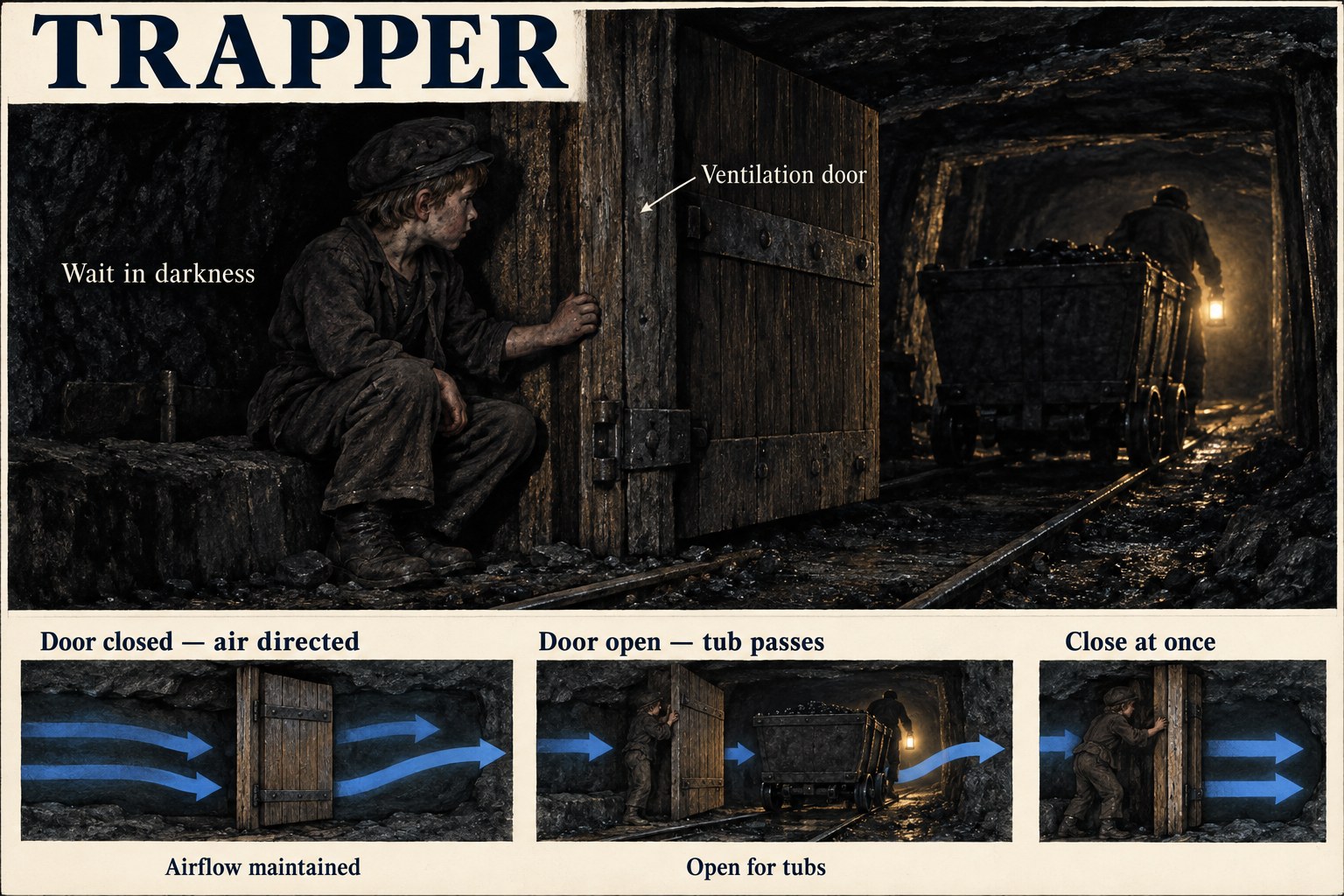
A child employed underground to open and close the wooden ventilation doors that controlled a mine's airflow, letting wagons and hurriers pass before closing again behind them.
Historical usage
Children as young as five or six worked as trappers, typically the first and lightest underground job given to a mining family's youngest children before they were old enough to become hurriers, pushing and pulling loaded tubs. The role, and the conditions attached to it, were documented in detail by the Royal Commission of Inquiry into Children's Employment, set up under Lord Ashley (later the Earl of Shaftesbury) in 1840; its 1842 report, illustrated with engravings and first-hand testimony from mine workers, shocked Victorian public opinion and led directly to the passing of the Mines and Collieries Act 1842.
How it worked
A trapper sat alone beside their door, often in total darkness, for shifts of up to twelve hours, opening it only when a tub or hurrier needed to pass through and closing it again immediately afterward to keep the mine's ventilation circuit intact.
Why it was used
A mine's ventilation depended on doors being opened and shut promptly and only when needed, a task considered simple enough — if isolating and tedious — to assign to the youngest children in an underground workforce, while freeing older, stronger children and adults for haulage and coal-getting.
Risks & limitations
Long solitary hours in darkness, and the physical and developmental toll of full-time underground child labour more broadly, were central to the case the 1842 Royal Commission made to Parliament; the Mines and Collieries Act that followed banned underground work altogether for women and girls, and set a minimum age of ten for boys.
Regional variation
A general British coalfield term, not tied to a specific district.
Related terminology
Mines associated with this term
5 examples chosen from 6 linked records — the term page is not an index.
- Thornley Colliery — County Durham (notable incident)
The 1841 explosion here was caused when a nine-year-old trapper, Robert Gardiner, left his ventilation door open too long, allowing firedamp to accumulate. - Woodhorn Colliery — Northumberland (well documented example)
Named in this record’s history: “…coalfield ran on — hewers at the face, putters moving the coal, trappers on the ventilation doors. On the morning of Sunday 13 August 1916 an…” - Bigge Pit, Willington — Tyne and Wear (well documented example)
Named in this record’s history: “…exploded again in the Bigge Pit, 140 fathoms deep, killing 32 when a trapper's door was left open. The colliery closed in 1889 and reopened in…” - Burdon Main Colliery — Tyne and Wear (well documented example)
Named in this record’s history: “…and on 19 November 1835 a trap door left open by a ten-year-old trapper let gas gather that fired at the deputy's candle and killed eleven.…” - East Gawber Colliery — South Yorkshire (well documented example)
Named in this record’s history: “…over the cage while in the shaft in January 1870. Thomas Evans, a trapper of twelve, fell out of the cage in August 1874. Isaac Birch, a…”
Disasters associated with this term
5 examples chosen from 12 linked records, most direct relationship first.
- Thornley Colliery Explosion, 1841 (direct cause)
The explosion was caused when the nine-year-old trapper responsible for a ventilation door left it open too long, letting firedamp accumulate. - Bigge Pit explosion, 1841 (contextual relationship)
Named twice in this record, first in the narrative: “…traced the explosion to the middle of three doors, found open: the trapper, a boy named Cooper, was found where the blast could not have thrown…” - Burdon Main Colliery explosion, 1835 (contextual relationship)
Named 4 times in this record, first in the summary: “…men and eight boys. A trap door had been left open by a ten-year-old trapper, Joseph Arkley, who was among the dead.” - Gadlys Colliery explosion, 1871 (contextual relationship)
The youngest victim was a door boy. - Jarrow Colliery explosion, 1817 (contextual relationship)
Named in this record’s narrative: “…Samuel Hood and the deputy William Wilkinson, died the next day; the trapper James Brown died on 7 October, the hewer James Liddle on 10 October,…”
Sources
- (secondary) Children in the Mines — East Durham History
- (secondary) Mines and Collieries Act 1842 — Wikipedia
Record created: 27 August 2026 · Last researched: 27 August 2026