 MineArchive
Woodhorn Colliery
| Location | Ashington, Northumberland — 55.1895, -1.5468 (exact) |
|---|---|
| Commodity | Coal |
| Type | Coal |
| Worked | From 1894–1981 |
| Operators | Ashington Coal Company (1894–1947), National Coal Board (1947–1981) |
Overview
One of the Ashington group of collieries, sunk in 1894 and worked for 87 years, whose two winding houses and headgear survive as a museum, a scheduled monument and the home of the Northumberland Archives. Thirteen men died here in a single morning in 1916.
History
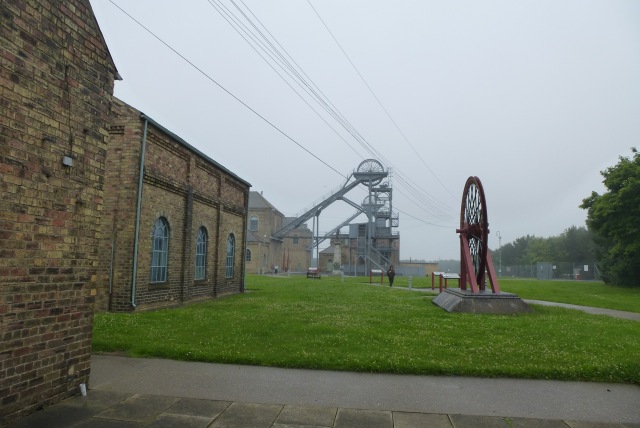
The Ashington Coal Company began sinking Woodhorn in 1894, in a district it already dominated, and the colliery worked for 87 years before closing in 1981. At its height around two thousand people worked there, in the graded hierarchy the Northumberland coalfield ran on — hewers at the face, putters moving the coal, trappers on the ventilation doors. On the morning of Sunday 13 August 1916 an explosion in the Main Seam killed thirteen men of a repairing shift (see Disasters, below). Woodhorn was one of five pits the Ashington Coal Company ran along this coast: Ashington itself from 1867, Woodhorn and Linton from 1894, Ellington from 1909 and Lynemouth from 1927. After the 1981 closure the pit yard survived intact enough to be scheduled in 1999, and the museum that opened in its buildings in 1989 was rebuilt between 2002 and 2006 around the headframes, the winding house and its steam engine, the stables and the workshops.
Geology
Woodhorn worked the Northumberland coalfield's Coal Measures seams, among them the Main Seam and the Low Main, in ground the Ashington Coal Company had been developing since the 1860s.
Geological setting: Sedimentary Beds and Seams (well documented example)
Workings
Two shafts: No. 1 the downcast and No. 2 the upcast, each with a substantial winding house, lowering the men in cages and raising the coal. Both winding houses and their headgear survive.
Closure
Woodhorn closed in 1981 after 87 years, part of the long contraction of the Northumberland coalfield rather than any single failure.
What remains
The site is now Woodhorn Museum — a scheduled monument, and the home of the Northumberland Archives, holding over 800 years of the county's records alongside the mining collections. The surviving colliery buildings were joined in 2006 by The Cutter, a museum building by the architect Tony Kettle whose form is based on a coal-cutting machine. A narrow-gauge heritage railway runs from the site, and the 1923 memorial to the men killed in 1916 stands here, moved from Hirst Park in 1991.
Both winding houses and headgear, colliery buildings, the 1923 disaster memorial and a narrow-gauge railway, all within the museum site.
Related mines
- Ashington Colliery — Both were Ashington Coal Company collieries at Ashington, worked together from the 1890s to nationalisation and linked by the company's own railway; Woodhorn Museum now stands on the Woodhorn site.
- Linton Colliery — One of the Ashington Coal Company's group of Northumberland collieries alongside Linton and Ellington.
Nearby mines
- Lynemouth Colliery — 0.9 miles (1.5 km) N
- Newbiggin Colliery — 1.3 miles (2.1 km) E
- Ashington Colliery — 2.0 miles (3.2 km) W
- Ellington Colliery — 2.1 miles (3.4 km) N
- West Sleekburn Colliery — 2.4 miles (3.8 km) S
Straight-line distance, within 9 miles (15 km). Show on the map.
Disasters & major incidents
-
Woodhorn Colliery explosion
13 August 1916 · Explosion · 13 fatalities
A repairing shift of thirteen men was setting steel roof girders in the Main Seam at Woodhorn when firedamp, accumulated over a weekend of reduced ventilation, was ignited by a naked light. All thirteen died.
Culture
- The Ashington Group (Art)
Many of the group's members worked here, and the former colliery, now Woodhorn Museum, has housed its permanent collection since 1989.
What's uncertain
Points where sources disagree or the record could not be settled; both accounts are kept. All open questions in the archive.
- Around two thousand people worked at Woodhorn, in a hierarchy of hewers, putters and trappers. (uncertain) 1
Recorded claims
Individual factual claims, each attached to the source(s) that support it below. Where sources disagree, both are kept.
- The Ashington Coal Company began sinking Woodhorn’s shafts in 1894; the colliery worked for 87 years and closed in 1981. 1
- Two shafts served the pit — No. 1 the downcast and No. 2 the upcast — each marked by a substantial winding house. 1
- Around two thousand people worked at Woodhorn, in a hierarchy of hewers, putters and trappers. (uncertain) 1
- The site is a museum and scheduled monument and houses the Northumberland Archives; The Cutter, a museum building based on the form of a coal-cutting machine, was added in 2006. 1
- BGS and the Coal Authority hold catalogued mine plans under Woodhorn; scans exist but are not publicly visible. 2
- The colliery opened in 1894 and closed in 1981; Woodhorn Colliery Museum opened in 1989 in the original pit buildings, the pit yard was designated a scheduled monument in 1999, and after redevelopment from 2002 to 2006 under the architect Tony Kettle the museum reopened in October 2006, keeping the two headframes, a winding house with its steam winding engine, other engine houses, stables, the ventilation building, the blacksmith's and joiners' shop and the office. 3
- Co-Curate lists the Ashington Coal Company's collieries as Ashington (1867-1988), Woodhorn (1894-1981), Ellington (1909-2005), Lynemouth (1927-1994) and Linton (1894-1968). 4
Photographs & further reading
The county archive’s account of the 1916 disaster, drawn from its own records.
View sourceSources
- (secondary) Woodhorn Museum — Fabulous North
- (primary) BGS mine plans catalogue: Woodhorn (record 21875178) — British Geological Survey / The Coal Authority
- (secondary) Woodhorn (museum) (Wikipedia) — Wikipedia
- (secondary) Ashington Coal Company Ltd. (Co-Curate, Newcastle University) — Co-Curate
Record created: 25 August 2026 · Last researched: 24 September 2026