 MineArchive
Hewer
| Category | Labour & Roles |
|---|
The standard English-coalfield term for the underground worker who cut coal directly from the seam at the working face, using hand tools before mechanisation.
Historical usage
The hewer, or collier, held the senior job in a colliery's underground workforce and made up its largest single group: by 1905, hewers accounted for roughly 48% of underground workers in north-east England, 56% in South Wales and 59% in Scotland.
How it worked
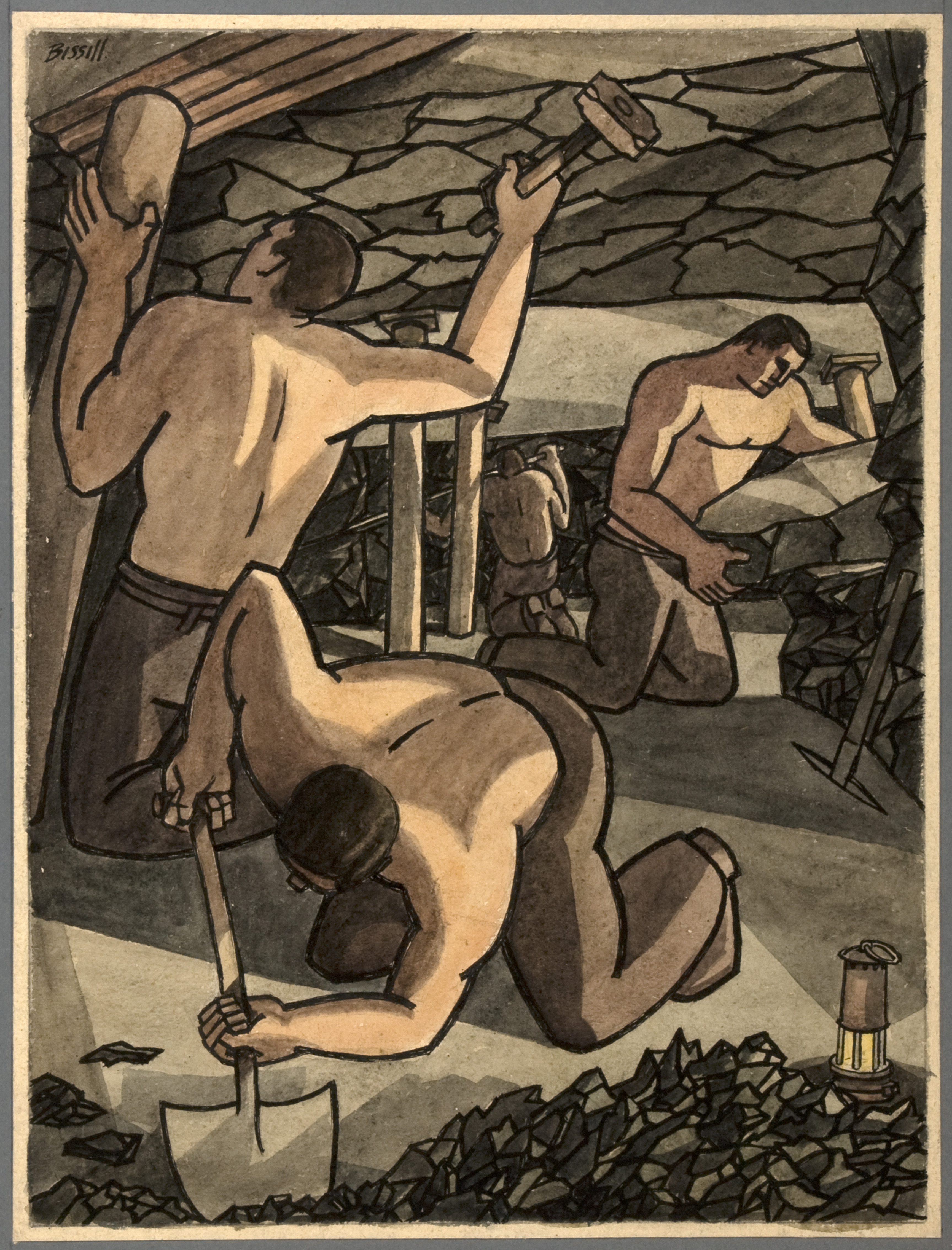
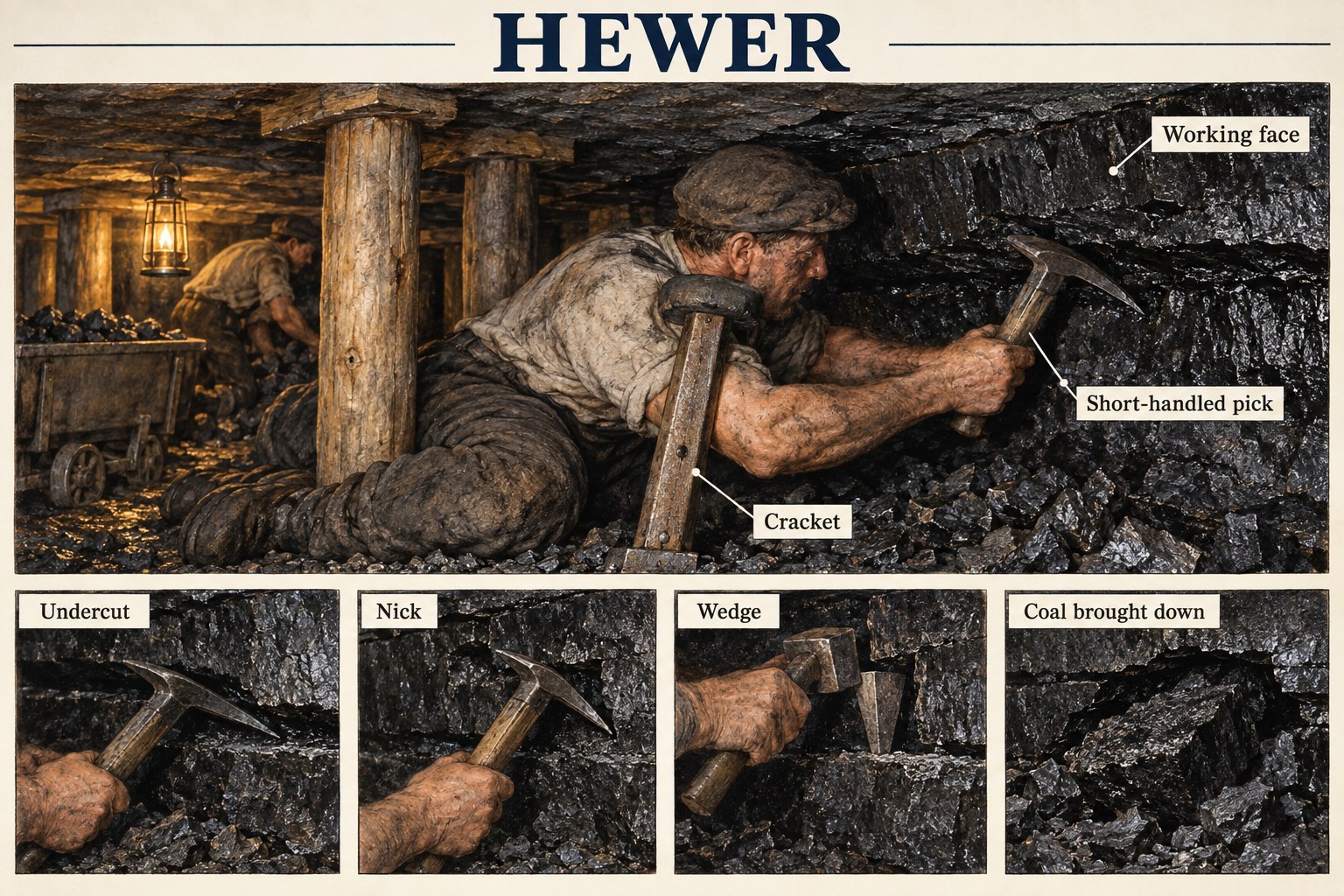
Hewers worked with short-handled picks and shovels, suited to the confined space of a coal seam, undercutting or 'nicking' the coal before wedging or blasting it down and filling it onto tubs or a conveyor. The method varied with seam thickness: in thick Scottish seams, hewers commonly worked 'Stoop and Room', cutting out rooms of coal while leaving stoops, or pillars, to support the roof, while thinner seams favoured the Longwall method, undercutting the whole face before bringing it down and advancing as one continuous line. The gear was as particular as the work. The Durham glossary records the cracket or triangular stool the hewer put under his shoulder to add leverage to the pick, and the North East glossaries measure the working place by the man: a bord a few yards wide, 'holding one and sometimes two hewers'. Barrowman's 1886 Scottish glossary reduces the whole grade to four words — a person who digs coal — and treats hewer and collier as the same job.
Why it was used
Cutting coal from the seam was the fundamental task of a working colliery — every other underground job, from putting to deputising, existed to support or move what the hewer produced.
Risks & limitations
Hewing was physically brutal, piece-rate work carried out in cramped, hot, dusty conditions, with high exposure to roof falls, dust disease and other underground hazards; the job's centrality declined through the 20th century as mechanical coal-cutters and, later, powered shearers took over the task hand hewing had always performed.
Regional variation
'Collier' and 'getter' were used more or less interchangeably with hewer in different English coalfields; the term itself, and 'Stoop and Room' working, were particularly associated with Scottish coalfields, while Longwall working dominated in thinner-seamed districts. The hiring was regional too: the North East hewer worked under the yearly bond, the annual agreement setting the conditions on which he was hired, which tied him to one colliery for the year and which the glossaries list as a term of art in its own right.
Related terminology
Coal Cutter, Dataller, Holing, Putter
Mines associated with this term
5 examples chosen from 43 linked records — the term page is not an index.
- Quarter Colliery — South Lanarkshire (well documented example)
Named twice in this record, first in the summary: “…the Labour Party — worked at Quarter as a pony driver and then as a hewer. Buddlepit records the colliery as worked from 1873 to 1930.” - Sheriff Hill Colliery — Tyne and Wear (well documented example)
Named in this record’s history: “…an hour before the pit was to finish its day's work and after the hewers had left, firedamp exploded and killed two men and thirty-three…” - Woodhorn Colliery — Northumberland (well documented example)
Named in this record’s history: “…there, in the graded hierarchy the Northumberland coalfield ran on — hewers at the face, putters moving the coal, trappers on the ventilation…” - Andrews House Colliery — County Durham (well documented example)
Named in this record’s history: “…by the viewer William Unthank and his deputy Thomas Hall; twelve hewers were paid 22d a score with extra for headways and trouble bords, and…” - Bedlington 'D' Colliery — Northumberland (well documented example)
Named in this record’s history: “…a pony putter of 19, and Robert Morris and Matthew Wilson, both hewers, each under a fall of roof or coal. Abandonment plans for the Five…”
Disasters associated with this term
5 examples chosen from 59 linked records, most direct relationship first.
- Adelaide Colliery roof fall, 1869 (contextual relationship)
Named twice in this record, first in the summary: “Two brothers, hewers at Adelaide Colliery, were killed together by a sudden fall of stone…” - Auchinraith Colliery explosion (contextual relationship)
Five of the six men killed were coal hewers, aged from twenty-four to sixty-four; the sixth was the underground fireman. - Auckland Park Colliery fall, 1906 (contextual relationship)
Named 4 times in this record, first in the summary: “On 2 August 1906 a hewer and a pony putter were killed by the same fall of stone in the…” - Auckland Park Colliery fall, 1907 (contextual relationship)
Named twice in this record, first in the summary: “…1907 an extraordinary fall of stone in the Harvey Seam killed two hewers and injured a third at Auckland Park Colliery, near Bishop Auckland…” - Axwell Park Colliery explosion, 1896 (contextual relationship)
Named 6 times in this record, first in the summary: “…firedamp, never before seen at Axwell Park Colliery, was fired at a hewer's naked light in the Five Quarter seam, burning three men; the…”
Sources
- (primary) Glossary of Mining and Geordie Words — Durham Mining Museum
- (primary) Glossary of Scotch Mining Terms — James Barrowman (1886), via Scottish Mining Website
- (secondary) A Glossary of Mining Terms — Coal Mining History Resource Centre
- (secondary) Coal Face to Fireplace 2: Hewing Coal — North Lanarkshire Museums (CultureNL)
- (secondary) Glossary of coal mining terminology — Wikipedia
Record created: 27 August 2026 · Last researched: 11 September 2026