 MineArchive
Sheriff Hill Colliery
| Also known as | Ellison Main Colliery |
|---|---|
| Location | Sheriff Hill, Gateshead Fell, Tyne and Wear — 54.9306, -1.5736 (exact) |
| Commodity | Coal |
| Type | Coal |
| Worked | By 1793–by 1895-97 |
| Maximum depth | Fanny Pit 804 ft (245 m) in 1894; Isabella Pit 738 ft (225 m), 125 fathoms to the Hutton seam |
| Operators | Lamb and Hutchinson (1840–?), R. Foster and Co. (1860–1869), Heworth Coal Company Ltd |
Overview
The colliery on the summit of Gateshead Fell, two and three-quarter miles south of Newcastle, known as Ellison Main after the Ellisons of Hebburn Hall who owned the royalty and as Sheriff Hill after the village that grew around it. Sunk in the 1780s and working by 1793, with Isabella and Fanny its principal pits among a dozen or more shafts, it was the largest and most important of the Gateshead collieries and one of the deadliest of the Tyne: explosions in 1793, 1815 and 1819 and a fire in 1815 killed at least 65 people, two men and thirty-three boys in 1819 alone (see Disasters, below). Its pitmen mounted one of England's earliest large-scale strikes in 1832-33. The colliery had closed by the 1890s.
History
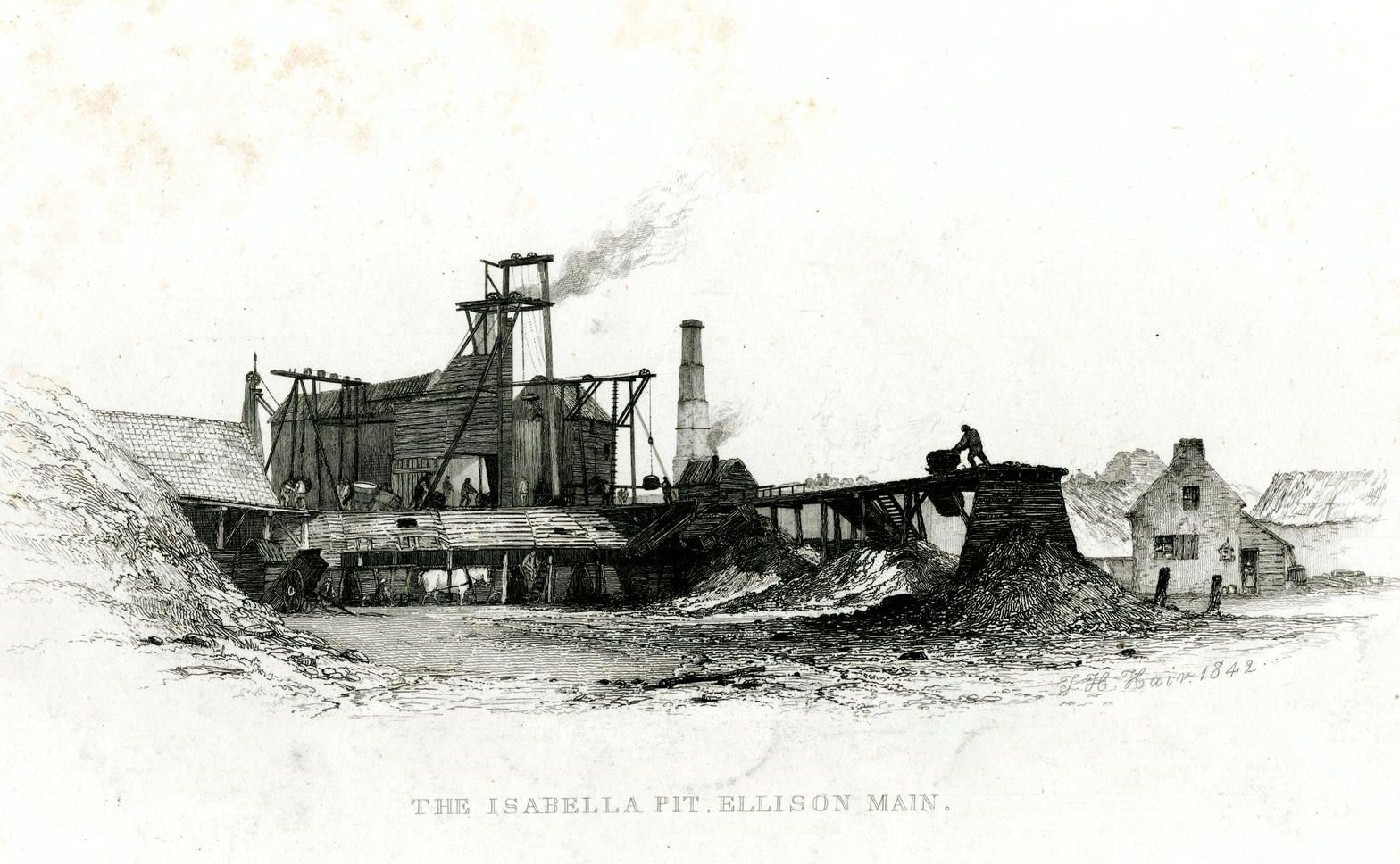
A 1773 plan of the collieries of Gateshead Fell marks a pit 'not sunk yet' on the site; the colliery was founded in the 1780s, and by 27 December 1793 it was at work and suffered its first recorded explosion, in the Hope Pit, which killed fourteen (see Disasters, below). Another explosion followed on 21 December 1794, its death toll unrecorded. The Isabella Pit was sunk about 1785-95 to the Hutton seam, five feet thick at 125 fathoms, passing fifteen seams on the way, with the High Main at about 60 fathoms cropping out in a quarry at Low Fell; its plan for the Bensham seam under Sheriff Hill and Park Moor is dated 1783. On 27 June 1815 an explosion killed eleven, including the viewer and his two brothers, and on 11 December that year a fire in the shaft partition killed five (see Disasters, below). On the morning of 19 July 1819, half an hour before the pit was to finish its day's work and after the hewers had left, firedamp exploded and killed two men and thirty-three boys, some as young as seven; contemporary report blamed neglect or mismanagement of the safety lamps, and eighteen of the dead were buried in Gateshead churchyard and fourteen in the chapel yard (see Disasters, below). In 1821 the pitman John Wilson fell into the shaft in the dark and was hauled out alive after hanging from the engine rope, and in 1824 two pitmen were sent to the House of Correction at Durham for taking the tops off their Davy lamps underground. In 1832 the pitmen marched through Sheriff Hill and Low Fell behind a banner showing the owners as rats taking bread from the workers' mouths, and in 1833 they were forcibly ejected from the colliery, soldiers were called from Newcastle, and Welsh replacement workers were brought in, many of whom joined the strikers' camp on Church Road instead; the owners conceded, though the organisers were never employed again. Thomas Hair drew the Isabella Pit in 1842, when Messrs Lamb and Hutchinson held the lease under Cuthbert Ellison of Hebburn Hall: the coals were drawn at two shafts by a 30-horsepower engine raising three corves at once, another engine lifted the water 30 fathoms into a drift a mile and a quarter long to be pumped out at Low Fell, and a three-mile waggonway of inclined planes ran from the Isabella Pit to the Tyne. R. Foster and Co. were owners in the 1860s, when the Hartley disaster of 1862 forced a second shaft to be sunk to give the colliery two exits, and the Historic Environment Record also names Allhusen and Co., Gibson and Co. and Charlton and Gibson. The Fanny Pit, off the turnpike at the crest of the hill, was 804 feet deep in 1894 and the Isabella 738 feet. The metal seam was abandoned in 1892 and the colliery had closed by 1895-97, though the Heworth Coal Company Ltd is named as its last owner and a Gateshead Council photograph shows Fanny Pit miners as late as 1921.
Geology
The pits sank through the Coal Measures of the Gateshead Fell ridge, where Forster's section of the strata records fifteen seams passed in the Isabella Pit: the High Main at about 60 fathoms, outcropping in the Low Fell quarry, the Bensham, and the Hutton at 125 fathoms, five feet thick and the pit's principal seam. The colliery was notably gassy, firing four times in twenty-six years.
Geological setting: Sedimentary Beds and Seams (well documented example)
Workings
Twelve or more pits over the colliery's life, named Ann, Bess, Centre, Dolly, Edge, Fanny, George, King, Bradley, Doll, Isabella, Kells, Stapple and Hope, the Isabella and Fanny the principal winding shafts. In 1842 a 30-horsepower engine drew three corves at once from two shafts and a second engine pumped the water 30 fathoms into a mile-and-a-quarter drift draining to an engine at Low Fell; coal went to the Tyne by a three-mile waggonway worked chiefly by inclined planes, the Bensham and Gateshead Fell Way. A second shaft was sunk after the 1862 Hartley disaster to comply with the two-exits law.
Closure
The Historic Environment Record and the Durham Mining Museum both put closure before 1895-97, after the metal seam was abandoned in 1892; Wikipedia's 1926 and its 1921 photograph of Fanny Pit miners suggest some working continued under the Heworth Coal Company, and the date is left open.
What remains
The colliery lies under the built-up suburb of Sheriff Hill; the Fanny Pit Plantation woodland survived beside the turnpike. No observational report of surviving remains are recorded.
The site lies under the built-up suburb of Sheriff Hill and no surviving colliery structure has been recorded; the Fanny Pit Plantation woodland survives beside the turnpike.
Related mines
- Heworth Colliery — Neighbouring Gateshead collieries both run by the Heworth Coal Company in the twentieth century.
Nearby mines
- Stormont Main Colliery — 0.3 miles (0.4 km) SE
- Heworth Colliery — 0.9 miles (1.4 km) NE
- Springwell Colliery — 0.9 miles (1.4 km) SE
- Team Colliery — 1.2 miles (1.9 km) SW
- Mount Moor Colliery — 1.2 miles (2.0 km) S
Straight-line distance, within 9 miles (15 km). Show on the map.
Disasters & major incidents
-
Sheriff Hill Colliery explosion, 1793
27 December 1793 · Explosion · 14 fatalities
On 27 December 1793 an explosion in the Hope Pit at Sheriff Hill Colliery, on Gateshead Fell, killed fourteen people, the first of the colliery's recorded disasters. Almost nothing else about it survives: John Sykes's Local Records gave it a single sentence, and only four of the dead are known by name, from their burials at Lamesley church a week later. -
Sheriff Hill Colliery explosion, 1815
27 June 1815 · Explosion · 11 fatalities
At four in the morning of 27 June 1815 Sheriff Hill Colliery near Gateshead fired while its viewer, William Foggett, and his brothers George and Robert were down the pit. The blast killed all three, and eight workmen died of the afterdamp, among them the overman Scott, a father and son named Wind and youths of seventeen and eighteen. -
Sheriff Hill Colliery fire, 1815
11 December 1815 · Fire · 5 fatalities
On 11 December 1815 the wooden partition that divided Sheriff Hill Colliery's shaft into upcast and downcast caught fire from the coal lamp burning to draw the air up. With the partition gone the ventilation failed. Every effort was made to get the men and horses out, and all were saved but five wastemen, who perished in the workings. -
Sheriff Hill Colliery Explosion, 1819
19 July 1819 · Explosion · 35 fatalities
On the morning of Tuesday 19 July 1819, after the hewers had left and half an hour before the pit was to finish its day's work, firedamp exploded in Sheriff Hill Colliery on Gateshead Fell and killed two men and thirty-three boys. Had it come an hour later, it was said, a hundred would have died. Contemporary report blamed neglect or mismanagement of the safety lamps. Eighteen of the dead were buried in Gateshead churchyard and fourteen in the chapel yard; three were brothers from Whitehaven whose mother had only just persuaded the colliery to take them back on.
What's uncertain
Points where sources disagree or the record could not be settled; both accounts are kept. All open questions in the archive.
- The Historic Environment Record gives closure by 1897 and the Durham Mining Museum before 1895, the metal seam having been abandoned in 1892; Wikipedia gives 1926 under the Heworth Coal Company Ltd. (disputed) 4,1,2
Recorded claims
Individual factual claims, each attached to the source(s) that support it below. Where sources disagree, both are kept.
- The colliery was founded in the 1780s; a 1773 plan of Gateshead Fell marks a pit not yet sunk on the site, and it was working by 1793. 1,2
- The pits were Ann, Bess, Centre, Dolly, Edge, Fanny, George, King, Bradley, Doll, Isabella, Kells, Stapple and Hope. 2,3
- The Isabella Pit was 125 fathoms deep to the Hutton seam, five feet thick, having passed fifteen seams; the High Main lay at about 60 fathoms. 1,3
- In 1842 a 30-horsepower engine drew three corves at once from two shafts, a second engine lifted water 30 fathoms into a mile-and-a-quarter drift to Low Fell, and a three-mile waggonway of inclined planes ran to the Tyne. 4,3,5
- Explosions on 27 December 1793 (14 killed), 21 December 1794, 27 June 1815 (11) and 19 July 1819 (35), and a fire on 11 December 1815 (5), are recorded at the colliery. 4,1,2
- On 19 July 1819, after the hewers had left and half an hour before the end of the day's work, firedamp exploded and killed two men and thirty-three boys. 4,6
- The pitmen struck in 1832, marching behind a banner of the owners as rats, and in 1833 were ejected from the colliery, soldiers being called and Welsh replacements brought in, many of whom joined the strikers. 4
- In June 1824 two pitmen were committed to hard labour at Durham for removing the tops of their Davy lamps in the pit. 4
- After the Hartley disaster of 1862 a second shaft was sunk at Sheriff Hill to meet the new law requiring two exits. 4,1
- The Fanny Pit shaft, 535 feet above sea level, was 804 feet deep in 1894 and the Isabella Pit 738 feet. 4
- The Historic Environment Record gives closure by 1897 and the Durham Mining Museum before 1895, the metal seam having been abandoned in 1892; Wikipedia gives 1926 under the Heworth Coal Company Ltd. (disputed) 4,1,2
- A plan of the Bensham seam under Sheriff Hill and Park Moor in the national catalogue is dated 1783. 7
Photographs & further reading
The fullest account online, with contemporary newspaper extracts on the 1819 explosion, the 1821 shaft fall and the 1832-33 strikes.
View sourceOwners, maps, shaft details, the five disasters and the names of those killed.
View sourceThe Historic Environment Record's summary of the colliery's pits, owners, disasters and sources.
View sourceSources
- (primary) Durham Mining Museum: Sheriff Hill Colliery — Durham Mining Museum
- (primary) Tyne and Wear HER 3844: Sheriff Hill Colliery (Ellison Main) — Tyne and Wear Historic Environment Record (Sitelines)
- (secondary) Sheriff Hill Colliery — Co-Curate, Newcastle University (with the extract from Hair's Views of the Collieries, 1844)
- (secondary) Sheriff Hill Colliery — Wikipedia
- (primary) The Isabella Pit, Ellison Main (engraving by Thomas Harrison Hair, 1842, for Views of the Collieries in the Counties of Northumberland and Durham, 1844) — British Museum, via Wikimedia Commons
- (primary) Colliery disaster, 19th July 1819, Sheriff Hill (with M. A. Richardson's Local Historian's Table Book account, 1844) — Durham Mining Museum
- (primary) Sheriff Hill and Park Moor: Bensham seam plan, 1783 (mine plans catalogue) — British Geological Survey / Mining Remediation Authority
_-_edited.jpg)
Record created: 9 September 2026 · Last researched: 9 September 2026