 MineArchive
Heworth Colliery
| Location | Heworth, Gateshead, Tyne and Wear — 54.9388, -1.5575 (approximate) |
|---|---|
| Commodity | Coal |
| Type | Coal |
| Worked | 1821 (High Heworth from 1710)–29 June 1963 |
| Maximum depth | About 1,004 feet (John Pit, to the Beaumont seam) |
| Operators | Heworth Coal Company Ltd (1906–1947), National Coal Board (1947–1963), J. B. Pearson and Co., Henderson, Anderson and Co. |
Overview
A Gateshead colliery at Heworth, sunk on a new site about 1819-1821 to replace the Blacketts' worked-out High Heworth pit of 1710, with the John, Ada and Fanny shafts. It employed over 2,000 in 1921 and closed in 1963; an explosion killed five in 1826.
History
High Heworth Colliery was first sunk in 1710 near the present Fiddlers public house on Albion Street, and was worked by the Blacketts; its High Main seam, reached in 1762, was nearly exhausted by 1819. A new pit was then sunk a little to the south-east, beside today's Whitehill Drive, and was ready to work in 1821. Heworth Colliery had three shafts, John, Ada and Fanny, the Fanny being the old shaft of the original workings, kept as the upcast. The winding pit reached the Hutton seam in 1819 and was deepened to the Beaumont in 1875-76, the John Pit going down to about 1,004 feet. Coal went down the Pelaw Main waggonway to staithes on the Tyne at Pelaw and Bill Quay.
An explosion of firedamp at open lights in the Hutton seam on 5 September 1826 killed five, among them the master wasteman, John Scott. The Blacketts held the colliery until the 1850s; it then passed to J. B. Pearson and Co., to Henderson, Anderson and Co. in the 1860s, and from 1906 to the Heworth Coal Company. In the early twentieth century it worked the Beaumont, Bensham, Five Quarter, High Main, Hutton, Six Quarter and Yard seams. In 1921 it employed 2,012. The National Coal Board closed it on 29 June 1963.
Geology
Durham Coal Measures: the High Main, Hutton (Low Main) at about 830 feet, and Beaumont at about 967 feet in the John Pit, with the Bensham, Five Quarter, Six Quarter and Yard seams.
Workings
Three shafts, John, Ada and Fanny (the 1710 shaft, used as the upcast); the winding pit sunk to the Hutton in 1819 and deepened to the Beaumont in 1875-76; coal carried by the Pelaw Main waggonway to the Tyne.
Closure
Closed by the National Coal Board on 29 June 1963.
What remains
The concrete cap over the Fanny shaft is visible on the field opposite the junction of Barton Road; deputies' and managers' houses and a public house survive.
Redevelopment
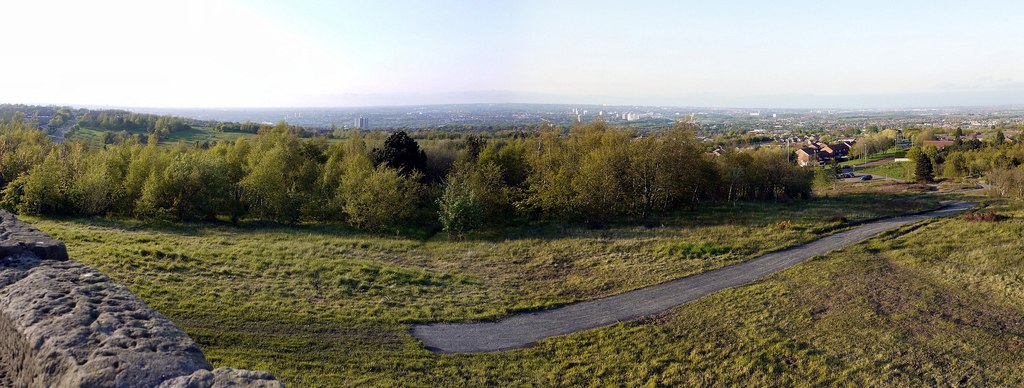
The former slag heap became the landscaped area called 'The Fortress' at Whitehills.
Related mines
- Sheriff Hill Colliery — Neighbouring Gateshead collieries both run by the Heworth Coal Company in the twentieth century.
Nearby mines
- Sheriff Hill Colliery — 0.9 miles (1.4 km) SW
- Stormont Main Colliery — 0.9 miles (1.5 km) SW
- Springwell Colliery — 1.1 miles (1.7 km) S
- Felling Colliery — 1.3 miles (2.0 km) NW
- Wardley Colliery — 1.6 miles (2.6 km) NE
Straight-line distance, within 9 miles (15 km). Show on the map.
Recorded claims
Individual factual claims, each attached to the source(s) that support it below. Where sources disagree, both are kept.
- High Heworth Colliery was sunk in 1710 and worked out by 1819; new shafts nearby were ready to work in 1821. 1,2
- The colliery had three shafts, John, Ada and Fanny, the Fanny being the old 1710 shaft used for ventilation. 3,1
- The John Pit was sunk to the Hutton seam and deepened to the Beaumont in 1875-76, to about 1,004 feet. 4,2
- In 1921 the colliery employed 2,012. 3,1
- Heworth Colliery closed on 29 June 1963. 3,1,2
Photographs & further reading
The colliery's shafts, owners, community and closure.
View sourceOwners, output, employment, seams and those killed.
View sourceSources
- (secondary) Heworth Colliery — Gateshead History
- (secondary) HER 3890: Upper Heworth Colliery (Ada Pit) — Sitelines (Tyne and Wear HER)
- (primary) Heworth Colliery — Durham Mining Museum
- (primary) Shafts: Heworth Colliery, John Pit — Durham Mining Museum
Record created: 4 October 2026 · Last researched: 4 October 2026