 MineArchive
Team Colliery
| Also known as | Ravensworth Ann Colliery, Eighton Moor Colliery, Low Eighton Colliery |
|---|---|
| Location | Eighton Moor, near Birtley, Gateshead, Tyne and Wear — 54.9150, -1.5867 (exact) |
| Commodity | Coal |
| Type | Coal |
| Worked | 1726–1973 |
| Maximum depth | Unknown. |
| Operators | William Wharton Burdon (1796–1900), Charles Perkins & Partners (1900–1910), Birtley Iron Company (1910–1940), Pelaw Main Collieries Ltd (1940–1947), National Coal Board (1947–1973) |
Overview
A colliery on Eighton Moor south of Gateshead, held under lease from Lord Ravensworth and worked under at least four names — Team, Eighton Moor, Low Eighton and Ravensworth Ann. Its recorded working life runs from 1726, and more than two dozen pits were sunk across the take over that time. The Angel of the North now stands on ground cleared from it — its pithead baths or its reservoir, depending which account you follow.
History
Coal was being worked here by 1726, and an explosion at the Ravensworth Whin Pit in June 1757 killed sixteen. The principal pit is said to have been sunk in 1824, and by 1843, under the name Eighton Moor Colliery, it appears on a plan of the Tyne and Wear coal district served by a wagonway running north-west past Farnacres Colliery to the river Team and north-north-east past Sheriff Hill Colliery to join the Ouston and Pelaw wagonway.
In 1844 the colliery was held under lease from Lord Ravensworth by William Wharton Burdon of Hartford House, County Durham, whose family had held it since 1796. It passed through W. W. Burdon in the 1860s and A. E. Burdon in the 1880s to Charles Perkins & Partners in the 1900s, the Birtley Iron Company in the 1910s and Pelaw Main Collieries Ltd in the 1940s, before nationalisation in 1947, when it raised 230,000 tons of coking, gas and industrial coal.
The number of pits sunk on the take over two and a half centuries is remarkable. Besides the Centre and Street pits, the heritage record names Meadow, Flat and Corn — all disused by 1897 — and Nelly, Chance and Nanny, disused by 1967; and the Ordnance Survey's first edition of about 1860 shows Bank, Betty, Corner, Dene, Emidy, George, Green, Hall, Hill, Landsale, Lane, Letch, North, Quarry, Rush, Spring and Wood pits besides. By the 1950s the returns were being made for the Ann and Betty pits together, and coking coal alone in the last years.
Geology
The colliery worked the Coal Measures on the high ground of Eighton Moor above the Team valley, in the heart of the Great Northern Coalfield. The pattern of working here — dozens of small shafts sunk, worked out and abandoned across two centuries rather than a few deep ones — is characteristic of a district where the coal lay near enough the surface to be reached repeatedly and cheaply, long before the deep sinkings of the later nineteenth century.
Workings
A colliery of many small pits rather than one or two great shafts. The Centre and Street pits are named in the colliery records, the Street Pit joined to the Team Colliery by a wagonway; the heritage record adds Meadow, Flat, Corn, Nelly, Chance and Nanny, and lists seventeen more shown on the Ordnance Survey's first edition of about 1860. By 1843 the colliery was served by wagonways running to the river Team and to the Ouston and Pelaw line. In its last decades the output returns were made for the Ann and Betty pits together, and by the 1970s the colliery was raising coking coal alone.
Closure
Sources differ. The Durham Mining Museum gives the colliery as closing in 1973, and the Wikipedia article on the housing estate that took its name agrees; the Tyne and Wear Historic Environment Record states that Team Colliery closed in 1941 and the site was subsequently reclaimed. The likeliest explanation is that the original Eighton Moor workings ceased in 1941 while the Ravensworth Ann operation continued under that name to 1973, but no source says so.
What remains
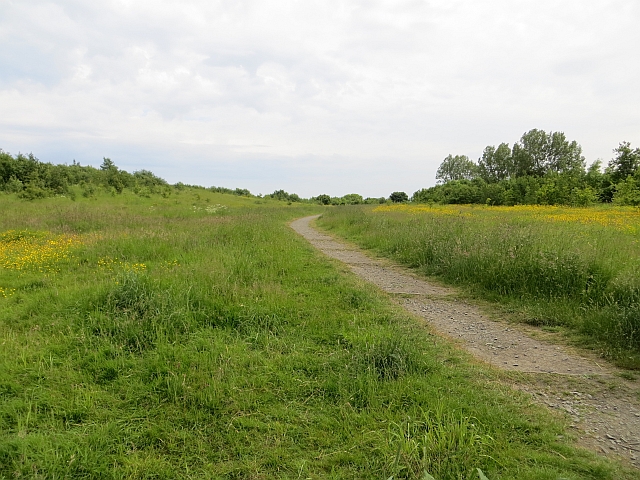
The colliery site has been reclaimed and is now open ground crossed by footpaths, with the line of a former mineral railway still legible. Antony Gormley's Angel of the North, completed in February 1998, stands on high ground at Eighton Lodge on ground cleared from this colliery — accounts differ as to whether the specific structure there was the pithead baths of the Betty Ann pit or a colliery reservoir; the small housing estate below it is still called Team Colliery and takes its name from the mine.
No colliery buildings; the course of a former mineral railway, and the reclaimed site itself.
Redevelopment
The site was reclaimed after closure. The Angel of the North was erected in February 1998 on ground cleared from the colliery — described in one account as the site of the pithead baths of the Betty Ann pit and in another as a colliery reservoir, and a housing estate of twenty-three houses at Cowen Gardens, 322 metres from the sculpture, still carries the colliery's name.
Related mines
- Bewicke Main Colliery — Both worked by Charles Perkins and Partners in the 1890s, and later by the Birtley Iron Company and Pelaw Main Collieries.
- Ouston Colliery — Both were held in turn by Charles Perkins and Partners, the Birtley Iron Company and Pelaw Main Collieries.
- Ravensworth Shop Colliery — Team collieries at Lamesley: the HER gives Team Colliery as another name for Allerdean (Ravensworth Shop). Kept as two records under the keep-both ruling.
Nearby mines
- Mount Moor Colliery — 0.8 miles (1.4 km) E
- Stormont Main Colliery — 1.1 miles (1.7 km) NE
- Sheriff Hill Colliery — 1.2 miles (1.9 km) NE
- Bewicke Main Colliery — 1.3 miles (2.1 km) SW
- Springwell Colliery — 1.4 miles (2.3 km) NE
Straight-line distance, within 9 miles (15 km). Show on the map.
Disasters & major incidents
-
Team Colliery explosion, 1757
10 June 1757 · Explosion · 16 fatalities
An explosion at the Whin Pit, Ravensworth — part of what became Team Colliery — killed sixteen men and boys, one of the earliest well-documented colliery disasters on the Durham coalfield.
Culture
- The Angel of the North (Art)
The sculpture stands on the reclaimed site of Team Colliery at Low Eighton, ground the colliery worked from 1726. Gormley has said explicitly that the mining done beneath the site gives it a poetic resonance, and that connection is recorded on the plaque beside the work.
What's uncertain
Points where sources disagree or the record could not be settled; both accounts are kept. All open questions in the archive.
- The Durham Mining Museum gives the colliery as opened in 1726; the Tyne and Wear Historic Environment Record says the pit is said to have been sunk in 1824. (disputed) 1,2
- The Durham Mining Museum and the Wikipedia article on the estate both give the colliery as closing in 1973; the Tyne and Wear Historic Environment Record states that Team Colliery closed in 1941 and the site was subsequently reclaimed. (disputed) 1,2,3
- An explosion at the Ravensworth Whin Pit on 10 June 1757 killed sixteen. The only account found is a single sentence in John Sykes's Local Records of 1833. (uncertain) 4
- Antony Gormley's Angel of the North, completed in February 1998, stands on high ground at Eighton Lodge on ground cleared from this colliery. Accounts of Birtley and of the Team Colliery estate say it occupies the site of the pithead baths of the Betty Ann pit; the account of the sculpture itself says the land previously contained a colliery reservoir. The housing estate 322 metres away still carries the colliery's name. (disputed) 3,5
Recorded claims
Individual factual claims, each attached to the source(s) that support it below. Where sources disagree, both are kept.
- The Durham Mining Museum gives the colliery as opened in 1726; the Tyne and Wear Historic Environment Record says the pit is said to have been sunk in 1824. (disputed) 1,2
- In 1844 the Team Colliery — the Betty Pit by 1898 — was held under lease from Lord Ravensworth by William Wharton Burdon of Hartford House, County Durham, whose ancestors had had it since 1796. 2
- In 1843, as Eighton Moor Colliery, it was shown on a plan of the Tyne and Wear coal district served by a wagonway running north-west past Farnacres Colliery to the river Team and north-north-east past Sheriff Hill Colliery to join the Ouston and Pelaw wagonway. 2
- Besides the Centre and Street pits, the heritage record names Meadow, Flat and Corn, all disused by 1897, and Nelly, Chance and Nanny, disused by 1967, and lists seventeen more shown on the Ordnance Survey's first edition of about 1860. 2
- The colliery passed through W. W. Burdon in the 1860s, A. E. Burdon in the 1880s, Charles Perkins & Partners in the 1900s, the Birtley Iron Company in the 1910s and Pelaw Main Collieries Ltd in the 1940s to the National Coal Board in 1947, when it raised 230,000 tons. 1
- The Durham Mining Museum and the Wikipedia article on the estate both give the colliery as closing in 1973; the Tyne and Wear Historic Environment Record states that Team Colliery closed in 1941 and the site was subsequently reclaimed. (disputed) 1,2,3
- An explosion at the Ravensworth Whin Pit on 10 June 1757 killed sixteen. The only account found is a single sentence in John Sykes's Local Records of 1833. (uncertain) 4
- Antony Gormley's Angel of the North, completed in February 1998, stands on high ground at Eighton Lodge on ground cleared from this colliery. Accounts of Birtley and of the Team Colliery estate say it occupies the site of the pithead baths of the Betty Ann pit; the account of the sculpture itself says the land previously contained a colliery reservoir. The housing estate 322 metres away still carries the colliery's name. (disputed) 3,5
- The BGS and Mining Remediation Authority mine plans catalogue holds five records under the name Ravensworth Ann & Betty, together with separate entries for Ravensworth and Ravensworth Park — the drift that took over winding when the Ann Pit stopped drawing coal. 6
Photographs & further reading
The official heritage record for the site: the Ravensworth lease, the wagonways of 1843, and the full roll of subsidiary pits sunk across the take with their grid references and the dates they fell out of use.
View sourceThe colliery's opening and closing dates, its Centre and Street pits, the succession of owners from the Burdons to the National Coal Board, and the output returns for the Ann and Betty pits.
View sourceSources
- (primary) Durham Mining Museum: Ravensworth Ann Colliery — Durham Mining Museum
- (primary) Team Colliery (Eighton Moor or Ravensworth Ann Colliery), Tyne and Wear HER 356 — Tyne and Wear Historic Environment Record
- (secondary) Team Colliery — Wikipedia
- (primary) John Sykes, Local Records or Historical Register of Remarkable Events (1833), on the Ravensworth Whin Pit explosion of 1757 — Durham Mining Museum, quoting Sykes
- (secondary) Birtley, Tyne and Wear — Wikipedia
- (primary) BGS mine plans catalogue: Ravensworth Ann & Betty — British Geological Survey / Mining Remediation Authority
Record created: 3 September 2026 · Last researched: 4 September 2026