 MineArchive
Viewer
| Also known as | Under-Viewer (North East England), Check Viewer (North East England), Coal Viewer (North East England) |
|---|---|
| Dialect | North East England |
| Category | Labour & Roles |
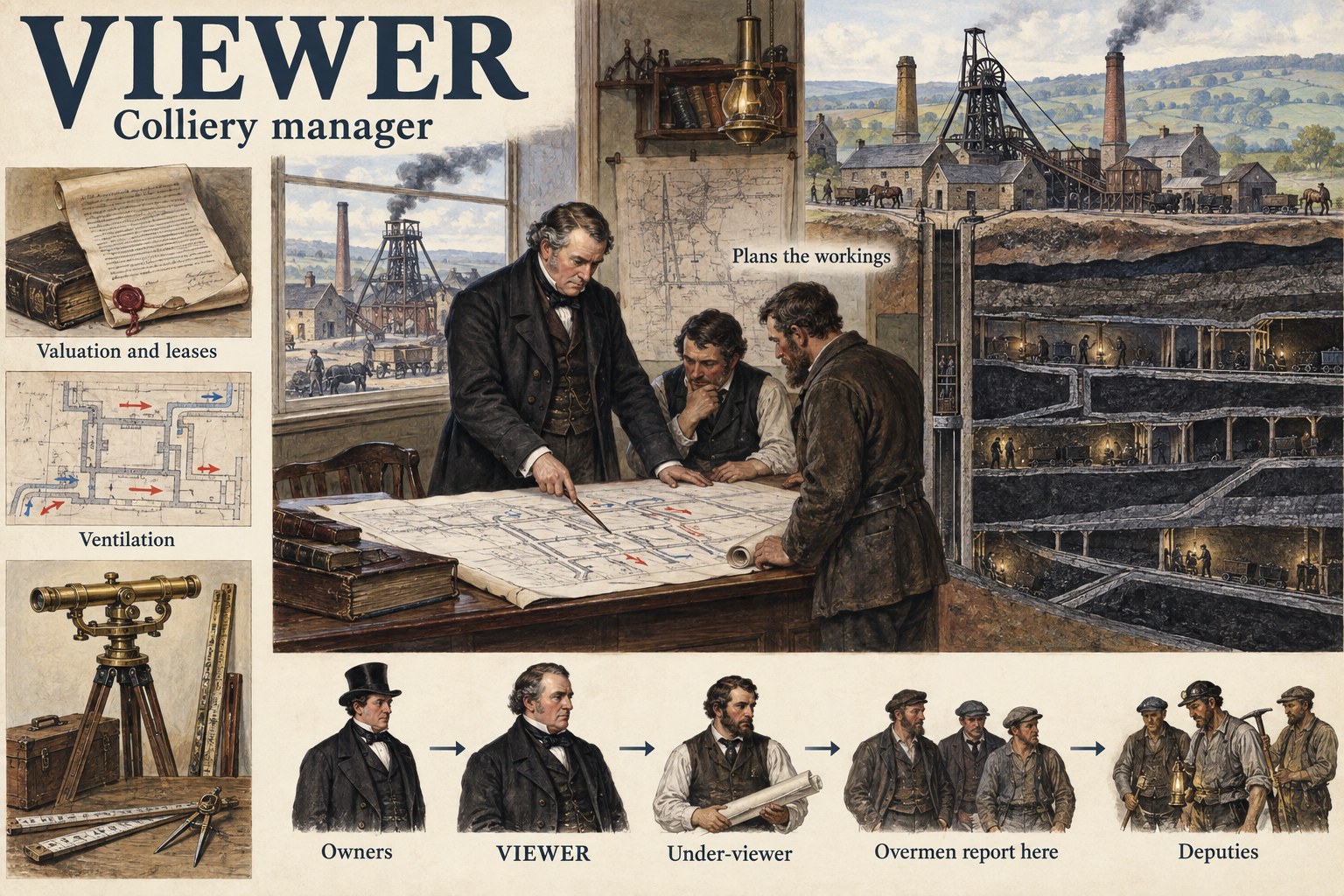
The manager of a colliery in the North East coalfield — the man who decided how the mine was to be worked and ventilated, and to whom the overmen answered. In the largest collieries he had an under-viewer beneath him.
Historical usage
The word belongs to Northumberland and Durham and to the period before "manager" became the statutory title. Greenwell’s glossary of the coal trade of the two counties gives two definitions a generation apart. In 1825 the viewer is "the person who gives directions as to the method of working and ventilating the mine. In large collieries he has a person under him called the Under-Viewer. From the viewers, overmen receive their instructions." By 1849 the definition has hardened into "The manager of a colliery; one who has the charge of all underground, and generally of all surface, arrangements." The role outlived the word: by the twentieth century glossaries describe viewer as "an early term for the general manager or mining engineer of one or more collieries", and it survives mostly in older records and in the names of the men who held it.
How it worked
A viewer was not tied to one pit. The best of them were consulting mining engineers who reported to a colliery’s owners on several collieries at once, laid out the workings, specified the ventilation, valued the coal and advised on leases. The under-viewer was "the responsible manager of a colliery in the absence of the viewer", and a check viewer was something else again — "a viewer employed by the lessor to see that the provisions of the lease are duly observed", watching the lessee on the landlord’s behalf.
Why it was used
The North East coalfield industrialised earlier and on a larger scale than anywhere else in Britain, and it produced a profession to match before the law required one. A viewer combined roles later split between colliery manager, mining engineer and consultant, and the great names of the trade were viewers: William Hedley, viewer at Wylam, built Puffing Billy and Wylam Dilly there.
Regional variation
Essentially a Northumberland and Durham word. It has no place in Barrowman’s glossary of Scotch mining terms, where the equivalent authority is simply the manager, with an oversman below him. Elsewhere in England the usual words were agent or manager.
Related terminology
Mines associated with this term
5 examples chosen from 21 linked records — the term page is not an index.
- Poynton Collieries — Cheshire (well documented example)
Named twice in this record, first in the history: “…and the Anson’s 72,140. That was close to the peak. The colliery viewer Greenwell was already warning in March 1892 that costs were rising…” - Sheriff Hill Colliery — Tyne and Wear (well documented example)
Named in this record’s history: “…1783. On 27 June 1815 an explosion killed eleven, including the viewer and his two brothers, and on 11 December that year a fire in the…” - Andrews House Colliery — County Durham (well documented example)
Named twice in this record, first in the history: “…to the Bob Gins House were still untouched, and the Grand Allies' viewers — Nicholas Walton, Amos Barnes and William Daglish — found the drift…” - Benwell Colliery — Tyne and Wear (well documented example)
Named in this record’s history: “…lead down the shaft. Witnesses from the colliery, among them its under-viewer, gave evidence to the Children's Employment Commission in 1841. W.…” - Bryn Hall Colliery — Greater Manchester (well documented example)
Named in this record’s history: “…William Crippin was then sinking new pits; Peter Higson junior was viewer and Frederick Crippin manager. In 1908 Bryn Hall had five shafts…”
Disasters associated with this term
5 examples chosen from 40 linked records, most direct relationship first.
- Beamish Colliery inundation, 1832 (contextual relationship)
Named twice in this record, first in the summary: “…rush of water at Beamish Colliery on 7 March 1832 drowned the viewer, William Millar, and Robert Moody; a third man escaped with…” - Bigge Pit explosion, 1841 (contextual relationship)
Named twice in this record, first in the narrative: “…the dead were the brothers Thomas and William Dodshon. The deputy viewer Thomas Campbell told the inquest the men had complained of cold that…” - Birley Vale Colliery Explosion, 1876 (contextual relationship)
Named 4 times in this record, first in the summary: “…had been using locked safety lamps until two days earlier, when the under-viewer reported the ventilation improved and the manager left the choice of…” - Black Vein Colliery haulage accident, 1866 (contextual relationship)
Named in this record’s investigation: “At the inquest the colliery viewer, George James, said he had given strict instructions against riding…” - Burdon Main Colliery explosion, 1835 (contextual relationship)
Named twice in this record, first in the narrative: “…grown men on good wages would not make better door-keepers. The viewer, George Johnson, answered that boys of eight to twelve were more…”
Sources
- (primary) Mining Occupations (from G. C. Greenwell, A Glossary of Terms Used in the Coal Trade of Northumberland and Durham, 1849/1888) — Durham Mining Museum
- (secondary) Glossary of mining terms (V) — North Staffordshire Miners’ Group, Apedale
Record created: 8 September 2026 · Last researched: 8 September 2026