 MineArchive
Putter
| Also known as | Hurrier (Yorkshire), Drawer (Lancashire), Waggoner (Lancashire), Foal (a young putter), Half-marrow (a putter's junior partner) |
|---|---|
| Dialect | North East England |
| Category | Labour & Roles |
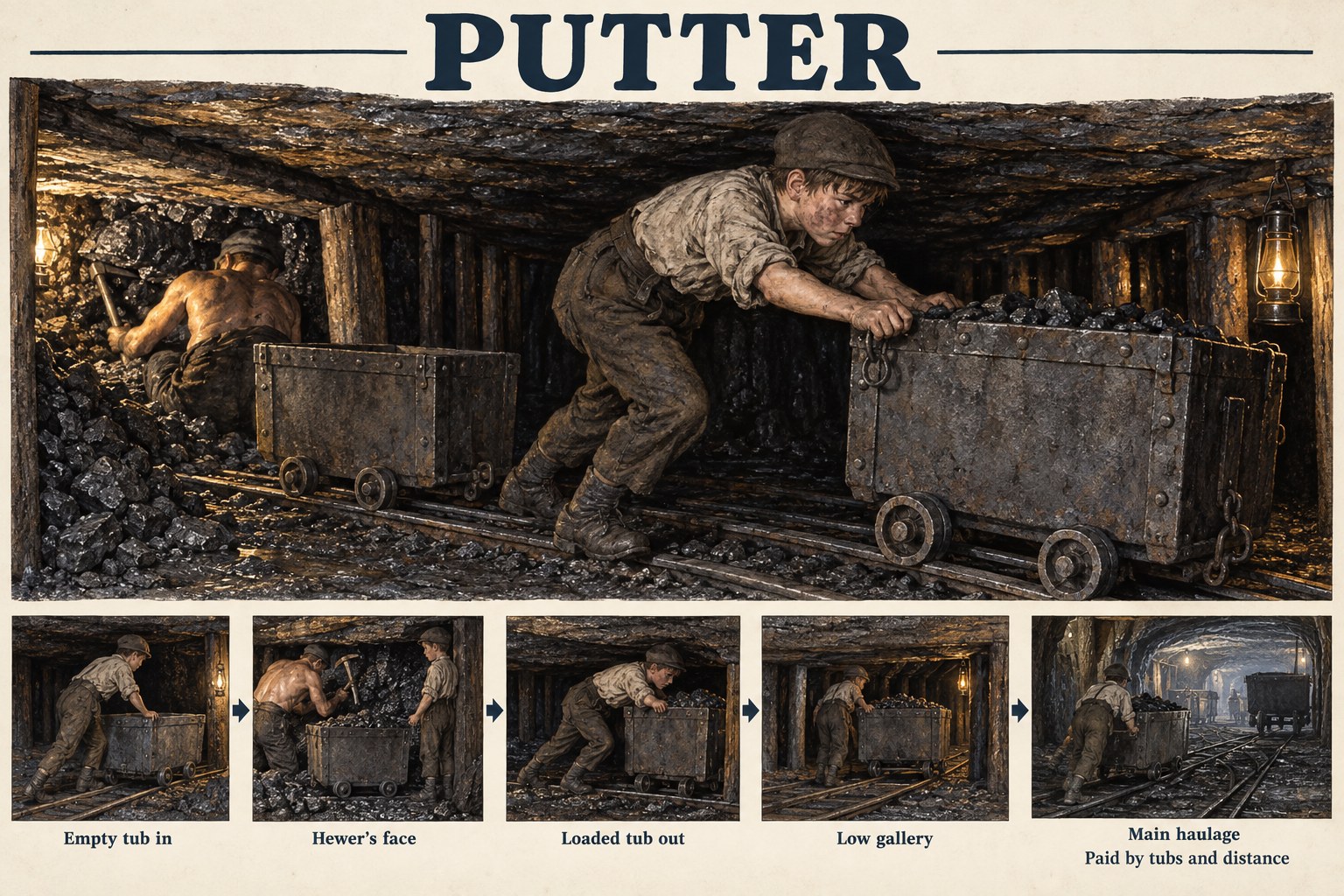
The worker — most often a boy or a youth — who moved the coal between the hewer at the face and the haulage road or shaft bottom, bringing empty tubs up and taking loaded ones away.
Historical usage
Putting was a rung on the pit's age ladder rather than a trade of its own. A boy went underground as a trapper, opening and shutting the ventilation doors for the tubs; moved on to driving ponies; then to putting, which was the hardest physical work in the pit; and only then, as a grown man, to hewing. One account of the north-east pits reckons a boy starting at ten would work eleven years from trapping to putting before he became a hewer. Putters worked singly or in pairs, and had their own junior grades — foals, meaning young putters, and half-marrows, a marrow being a mate or equal.
How it worked
The hewer's job stopped at the coal he had brought down; the putter's began there. He took the loaded tub from the face along the low, unimproved gallery — often too low to stand in — to the crane or the main haulage road, and brought an empty one back. Pay followed the work rather than the clock: putters were paid by the score plus distance, a score being the standard number of tubs a particular colliery reckoned on, generally between twenty and twenty-six, while trappers and drivers were paid by the day.
Why it was used
Because the coal had to leave the face as fast as the hewer could win it, and until mechanical haulage reached the face there was nothing to do it but muscle. Putting is also where the pit made its hewers: the work built the strength and the knowledge the face demanded, and a man who had not started young was thought never to make a collier.
Risks & limitations
The job put children and youths in the lowest and least supported parts of the mine, moving heavy tubs on rough roads in the dark, and it kept them there for years. When something went wrong in the haulage roads it was putters and drivers who were in them — at Seaham in 1880 twenty of the dead were putters or drivers, and two of the thirteen killed at Woodhorn in 1916 were putters.
Regional variation
Northumberland and Durham said putter; Yorkshire said hurrier; Lancashire said waggoner or drawer. The job was the same and the word was not, which is why a colliery record's vocabulary often places it as precisely as its geology does.
Related terminology
Coal, Deputy, Haulier, Hewer, Incline, Man-riding, Miners' Barracks, Overman, Trapper, Tub
Mines associated with this term
5 examples chosen from 44 linked records — the term page is not an index.
- Auchinreoch Colliery — East Dunbartonshire (well documented example)
Named twice in this record, first in the history: “…blades of a dross conveyor on 28 December 1905. Charles Wilson, a drawer of twenty-three, was run into by a runaway hutch in 1906 after…” - Avenue Colliery — Derbyshire (well documented example)
Named in this record’s history: “…the district's court reports in the ordinary way: in October 1890 a putter at the company's Avenue pit, William Woodhouse, was summoned at…” - Bedlington 'D' Colliery — Northumberland (well documented example)
Named in this record’s history: “…died in the Low Main seam in 1906 alone: Frank Joyce Straker, a pony putter of 19, and Robert Morris and Matthew Wilson, both hewers, each under…” - Booth Town Pit — West Yorkshire (well documented example)
Named in this record’s summary: “…through the evidence Patience Kershaw, a seventeen-year-old hurrier, gave there to the Children's Employment Commission on 15 May 1841.” - Brown Top Pit — West Yorkshire (well documented example)
Named in this record’s summary: “A Joseph Stocks shaft pit near Halifax, wound by a horse gin, whose hurriers Elizabeth Jackson and Selina Ambler gave evidence to the Children's…”
Disasters associated with this term
5 examples chosen from 58 linked records, most direct relationship first.
- Abram Colliery explosion, 1881 (contextual relationship)
Named in this record’s investigation: “…body was recognised by a widow who knew her husband's red flannel drawers and clogs. The main inquest opened before Coroner Baker on 24…” - Aspen Colliery inrush, 1909 (contextual relationship)
Named twice in this record, first in the summary: “…Belthorn End for hours; all struggled out except a thirteen-year-old drawer, who drowned.” - Auckland Park Colliery fall, 1906 (contextual relationship)
Named 3 times in this record, first in the summary: “On 2 August 1906 a hewer and a pony putter were killed by the same fall of stone in the Harvey Seam at Auckland…” - Bearpark Colliery fall of stone, 1902 (contextual relationship)
Named twice in this record, first in the summary: “On 20 June 1902 a chock drawer and a young timber leader were killed by a large fall of stone while…” - Bent Grange Colliery explosion, 1850 (contextual relationship)
Named in this record’s narrative: “…Among those killed were Bartholomew Bambling, a twelve-year-old drawer; the brothers Benjamin and Jonas Fox; Edmund Butterworth, who left a…”
Sources
- (secondary) A Glossary of Mining Terms — Coal Mining History Resource Centre
- (secondary) Glossary of coal mining terminology — Wikipedia
- (secondary) Glossary of mining terms (S) — North Staffordshire Miners Group
- (secondary) Working in the North East: pitmen and miners — William English
Record created: 25 August 2026 · Last researched: 25 August 2026