 MineArchive
Coal Cutter
| Category | Structures & Machinery |
|---|
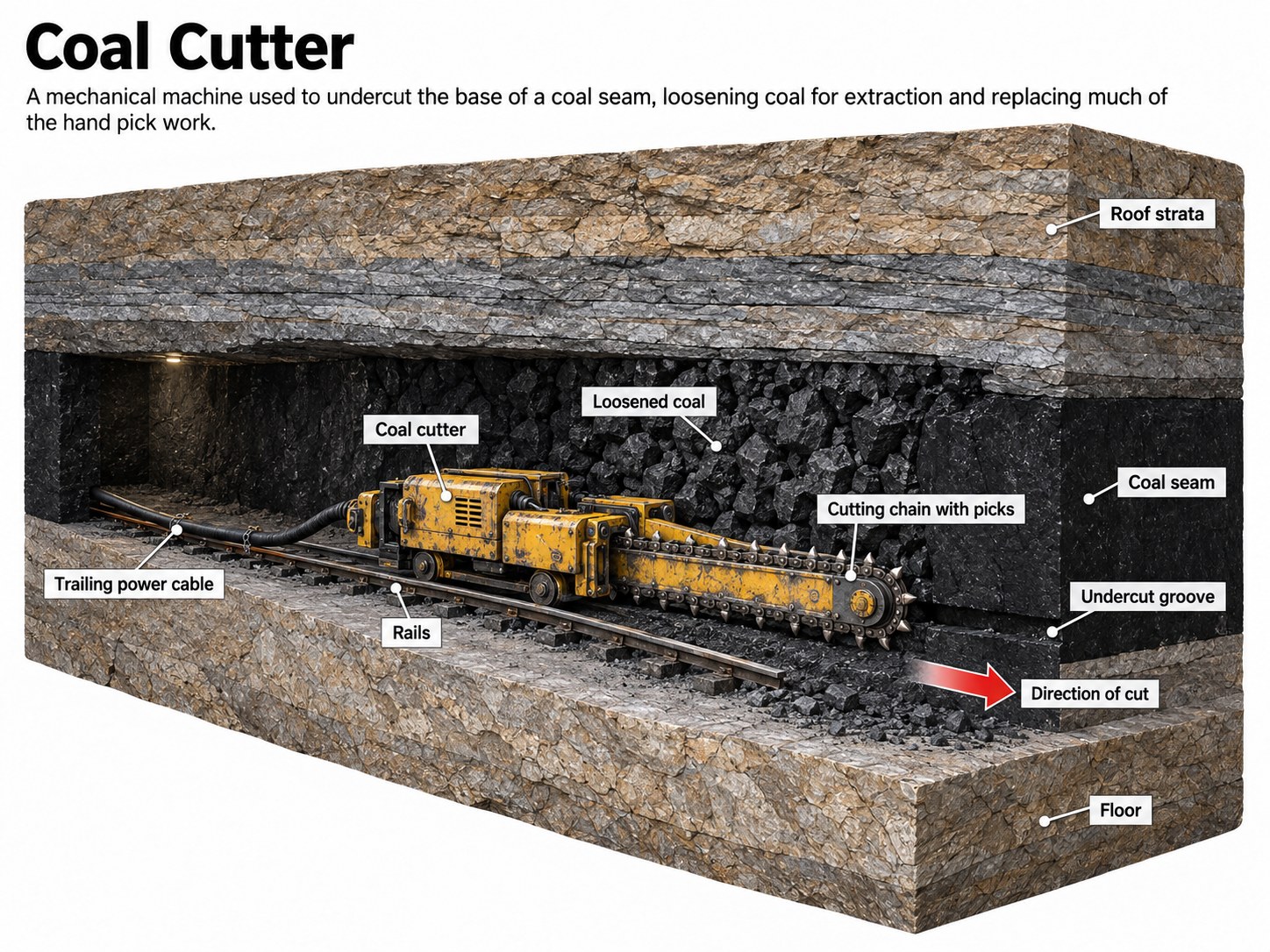
A mechanical machine used to undercut a coal seam ahead of extraction, replacing the hand pick as the standard way of loosening coal from the face.
Historical usage
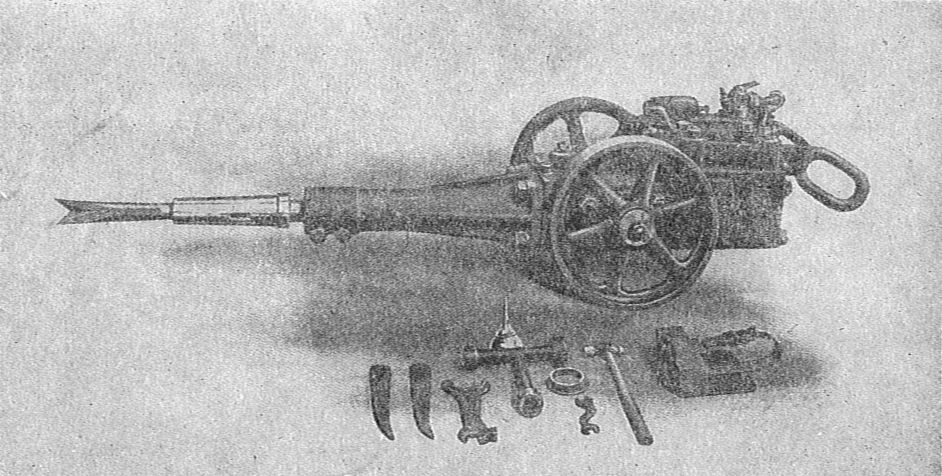
For most of the 19th century, coal was undercut and broken down entirely by hand, a hewer lying or kneeling in a seam sometimes barely a metre high to chip away at it with a short-handled pick. The earliest mechanical coal-cutters -- rail-mounted disc cutters built to the Gillott and Copley patent of 1868 -- were powered by compressed air piped from the surface, but lost effectiveness as workings extended further from the shaft and pressure dropped along the pipe run. Electric cutters followed from the 1880s-90s -- an early UK attempt in 1887, with T. B. A. Clarke's electrically driven conversion publicly demonstrated in 1894 -- using a rotating chain fitted with cutting picks, working on the same principle as a giant chainsaw, to cut a groove sometimes over a metre deep along the base of the seam. After nationalisation in 1947 the National Coal Board invested heavily in mechanised longwall faces, and the electric shearer -- a machine with rotating drums studded with hardened steel picks, travelling the length of the face -- eventually replaced the standalone coal cutter entirely.
How it worked
Early machines drove a chain or rotating disc, fitted with small cutting picks, into the base of the seam to cut a continuous groove; once undercut this way, the coal above could be brought down far more easily -- by wedges, explosive shot-firing, or simply its own weight -- than if it had to be broken out entirely by hand.
Why it was used
Mechanical cutting let a single machine do the work that would otherwise occupy several hewers, and turned coal-getting into a task that could keep pace with the growing capacity of steam and, later, electric winding and haulage -- production that nineteenth-century hand methods, producing a few tonnes a shift, could never have matched.
Risks & limitations
Coal-cutting machinery introduced hazards distinct from hand working -- most notably the trailing power cables that fed compressed-air and, later, electric machines, which could be damaged by falling material or the cutter's own movement and, if re-energised while damaged, ignite gas that had accumulated nearby.
Related terminology
Mines associated with this term
5 examples chosen from 37 linked records — the term page is not an index.
- Moorgreen Colliery — Nottinghamshire (well documented example)
Named in this record’s workings: “…roadways in the 1890s, electric power from 1907, electrically driven coal-cutters on 550-volt three-phase supply by 1913, rope-hauled man-riding…” - Poynton Collieries — Cheshire (well documented example)
Named in this record’s workings: “…experience, one imagines, for the men riding in them. Compressed-air coal cutters were introduced at the Anson in 1922 but electricity never reached…” - Abercwmboi Colliery — Rhondda Cynon Taf (well documented example)
Coal cutters were introduced in 1906, ahead of the pit's revival to 470 men by 1910. - Altofts Colliery — West Yorkshire (well documented example)
Named in this record’s summary: “…village of Silkstone Buildings and of William Garforth's pioneering coal-cutters and rescue work after the 1886 explosion, and worked until 1966.” - Bent Colliery — South Lanarkshire (well documented example)
An electrically driven coal cutter was in use by 1914, when a machineman was killed pulling one into position.
Disasters associated with this term
5 examples chosen from 13 linked records, most direct relationship first.
- Milfraen Colliery explosion, 1929 (direct cause)
A defective coal cutter sparked. - Moorgreen Colliery Electrocution, 1913 (direct cause)
The men were electrocuted by the frame of an electrically driven coal-cutter made live by two simultaneous defects. - Digby Colliery Explosion, 1928 (relevant method/equipment)
The explosion happened at an electrically driven coal-cutting machine minutes after it was switched on; the electricians found no evidence of sparking. - Rosehall Colliery explosion, 1934 (relevant method/equipment)
The machine tapped through into old workings, releasing the gas. - Adelaide Colliery roof fall, 1904 (contextual relationship)
Named twice in this record, first in the cause: “…stone from a slip in the roof, which displaced the timber after the coal cutter had passed.”
Sources
- (primary) An advertisement for Gillott and Copley Patent Rotary Coal-Cutting Machine — Historic England
- (primary) From Picks to Shearers: The Evolution of Coal Cutting in British Mines — National Coal Mining Museum for England
Record created: 31 August 2026 · Last researched: 31 August 2026