 MineArchive
Power Loading
| Also known as | Power-loaded face, Cutter loader, Mechanised loading, Meco-Moore, Huwood power loader |
|---|---|
| Category | Mine Workings & Access |
Getting coal off the face by machine rather than by men shovelling it onto the conveyor. The National Coal Board used the proportion of output that was power-loaded as its measure of how modern a pit was, and the phrase runs through colliery records of the 1950s and 1960s.
Historical usage
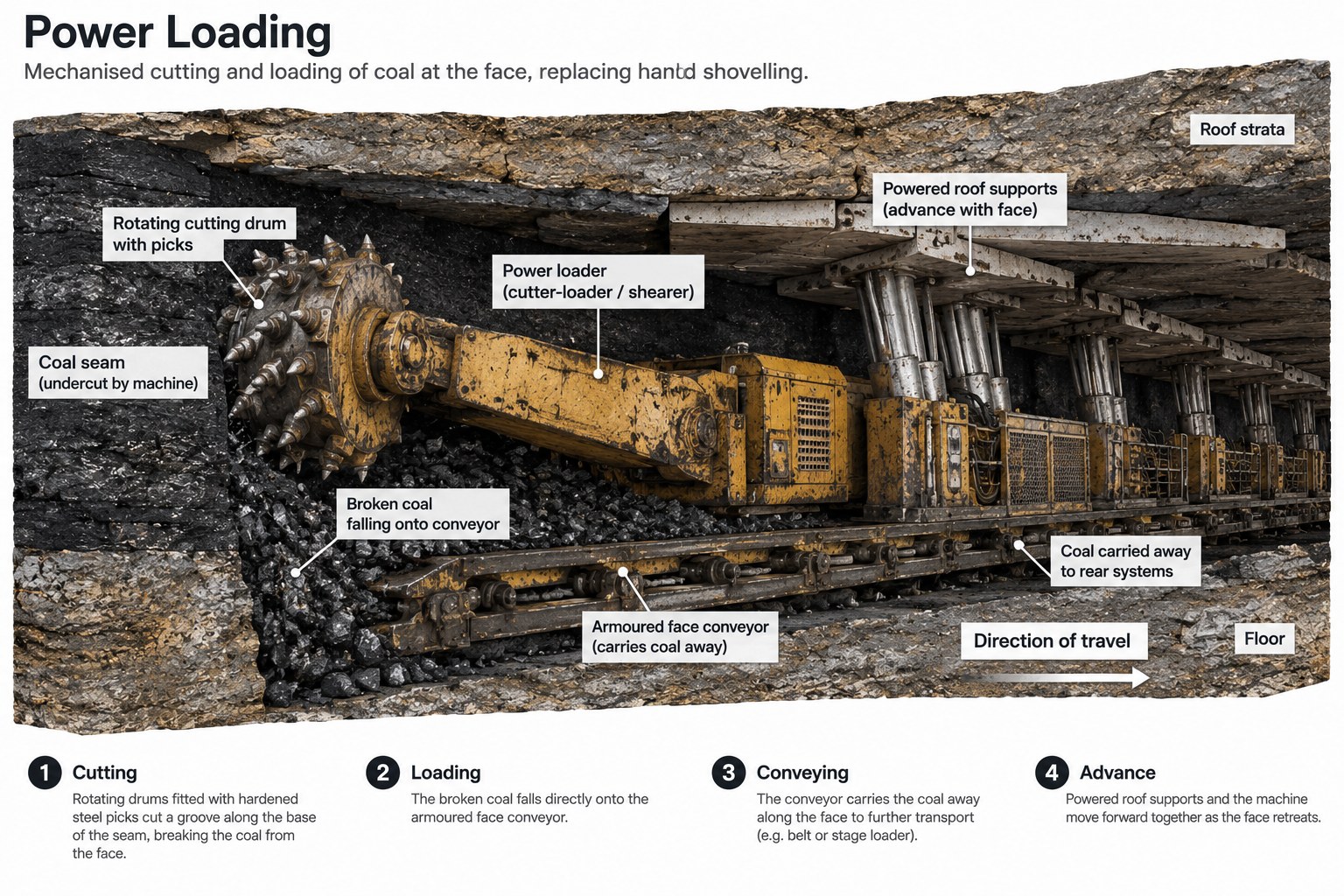
Mechanised cutting came long before mechanised loading: a coal cutter undercut the seam from the 1890s, but the coal still had to be filled by hand. The Meco-Moore cutter loader, invented by M. Moore and developed by the Mining Engineering Company of Worcester, was first used in a Lancashire pit in 1934 and was among the first machines to cut and load at once. The Huwood power loader, a small winch-hauled machine of about six feet by two, worked by a ten horsepower engine, came in around 1950 and shifted cut coal onto the conveyor with horizontal and rotary motions; Pleasley Colliery in Derbyshire had one of the first in 1950. The Anderton shearer loader of 1953 settled the question, and by 1977 it alone produced eighty per cent of British coal. In the first half of 1964, the Minister of Power told the Commons, more than 70 per cent of the Board's deep-mined output came from power loaders, against 37½ per cent in 1960.
How it worked
A power-loaded face is a face where the same machine that breaks the coal also throws it onto a conveyor running the length of the face, which carries it into the gate road and onto the belts out of the pit. What the machine is varies by decade: a jibbed cutter loader, a winch-hauled loader working behind a cutter, or a shearer with rotating drums. What matters for the term is that no man handles the coal between the seam and the conveyor.
Why it was used
Hand filling set the pace of the whole face and cost more men than any other job on it. Machine loading raised output per manshift sharply, and it is the single measure against which the Board judged its collieries through the 1950s and 1960s: a pit power-loading three quarters of its coal was a pit with a future, and a pit still filling by hand was on a list.
Risks & limitations
The machines were expensive and the ground had to suit them, so power loading arrived unevenly. The measure itself became a political instrument: a percentage that could justify investment could equally justify closure, and the run of collieries in this archive that record their power-loading figure in one decade and their closure in the next is not a coincidence. Machine loading also multiplied the airborne dust at the face.
Related terminology
Coal Cutter, Filler, Longwall, National Coal Board, National Union of Mineworkers, Shearer
Mines associated with this term
5 examples chosen from 12 linked records — the term page is not an index.
- Penallta Colliery — Caerphilly (well documented example)
Named twice in this record, first in the history: “…to invest in new technology, installing one of Britain's first Meco-Moore power loaders in the late 1940s and working the Lower Nine Feet and…” - Williamthorpe Colliery — Derbyshire (well documented example)
Named in this record’s history: “…in 1954, a Gloster getter in 1955, pithead baths in 1958, a Huwood power loader and a new Sirocco fan late on. A brickworks on the site was at one…” - Alfreton Colliery — Derbyshire (well documented example)
Named in this record’s summary: “…which pioneered the conveyor-mounted double-ended trepanner and was power-loading three quarters of its output by the 1960s. Its reserves were nearly…” - Brackley Colliery — Greater Manchester (well documented example)
Named twice in this record, first in the history: “…32.4 hundredweight against 19 in 1934. After nationalisation a Meco-Moore cutter loader was put into the Plodder; where the machine proved…” - Deep Duffryn Colliery — Rhondda Cynon Taf (well documented example)
Named twice in this record, first in the history: “…the advice of its own executives. An investment of 250,000 pounds in power loading in 1968 raised output per manshift to 47.6 hundredweight, and…”
Sources
- (primary) Coal Production (Automation) (Hansard, 16 July 1964) — Hansard, House of Commons
- (secondary) Anderton Shearer Loader — Wikipedia
- (secondary) Huwood power loader — Wikipedia
- (secondary) Meco-Moore Cutter Loader — Wikipedia
Record created: 11 September 2026 · Last researched: 11 September 2026