 MineArchive
Penallta Colliery
| Location | Hengoed, Rhymney Valley, Caerphilly — 51.6544, -3.2447 (exact) |
|---|---|
| Commodity | Coal |
| Type | Coal |
| Worked | From 1905 (sinking)–1 November 1991 |
| Maximum depth | No.1 shaft (downcast) 783 yards; No.2 shaft (upcast) 750 yards — the deepest in South Wales when sunk |
| Operators | Powell Duffryn (1905–1947), National Coal Board (1947–1991) |
Overview
A Powell Duffryn 'superpit' near Hengoed whose deep shafts once held the European record for coal wound in a day, closed as the last deep mine in the Rhymney Valley in 1991 with its final shift led out by a brass band, and now a country park watched over by a 656-foot earth sculpture of a pit pony.
History
Powell Duffryn began sinking Penallta Colliery near Hengoed in 1905, employing 291 men by 1908; sinking encountered serious flooding, with one water feeder above the Brithdir seam alone exceeding 24,000 gallons an hour. First coal was raised in 1909, and the colliery's twin shafts — No.1 downcast at 783 yards and No.2 upcast at 750 yards — were the deepest in the South Wales Coalfield at the time. Employment grew steadily, reaching 2,395 by 1923 working the Six Feet seam, and peaking at over 3,200 during the 1930s; in 1935 Penallta held the European record for the most coal wound to the surface in a 24-hour period.
The colliery passed to the National Coal Board on the 1947 nationalisation of the coal industry, by then employing 1,920 men, and continued to invest in new technology, installing one of Britain's first Meco-Moore power loaders in the late 1940s and working the Lower Nine Feet and Seven Feet seams in its later decades. Penallta survived the 1984-85 miners' strike and went on to make strong production gains afterward, though by the 1970s its workforce had fallen to around 700, producing some 210,000 tons a year. It finally closed on 1 November 1991, its last shift led out of the pit by a brass band, as the last working deep mine in the Rhymney Valley.
Geology
Penallta worked the Six Feet seam through the 1920s and 1930s, and later the Lower Nine Feet and Seven Feet seams; sinking the original shafts had to overcome serious water ingress, with a single feeder above the Brithdir seam alone exceeding 24,000 gallons an hour.
Workings
Twin shafts — No.1 (downcast, 783 yards) and No.2 (upcast, 750 yards) — were the deepest in the South Wales Coalfield when sunk, and in 1935 the colliery set a European record for coal wound to the surface in a single 24-hour period. Penallta continued to modernise under National Coal Board ownership, installing one of Britain's first Meco-Moore power loaders in the late 1940s.
Closure
British Coal closed Penallta on 1 November 1991, its final shift led out of the colliery by a brass band, marking the end of deep coal mining in the Rhymney Valley.
What remains
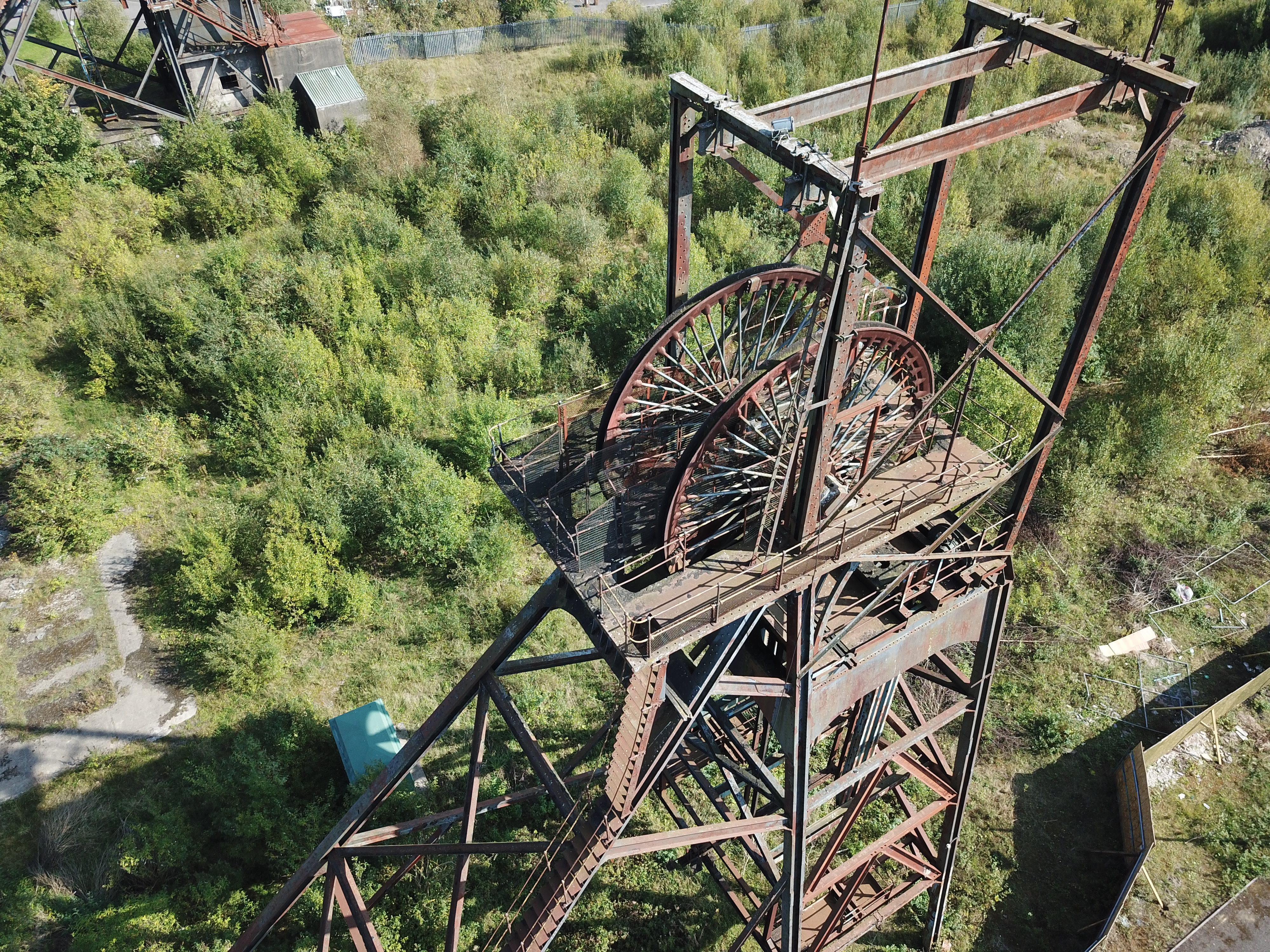
From 1996, Caerphilly County Borough Council, Groundwork Wales and local partners transformed the site into Parc Penallta, converting 180 hectares of derelict colliery land into a country park in its first phase; the headgears of both original shafts still stand over the site, and several colliery buildings are Grade II* listed. In 1999 the artist Mick Petts completed Sultan, a 656-foot-long, 15-metre-high earth sculpture of a pit pony built from 60,000 tons of colliery shale, dirt and stone, named locally after a well-known Penallta show pony; it doubles as a windbreak for the park's events area, with a path along its spine and a seating area in its nostril.
The headgears of both original shafts survive above the former colliery site, along with several Grade II* listed colliery buildings, some since converted for housing.
Related mines
- Britannia Colliery, Pengam — Powell Duffryn Rhymney Valley pits; Penallta's exhaust-steam plant supplied Britannia's electricity.
- Ogilvie Colliery — Both were Powell Duffryn collieries of the Rhymney valley sunk in the company's twentieth-century expansion, and worked through the same company structure to nationalisation.
Nearby mines
- Glanddu Colliery — 0.8 miles (1.2 km) NE
- Gelligaer Colliery — 1.0 miles (1.7 km) W
- Buttery Hatch Colliery — 1.1 miles (1.8 km) E
- Britannia Colliery, Pengam — 1.7 miles (2.7 km) NE
- Llancaiach Colliery — 1.7 miles (2.7 km) W
Straight-line distance, within 9 miles (15 km). Show on the map.
Disasters & major incidents
-
Penallta Colliery crane accident, 1908
7 January 1908 · Machinery · 2 fatalities
Two young fitters fell about fifty feet to their deaths in the Penallta engine house on 7 January 1908 when the plank they sat on, working on the overhead crane, broke in the middle. -
Penallta Colliery sinking accident, 1909
11 February 1909 · Winding / Shaft Accident · 2 fatalities
Two sinkers died at the bottom of Penallta's No. 2 shaft, then 460 yards deep, on 11 February 1909 when the winder lowered an empty bowk onto the sixteen men working there instead of stopping it above them. -
Penallta Colliery runaway drams, 1913
25 February 1913 · Haulage / Transport · 2 fatalities
Three drams of rubbish ran away down an incline at Penallta Colliery on 25 February 1913, killing a mason contractor and his labourer and injuring two more men.
Culture
- Sultan the Pit Pony (Art)
The sculpture stands on the colliery's spoil tip, is built from sixty thousand tons of the colliery's own shale, and is named by local people after a pony that worked at the pit.
Recorded claims
Individual factual claims, each attached to the source(s) that support it below. Where sources disagree, both are kept.
- Powell Duffryn began sinking Penallta in 1905, encountering serious flooding including one water feeder above the Brithdir seam exceeding 24,000 gallons an hour; first coal was raised in 1909 from twin shafts, 783 and 750 yards deep, the deepest in the South Wales Coalfield at the time. 1,2
- Employment peaked at over 3,200 during the 1930s, working the Six Feet seam; in 1935 Penallta held the European record for the most coal wound to the surface in 24 hours. 1
- The colliery passed to the National Coal Board in 1947, by then employing 1,920 men, and installed one of Britain's first Meco-Moore power loaders in the late 1940s. 2
- Penallta closed on 1 November 1991, its last shift led out by a brass band, the last deep mine working in the Rhymney Valley. 1
- From 1996 the site was redeveloped as Parc Penallta, converting 180 hectares of derelict land into a country park; in 1999 artist Mick Petts completed Sultan, a 656-foot, 15-metre-high earth sculpture of a pit pony built from 60,000 tons of colliery shale, dirt and stone, named after a well-known Penallta show pony. 1,3
- Located at about 51.654 N, 3.245 W. 1
Sources
- (secondary) Penallta Colliery — Wikipedia
- (secondary) Penallta Colliery — welshcoalmines.co.uk
- (observational) Sultan the Pit Pony in Caerphilly — Atlas Obscura
Record created: 27 August 2026 · Last researched: 27 August 2026