 MineArchive
Britannia Colliery, Pengam
| Location | Pengam, Rhymney Valley, Caerphilly — 51.6735, -3.2205 (approximate) |
|---|---|
| Commodity | Coal |
| Type | Coal |
| Worked | Sunk 1910-1914–8 December 1983 (pumping until 1989) |
| Maximum depth | About 730 yards: 2,181 ft and 2,202 ft to the Lower Nine-Feet seam (NMRS); Welsh Coal Mines gives 615 and 714 yards. |
| Operators | Powell Duffryn Steam Coal Company (1910–1947), National Coal Board (1947–1989) |
Overview
Britannia Colliery at Pengam in the Rhymney Valley was sunk by the Powell Duffryn Steam Coal Co. between 1910 and 1914 and was hailed as the first all-electric colliery, with no steam boilers or smoke stack. At its height in the 1920s it employed well over 1,500 men; under the National Coal Board it pioneered plough mining in South Wales, stopped producing coal in December 1983, and pumped water to protect Oakdale Colliery until 1989.
History
Preparations for a new Powell Duffryn pit about a mile below Bargoed, between the Gilfach and Pengam pits, began in June 1910. The Northern Mine Research Society dates the shaft sinking from February 1911 to September 1913, to 730 yards, with the pit bottoms and first coalfaces finished by August 1914; Welsh Coal Mines gives the start of sinking as 1910 and first coal as 1912, while the Colliery Guardian reported in February 1915 that coal raising had just begun with about 200 men. Because the site was cramped, the whole colliery was run on electricity fed over Powell Duffryn's own lines from the gas engines at Bargoed and the exhaust-steam plant at Penallta, and later from Middle Duffryn power station. Its Ilgner winding sets came from Siemens, whose German engineers were still installing the third when war broke out in 1914; they were interned and English Electric finished the job. The war also left the pit without horses, so all haulage was by conveyor and haulage engine from the start. Early years were eventful: a timberman, Patrick Whitty, was killed in August 1914; in July 1915 two trams fell back down a shaft and the men underground had to walk 2.5 miles to the Bargoed shafts; and by 1918 1,520 men were employed. In April 1920 all 2,000 men and officials struck together after a mechanic was dismissed for joining the officials' union. On 1 July 1924 a collier, John Sherway, collected his lamp and vanished, and was never found despite searches of the old and current workings. In 1930 an 18-year-old timberman's helper, Sidney Wallace, was killed pushing his father out of the path of a runaway dram. A School of Mines opened in 1930, pithead baths followed in 1933, and in 1934 the pit employed 1,290 and raised 400,000 tons. In April 1938 two men were killed when a compressed-air main burst beside the colliery (see Disasters, below). Nationalised in 1947, Britannia became a training centre for new recruits, and in 1952 the first 'rapid plough' in the South Wales coalfield was installed in its Seven-Feet seam. In 1954 a Jamaican miner there was refused a transfer to Denaby Main in Yorkshire, the Coal Board saying that the men there would not accept 'coloured or foreign nationals'. By the late 1960s the pit was losing money; after Lord Robens visited in March 1969 a new face was opened and it was soon top of the Rhymney Area's productivity list. In the mid-1970s £950,000 was spent linking the North and South pit workings across the Britannia Overthrust. The lodge accepted a manpower slimdown in November 1980, but with too few men to run two faces, the remaining reserves were allocated to Celynen North and the colliery closed as a production unit on 8 December 1983. Its shafts stayed in use pumping up to nine million gallons of water a day to protect Oakdale Colliery, where 60 men worked through the 1984-85 strike, with union approval, building an underground dam, until Oakdale itself closed in 1989.
Geology
The taking covered about 4.5 square miles, bounded by Oakdale Navigation Colliery to the east and the Pengam fault to the west, and was split between the North and South pits by the 250-foot Britannia Overthrust. The first steam coal, the Two-Feet-Nine or Elled, was reached in September 1913 and the Red Vein, 48 to 54 inches thick, developed from January 1914; the Red Vein, Big Vein and Rhas Las were worked in 1923, the Seven-Feet and Upper Four-Feet in 1947, the Seven-Feet and Lower Four-Feet in the 1970s, and the Five-Feet/Gellideg in 1980. Drivages proved the Rhas Las and Red Vein unworkable by 1980. Sinking met water at up to 100,000 gallons an hour.
Geological setting: Sedimentary Beds and Seams (well documented example)
Workings
Two 21-foot shafts, the South (No. 1) the downcast with rail guides and the North (No. 2) the upcast with rope guides, both with double-deck carriages. The electric winders, designed to wind six tons a minute from conical drums of 14 to 22 feet, were driven through Ilgner motor-generator sets with flywheels of 32 to 33 tons; the pit bottoms were lined with 22-foot concrete arches. Haulage underground was by conveyors and haulage engines, never horses. Later developments included a rapid plough and armoured face conveyor (1952), an 800-metre roadway and 915-metre drift linking the two pits (mid-1970s), and ranging-drum shearers on the faces by 1980.
Closure
Coal production ended on 8 December 1983 after a 1980 slimdown left too few men to work two faces and the remaining reserves were given to Celynen North. The shafts were kept as a pumping station for Oakdale Colliery until Oakdale closed in 1989, which is the closure date Coflein gives.
What remains
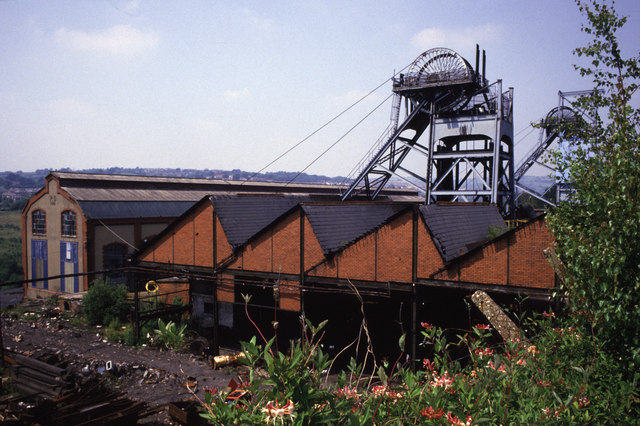
The sources disagree. Coflein, citing the Royal Commission's 2009 survey of Welsh collieries, says the headframes and major surface buildings remain intact; the photographer of a 1987 Geograph view, captioning it later, calls the colliery 'now long gone'. No recent report of the site has been found.
Uncertain: the headframes and main surface buildings were standing in 1987 and are recorded as intact by Coflein, but other sources describe the site as gone.
Related mines
- Bargoed Colliery — Connected underground: in 1915 men walked out through the Bargoed shafts; Bargoed's gas engines powered Britannia.
- Oakdale Colliery — Britannia's shafts were kept pumping water to protect Oakdale's workings until Oakdale closed in 1989.
- Penallta Colliery — Powell Duffryn Rhymney Valley pits; Penallta's exhaust-steam plant supplied Britannia's electricity.
Nearby mines
- Bargoed Colliery — 2.2 km N
- Darran Colliery — 2.5 km NW
- Llanbradach Colliery — 2.9 km S
- Oakdale Colliery — 2.9 km E
- Penallta Colliery — 3.6 km SW
Straight-line distance, within 15 km. Show on the map.
Disasters & major incidents
-
Britannia Colliery compressed-air main explosion, 1938
10 April 1938 · Machinery · 2 fatalities
On 10 April 1938 the main compressed-air pipe supplying Powell Duffryn's Rhymney Valley collieries burst while three men were repairing a joint beside Britannia Colliery, Pengam. The foreman boilermaker John Hammersley and the welder Roland Bond were killed outright and the fitter Frank Jones was seriously injured.
Recorded claims
Individual factual claims, each attached to the source(s) that support it below. Where sources disagree, both are kept.
- Britannia was the first colliery sunk and worked entirely by electricity, with no steam boilers. 1,2,3
- The shafts were sunk from February 1911 to September 1913, and coal raising began early in 1915. (disputed) 1
- Sinking began in 1910 and the first coal was produced in 1912. (disputed) 2
- The North Pit was sunk to 2,181 ft 3 in and No. 2 Pit to 2,202 ft, to the Lower Nine-Feet seam. (disputed) 1
- Shaft No. 1 (downcast) was 615 yards and No. 2 (upcast) 714 yards deep. (disputed) 2
- Each winder had two 2,000 hp motors, either able to run it alone. (disputed) 1
- Each winder had two 1,600 hp DC motors, 3,200 hp in all, fed by Ilgner sets. (disputed) 2
- Siemens' German engineers were interned in 1914 before finishing the third Ilgner set, which English Electric completed. 2
- Haulage was by conveyor and engine from the start because horses were unavailable during the First World War. 1,3
- In April 1920 all 2,000 men and officials struck after a mechanic was dismissed for joining the officials' union. 1
- John Sherway collected his lamp on 1 July 1924 and disappeared, and was never found. 1
- Sidney Wallace, 18, was killed by a runaway dram after pushing his father out of its way. 4
- The first rapid plough in the South Wales coalfield was installed at Britannia in 1952. 1
- The colliery closed as a production unit on 8 December 1983. (disputed) 1,2
- Coflein gives 1989 as the colliery's closure, the year its pumping for Oakdale ended. (disputed) 1,3
- Coflein records the headframes and major surface buildings as remaining intact. (disputed) 3
- A 1987 photograph's caption describes the colliery as 'now long gone'. (disputed) 5
Photographs & further reading
Short history with the Siemens and English Electric winding plant, shaft depths and manpower.
View sourceDetailed year-by-year history from sinking to closure, with manpower and output statistics.
View sourceRoyal Commission site record with aerial photographs.
View sourceSources
- (secondary) Britannia Colliery — Northern Mine Research Society (information supplied by Ray Lawrence)
- (secondary) Britannia Colliery, Pengam — Welsh Coal Mines
- (primary) Britannia Colliery, Pengam (NPRN 33549) — Coflein, Royal Commission on the Ancient and Historical Monuments of Wales
- (secondary) Welsh mining fatalities, 1930 — Welsh Coal Mines
- (observational) Britannia Colliery, Pengam (Geograph 754964, Chris Allen, 1987) — Geograph Britain and Ireland
Record created: 13 September 2026 · Last researched: 13 September 2026