 MineArchive
Timberman
| Also known as | Timber Boss (20th-century usage for a supervising timberman), Cogman (regional term for a timberman specialising in setting timber cogs/chocks) |
|---|---|
| Category | Labour & Roles |
The tradesman responsible for setting and maintaining pit props, roof supports, ladderways and other timber structures underground.
Historical usage
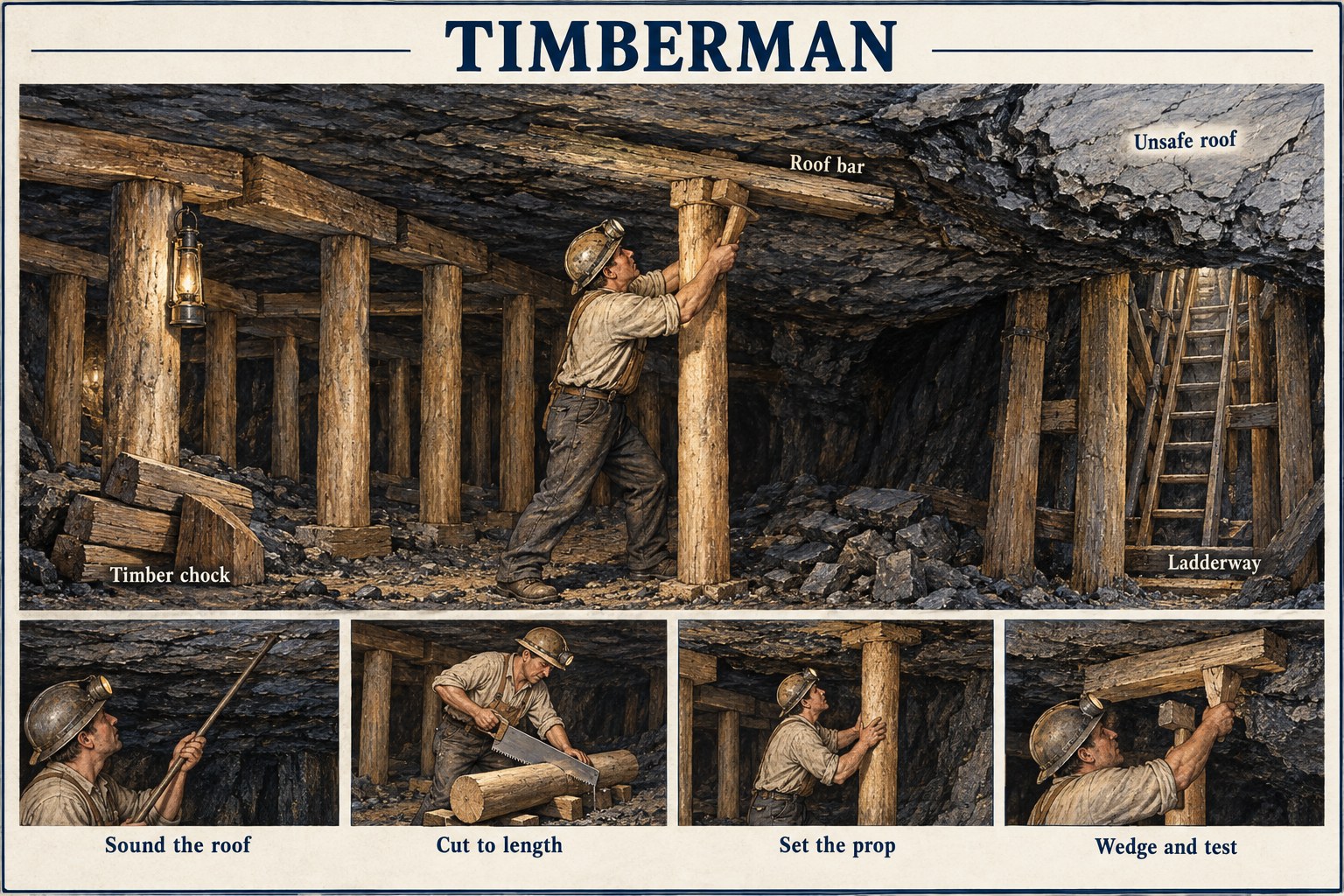
A timberman was called for wherever a working place needed support the existing structure didn't provide: when a deputy or fireman found bad roof conditions -- traditionally checked by 'sounding' it with a stick -- timbermen were sent in to set more props before work could resume. British coalfield practice split the trade into several named specialisms rather than one universal title: a cogman cut and built timber 'cogs' or chocks to support the roof, a chock drawer (or prop drawer, timber drawer) had the more dangerous job of withdrawing timber once the coal face had advanced past it and it was no longer needed, and a cog cutter sawed and shaped the timber itself to size. 'Timberman' served as the general term covering this whole family of trades, and in larger 20th-century collieries a head timberman or timber boss supervised the gang.
Why it was used
Roof and side support was the single most important safety measure underground, and setting it correctly demanded real skill: too little support risked a fall, too much wasted timber and restricted working space, and a badly-set prop could give way exactly when it was needed most.
Risks & limitations
The work was itself dangerous by nature -- setting a prop meant working directly under ground that had already been identified as unsafe, and drawing timber once a face had advanced meant deliberately removing support from ground that could fall at any moment.
Related terminology
Mines associated with this term
Included only where MineArchive's own research gives a reasonable evidential basis — not every mine where this might plausibly apply.
- Britannia Colliery, Pengam — Caerphilly (well documented example)
Named twice in this record, first in the history: “…and haulage engine from the start. Early years were eventful: a timberman, Patrick Whitty, was killed in August 1914; in July 1915 two trams…”
Disasters associated with this term
5 examples chosen from 8 linked records, most direct relationship first.
- Abercwmboi Colliery Explosion, 1870 (contextual relationship)
Named in this record’s narrative: “…night turn. About twelve o'clock the overman James Davies asked the timberman Thomas Thomas to come to the south side, having found gas in the…” - Cwmbran Colliery roof fall, 1893 (contextual relationship)
Named twice in this record, first in the summary: “A timberman and a fourteen-year-old boy retimbering a road at Cwmbran Colliery…” - Gelli Colliery roof fall, 1895 (contextual relationship)
Named in this record’s narrative: “…a roadway at Gelli Colliery when the roof came in on them. The timberman William Davies, 26 or 27, his assistant William Steger, 39, and Rees…” - Great Western Colliery roof fall, 1907 (contextual relationship)
Named twice in this record, first in the summary: “A timberman and his assistant were buried by a fall of roof in the Nine Feet…” - Markham Colliery roof fall, 1920 (contextual relationship)
Named in this record’s narrative: “In May 1920 the timberman Charles Barker, 48, and his assistant Francis, 36, were timbering up…”
Sources
- (secondary) 047 — Other Workers Below Ground — Dictionary of Old Occupational Terms (DOOT)
- (secondary) Spraggers and Sunshine Lamps — IUP Libraries Coal Mining History Archives
Record created: 29 August 2026 · Last researched: 30 August 2026